


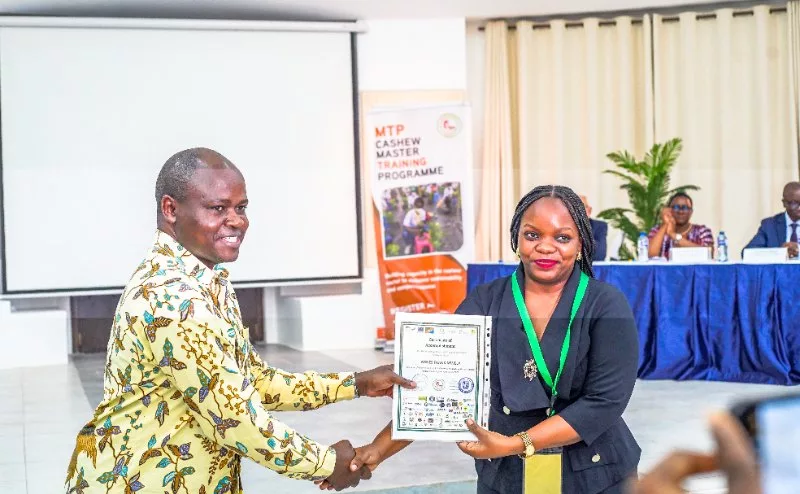
At least 81 key actors from 11 cashew-growing countries have completed intensive training aimed at transforming the sector through increased production, value addition and better market access.
The week-long training in Mombasa was organised by the African Cashew Alliance.
It sought to create a new generation of experts who will spearhead efforts to restore cashew production, strengthen processing industries and improve incomes for millions of smallholder farmers across the continent.
Participants from Burundi, Cameroon, Ghana, Kenya, Mozambique, Nigeria, Rwanda, Sierra Leone, South Sudan, Tanzania and Uganda were equipped with practical skills covering the entire cashew value chain.
This ranges from modern farming techniques and post-harvest handling to processing, value addition, quality assurance, leadership and marketing.
The programme forms part of a broader continental strategy to shift Africa from exporting raw cashew nuts to producing higher-value products, creating jobs, increasing foreign exchange earnings and driving rural industrialisation.
The Mombasa session marked the second phase of the 21st Master Training Programme for Cashew Value Chain Promotion in Africa, following an initial training held in Mtwara, Tanzania, in June.
Speaking during the graduation, Agriculture and Food Authority director general Calistus Kundu said the newly acquired knowledge should be cascaded to farmers, processors, extension officers and investors to accelerate the revival of the sector.
“The knowledge acquired should not end here. We have a responsibility to transfer these skills to farmers, processors, extension officers, investors and other value chain actors,” he said.
“By applying what you have learned, we can increase productivity, improve quality, promote value addition and ultimately raise farmers’ incomes.”
He noted that Kenya has enormous potential to reclaim its position as a leading cashew producer, recalling that the crop was once popularly known as “white gold” because of the wealth it generated for coastal communities.
Kundu said coordinated efforts between government, county administrations, the private sector, research institutions and development partners would help rebuild a vibrant cashew industry capable of creating employment, improving food security and stimulating economic growth.
The training was jointly organised by the ACA in partnership with the Market-Oriented Value Chains for Jobs and Growth in the Ecowas Region and the East African Community Secretariat, with support from the European Union and the Organisation of African, Caribbean and Pacific States.
ACA managing director Ernest Mintah said the Master Training Programme, launched in 2013, has continued to build a pool of highly skilled professionals to drive sustainable growth across Africa’s cashew value chain.
He noted that the programme continues to expand across the continent and that, following last year’s successful East African edition, which produced 54 certified cashew experts, this year’s programme further strengthens the region’s technical capacity.
“We are building professionals who will transform the cashew industry in their respective countries,” Mintah said.
“Strong local expertise is critical in making Africa more competitive in global cashew markets.”
EAC Secretariat principal economist for investment Charles Omusana said the programme was not only producing technical experts but also leaders capable of transforming the industry.
He said EAC partner states have prioritised cashew among the region’s strategic value chains because of its enormous potential to generate foreign exchange, improve household incomes, create employment and stimulate rural industrialisation.
“One thing we are looking at is strengthening regional value chains, increasing intra-EAC trade and earning more foreign exchange,” Omusana said.
He challenged African countries to move beyond exporting raw cashew nuts and instead invest in processing industries that produce high-value products for regional and international markets, saying value addition remains the surest way of ensuring farmers and national economies earn more from the crop.
Lydiah Mwenga, deputy director of industries at the Ministry of Trade, said Kenya remains committed to revitalising the cashew industry through the Bottom-Up Economic Transformation Agenda, Vision 2030 and other industrialisation policies.
Participant Pauline Mutuyimana said the programme gave trainees a complete understanding of the cashew value chain, beginning with production in Tanzania and ending with processing and marketing in Kenya.
“The biggest lesson is that quality starts on the farm, but greater profits come through processing, value addition and accessing better markets,” she said.