


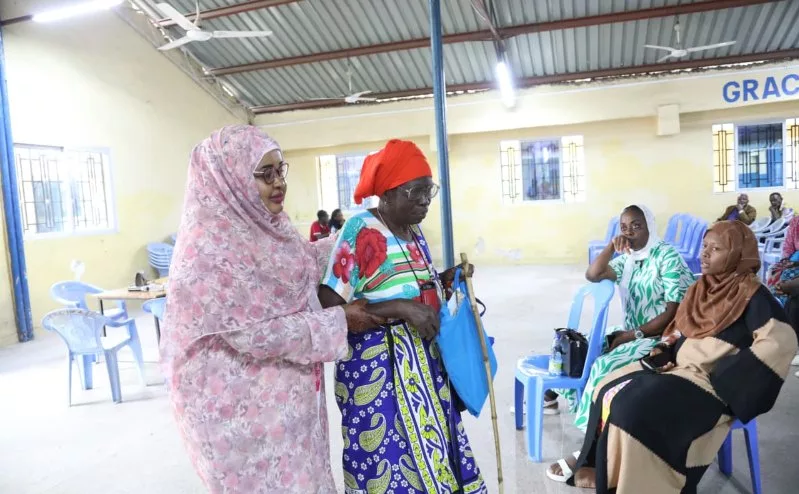
Years of unresolved land disputes, workplace injuries, botched compensation claims, inheritance battles and alleged legal injustices drove dozens of desperate residents to a free legal aid clinic in Jomvu subcounty.
The legal aid clinic, organised by advocate Fatma Barayan in partnership with fellow lawyer Lawrence Obonyo, attracted residents from Jomvu, Miritini, Mikindani and surrounding areas, many of whom said they had exhausted every avenue in pursuit of justice.
For several hours, lawyers listened to personal accounts, examined documents and advised residents on possible legal remedies, offering free legal services to people who would otherwise struggle to afford representation.
Many of the cases revolved around land ownership disputes, compulsory land acquisition compensation, inheritance conflicts, labour-related injuries and delayed court processes.
Harun Masolo from Majengo Mapya narrated a workplace accident that changed his life and left him fighting for justice for years.
Masolo said he was working as a casual labourer loading containers when tragedy struck.
According to his account, while reading a container’s serial number, the truck driver allegedly moved the vehicle, causing him to suffer severe injuries after he became trapped beneath the trailer.
He was admitted to Coast General Teaching and Referral Hospital for nearly a month before seeking legal representation to pursue compensation.
However, Masolo claimed his legal troubles only worsened.
He alleged that after entrusting his case to an advocate, he later discovered that court proceedings had been concluded without his knowledge.
When he visited the court registry to follow up on the matter, officials allegedly informed him they could not trace his case file.
He said repeated efforts to obtain copies of court documents proved futile until he allegedly paid someone to help him secure a copy of the judgement.
Even then, Masolo claimed he was unable to recover the compensation he believed he deserved.
“My children still need food, school fees and medical care. All I want is justice and my rights back,” he said.
Several residents also raised concerns over compensation linked to government infrastructure projects, claiming they had either received inadequate payments or had never been compensated despite losing homes, businesses and property.
One resident narrated how her family’s house was demolished years ago during a road project but said compensation remained unresolved despite mediation efforts.
Others claimed they had received compensation for structures but not for businesses that were also affected by compulsory acquisition.
The residents alleged that confusion over awards issued through the National Land Commission and subsequent changes in records had left many families stranded.
Lawyer Barayan said the clinic revealed recurring legal challenges affecting low-income residents, particularly land disputes and compensation claims.
“We have seen many conflicts involving compulsory land acquisition, labour matters and unresolved compensation cases,” she said.
Barayan noted that a significant number of residents from Miritini, Mikindani and Jomvu were still pursuing compensation linked to past government development projects.
She said several residents complained about discrepancies in compensation awards, with some alleging that the awards they initially received differed from later records.
“We have collected information from all the affected residents. Some matters are already before court, while others require fresh legal action. We shall review each file and determine the best legal path for every client,” she said.
She added that lawyers would continue investigating the complaints before offering further legal representation where necessary.
Her colleague, Lawrence Obonyo, said many vulnerable Kenyans fail to pursue justice simply because legal services remain beyond their financial reach.
He noted that free legal aid clinics bridge that gap by providing professional legal advice to people who might otherwise abandon legitimate claims.
“Many people think visiting a lawyer is only for those who have money,” Obonyo said.
“We want the public to understand that lawyers also have a duty to serve society. Through legal aid, we can empower vulnerable people to understand their rights and pursue justice.”
He encouraged members of the legal fraternity to dedicate part of their professional practice to community service, saying access to justice should not depend on one’s financial status.
By the close of the clinic, the legal team had handled more than 30 cases, each representing years of unresolved grievances that residents hope will finally receive attention.