


In recent months, Mombasa has experienced unusually high temperatures, leaving residents struggling with heat both indoors and outdoors.
Even with the onset of rains in recent days, the sweltering conditions have persisted, underscoring a growing urban heat crisis that is increasingly difficult to ignore.
In response, the Mombasa County Government, in partnership with environmental groups, youth organisations and community stakeholders, has launched an ambitious greening initiative aimed at cooling the city sustainably.
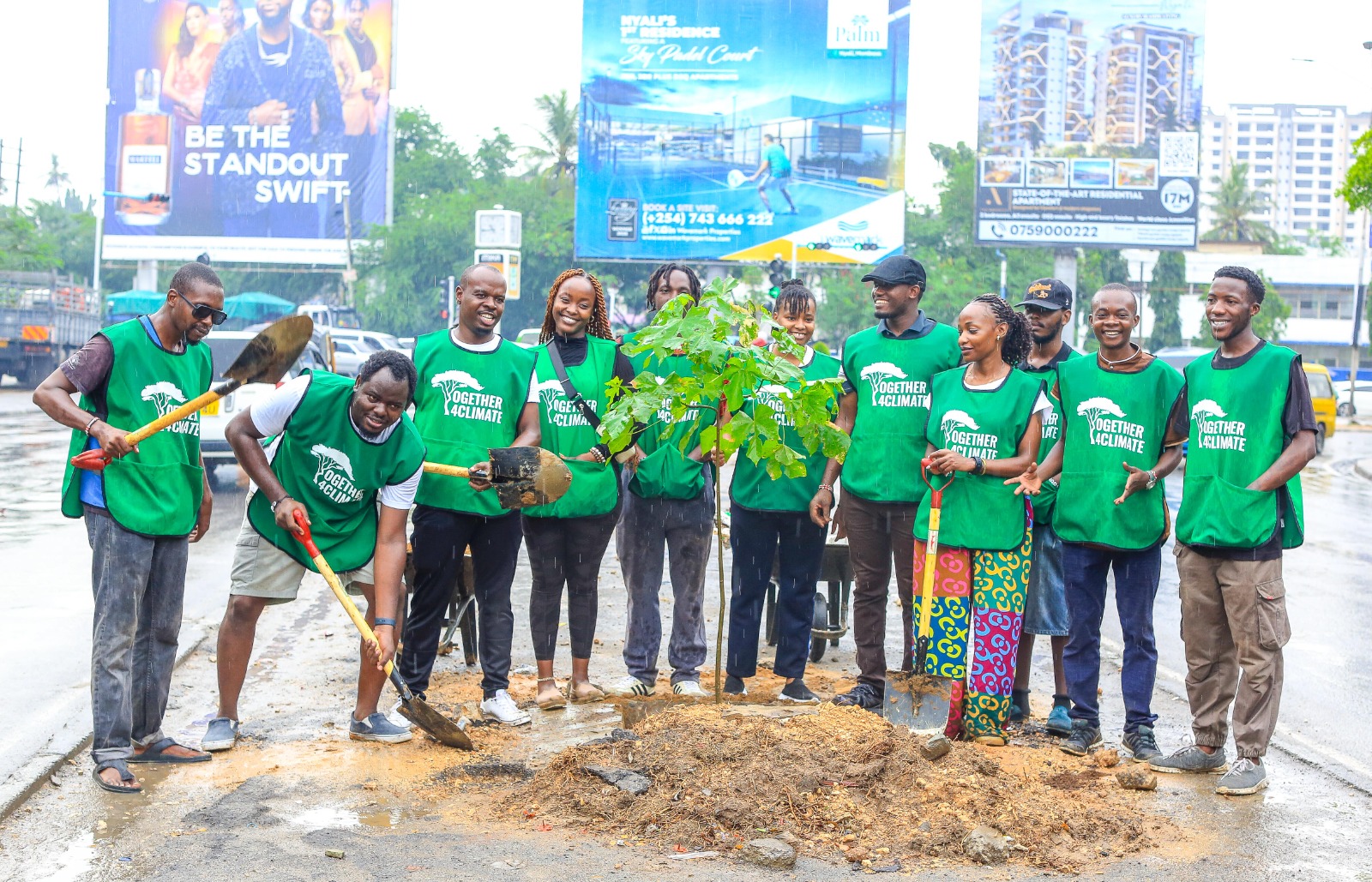
The programme involves planting indigenous trees across the central business district. The effort is designed not only to reduce temperatures but also to restore ecological balance and improve urban liveability.
Basil Angaga, Head of Sustainability in the county’s environment department and founder of Together 4 Climate, described the initiative as the culmination of months of planning, dialogue and collaboration.
“We brought together young people on board to tackle the issues facing our city and ensure a better climate, not only for us but for future generations,” he said.
The exercise, conducted under the People for Urban Resilience Project, saw the planting of 40 indigenous trees comprising 11 different species.
Carefully selected for their resilience and ecological benefits, the trees are expected to provide much-needed shade, lower surface and air temperatures and support biodiversity in the city.
“This may look like a young tree right now, but that is how progress works. What we are doing here is about long-term impact,” he said.
Unlike past greening efforts that largely focused on ornamental and exotic species such as palm trees, this initiative marks a shift towards science-driven urban forestry.
Experts from the Kenya Forest Service and independent botanists were involved in identifying suitable indigenous species capable of thriving in Mombasa’s coastal climate.
“For a long time, greening in our city focused on aesthetics rather than function. But palms, while beautiful, do not provide shade or cooling. Indigenous trees, on the other hand, offer real ecosystem services,” Angaga said.
The trees planted were nurtured for over a year at an indigenous nursery in Kilifi before being transplanted to Mombasa.
The planting process followed strict scientific standards, with one-metre cube holes prepared to ensure optimal root development and survival.
Beyond planting, the initiative places strong emphasis on maintenance and community ownership.
The county government has committed to regular watering, while local communities and partners will monitor the trees’ growth and health.
“This is not a one-day event. We will be back every two weeks to check on the trees, fix any issues and ensure a high survival rate,” he said.
The project also seeks to address urban heat through policy and planning reforms.
Advocates are pushing for updated building codes that integrate green spaces and climate-sensitive designs.
There are also plans to introduce landscaping ordinances requiring developers to incorporate greenery into their projects.
“We want buildings in this city to reflect the realities of our climate. People should live in spaces that are not only functional but also comfortable and connected to nature,” Angaga said.
The broader goal is to transform Mombasa into a city where outdoor life is once again possible. With extreme heat discouraging physical activity, experts warn of rising health risks linked to sedentary lifestyles.
The initiative is already expanding to other parts of the city, including Park Square and Jomo Kenyatta Road, where a mix of trees and shrubs will be introduced depending on infrastructure constraints such as power lines.
Plans are also underway to remove sections of concrete and artificial turf to restore soil and improve water absorption, helping to mitigate flash floods.
Lillian Wambua of Nia Ventures said the exercise represents a shift from discussion to action.
“It is time to move the climate conversation from boardrooms to communities. Simple acts like planting trees can have a powerful impact when we act collectively,” she said.
Young people have been particularly instrumental in driving the initiative.
Timothy Osala, a third-year counselling psychology student at the Technical University of Mombasa, highlighted the urgency of climate action.
“The heat in Mombasa is intense. You feel it everywhere. This project is about making our city habitable again. One tree may seem small, but it makes a difference,” he said.
Felix Mariera, a transport engineer with the county government, explained that tree-lined roads can improve road safety.
“Studies in transport psychology show that tree-lined corridors create a visual enclosure effect that encourages drivers to reduce speed. So, this is not just about beautification; it is a multifunctional infrastructure intervention,” he said.