


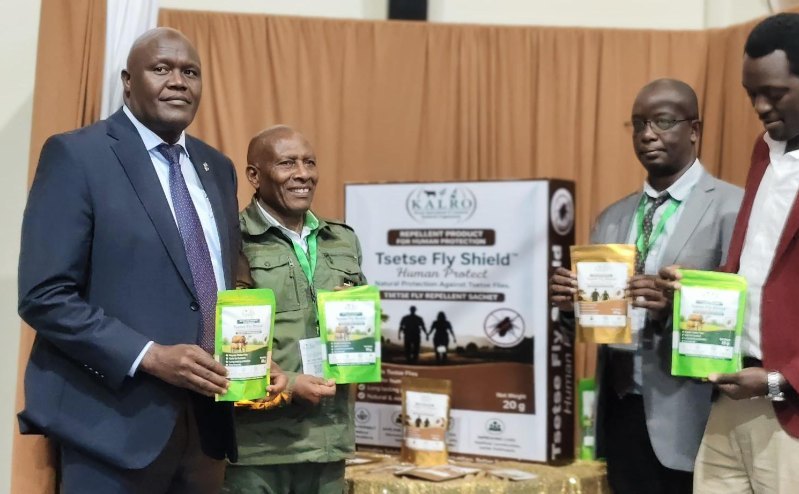
Scientists at the Kenya Agricultural and Livestock Research Organisation (Kalro) have developed an eco-friendly, natural tsetse fly repellent that protects livestock and people from tsetse fly bites.
The innovation offers a promising new tool in the fight against sleeping sickness and nagana.
The Kenyan Directorate of Veterinary Services (DVS) describes trypanosomiasis, commonly known as nagana or Animal African Trypanosomiasis in livestock, as a severe vector-borne parasitic disease that causes major losses in livestock productivity and affects human health.
Kalro deputy director general in charge of Livestock Research Dr Evans Ilatsia said scientists developed the Tsetse Fly Shield after studying wild animals that naturally resist tsetse fly attacks, particularly the waterbuck.
“The waterbuck naturally repels the tsetse fly,” he said.
After years of research, scientists identified the chemical compounds produced by the animal that repel the insect.
“We successfully identified the compounds, patented the innovation and are now exploring possibilities for mass production of the tsetse fly repellent,” Ilatsia said.
Field trials showed the product was highly effective in repelling tsetse flies from livestock herds in infested areas and from humans.
The research was conducted in partnership with the Kenya Wildlife Service, whose expertise in wildlife behaviour helped scientists understand the interaction between the waterbuck and the tsetse fly.
Ilatsia said the product is ready for commercialisation, with Kalro seeking regulatory approvals and licences to market it across East Africa, where trypanosomiasis remains widespread.
The organisation is also seeking investors and commercial partners to support mass production.
He added the repellent could be adapted for tourists visiting wildlife parks and game reserves by modifying the scent to make it more suitable for human use.
Kalro research scientist Dr Paul Mireji said tsetse flies transmit sleeping sickness to humans and nagana to livestock across sub-Saharan Africa, making the diseases among the region’s most neglected tropical illnesses.
He said nagana alone kills about three million cattle annually and causes agricultural Gross Domestic Product losses estimated at Sh613 billion (US$4.75 billion) each year.
“With no effective vaccines and limited chemotherapeutic and chemoprophylactic management options against sleeping sickness and nagana, control of tsetse flies constitutes a cornerstone in the campaign to suppress and eliminate these diseases,” Mireji said.
He explained that Tsetse Fly Shield is derived from natural odours that tsetse flies instinctively avoid.
It creates a protective barrier that reduces contact between the insects, livestock and humans, thereby lowering the risk of disease transmission.
The repellent is particularly effective against savannah tsetse fly species found in Eastern and Southern Africa.
It is intended for livestock farmers, pastoralists, veterinary personnel, wildlife rangers, researchers, outdoor workers and communities living in tsetse-infested areas.
The product comes in a sachet placed inside an animal’s neck collar or harness, where it provides protection for up to 30 days before replacement.
For people, the sachet can be worn as a bracelet or hung inside a vehicle while travelling through tsetse-infested areas.