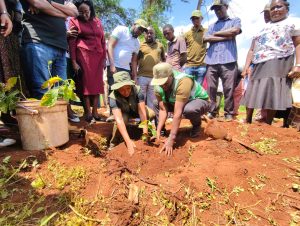




Concerned by the catastrophic rate at which pollinators are declining, the Kenya Forest Service has announced a new partnership with the National Bee Institute to train its officers in beekeeping and management.
KFS Chief Conservator of Forests Alex Lemarkoko said there is a need to reverse the rate at which pollinators are declining.
He spoke during the commemoration of this year’s World Bee Day on Wednesday.
“In recognition of the importance of bees both as pollinators and the role they play in improving community livelihoods as one of the major income-generating activities for Community Forest Associations (CFAs), the service is partnering with the National Bee Institute, which it hosts at Ngong Road Forest, to train KFS officers in beekeeping and management,” Lemarkoko said.
He said the officers will play a critical role in promoting beekeeping among CFAs and ensuring forests remain safe habitats for bees and other pollinators.
Observed each year, the day helps raise awareness of the essential role bees and other pollinators play in keeping people and the planet healthy, and of the many challenges they face today.
The day was marked under the theme ‘Protecting Bees for Biodiversity, Food Security, and Sustainable Forest Ecosystems’.
Bees are vital to the health and productivity of ecosystems.
Through pollination, they support the regeneration of forests, agricultural production, biodiversity conservation and the survival of many indigenous plant species.
Healthy pollinator populations contribute directly to food security, climate resilience, water catchment protection and sustainable livelihoods for millions of people.
Lemarkoko said forests and pollinators in Kenya share a critical ecological relationship.
“The conservation of forest ecosystems provides safe habitats and forage for bees, while bees enhance natural regeneration and ecosystem productivity,” he said.
Despite their immense contribution, bees and other pollinators continue to face serious threats arising from deforestation, forest degradation, climate change, habitat destruction, environmental pollution, wildfires and the indiscriminate use of harmful pesticides and chemicals.
Lemarkoko said the decline in pollinator populations poses a significant risk not only to biodiversity and ecosystem stability, but also to national food systems and rural livelihoods.
“This calls for urgent and collective action from governments, communities, institutions and individuals.”
KFS protects 6.4 million acres of gazetted forests and another 420 million acres under counties.
Lemarkoko said the partnership marks a significant milestone in advancing bee conservation, apiculture development, environmental awareness and community empowerment.
“It also demonstrates the importance of collaborative approaches in addressing environmental challenges while improving livelihoods and building resilient ecosystems.”
The International Union for Conservation of Nature (IUCN) states that around 75 per cent of the world’s leading food crops depend at least partly on pollinators, including coffee, almonds, apples and tomatoes.
The IUCN says there are more than 21,000 known bee species globally, but bees are only part of the story.
Butterflies, moths, beetles, hoverflies, birds and even bats also play essential pollination roles.
The IUCN says nearly 100 additional wild bee species in Europe are now classified as threatened in the latest IUCN Red List assessments.
Across the IUCN Species Survival Commission (SSC), several specialist groups are dedicated to pollinators, including the IUCN SSC groups on bumblebees, wild bees, butterflies and moths, which help drive research, assessments and conservation action worldwide.
The Food and Agriculture Organization (FAO) is currently consulting governments, researchers and stakeholders on the development of a Global Pollinator Platform aimed at improving global cooperation, knowledge-sharing and policy support for pollinator conservation.
The initiative builds on the Convention on Biological Diversity’s International Pollinators Initiative, which marks its 25th anniversary this year.
Lemarkoko said through the collaboration, the two institutions are working together to promote sustainable beekeeping and apiculture-based livelihoods and enhance the conservation of bee habitats within forest ecosystems.
He said the two institutions will also help support research, training and knowledge exchange on pollinator conservation, and empower forest-adjacent communities through income-generating activities linked to beekeeping.
Lemarkoko said the move will also encourage the restoration of degraded landscapes using bee-friendly and indigenous tree species, and strengthen climate change mitigation and biodiversity conservation initiatives.
He said KFS remains committed to restoring degraded forest landscapes and water towers, conserving biodiversity and indigenous tree species, and promoting sustainable forest management practices.
Lemarkoko said the service is also committed to supporting community participation in forest conservation, enhancing environmental education and awareness, and encouraging tree-planting initiatives that support pollinator habitats and ecosystem health.
“The service will continue working closely with partners, local communities, researchers and other stakeholders to promote healthy ecosystems that sustain both people and nature.”
Lemarkoko urged Kenyans to take deliberate steps towards protecting pollinators and conserving the environment.
“Let us plant more indigenous and flowering trees, reduce environmental pollution, embrace sustainable land-use practices, and protect natural habitats that support bees and other pollinators. As we mark this year’s World Bee Day, let us renew our collective responsibility to safeguard our forests, ecosystems and pollinators for present and future generations.”
He said protecting bees is protecting biodiversity, and protecting biodiversity is securing the future.