


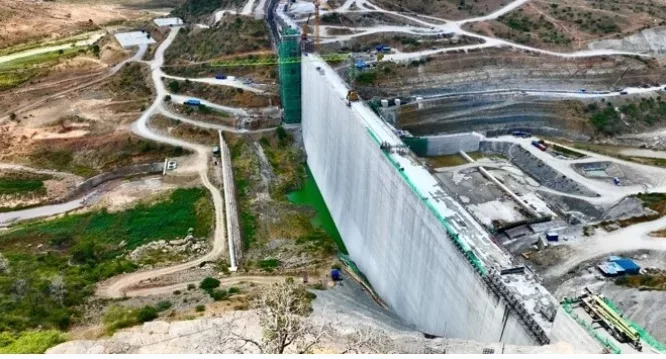
The Sh45 billion project at Fulugani has now crossed the 90 per cent completion mark, according to the Ministry of Water, Sanitation and Irrigation, with the government targeting completion and reservoir impoundment in the final stages of construction.
The scale of the water challenge explains why the dam has become one of the Coast’s most important infrastructure projects.
Water Cabinet Secretary Eric Mugaa recently put the region’s daily demand at about 512,000 cubic metres against available supply of only 185,000 cubic metres, leaving a deficit of approximately 327,000 cubic metres every day.
Mwache is designed to provide about 186,000 cubic metres of treated water daily for domestic and industrial consumption in Mombasa and Kwale.
Its reservoir is expected to hold about 136 million cubic metres of water, allowing the Coast to store water during periods of heavy rainfall and draw on it when supplies from existing sources decline.
The World Bank has described the project as a flagship investment intended to address chronic water shortages, particularly in Mombasa, where existing production has historically met only a fraction of demand.
The global lender says the initiative is part of a broader Coastal Region Bulk Water Programme designed to improve water security and climate resilience.
For Mombasa, the stakes are particularly high.
The city is both a major population centre and the country’s principal port, meaning unreliable water supplies have consequences beyond households.
Hotels, hospitals, manufacturers, schools, restaurants and other businesses depend on predictable water supplies to operate.
The shortage also pushes households towards alternative sources whose quality can vary.
Data from the 2022 Kenya Demographic and Health Survey put access to at least basic drinking-water services at about 47 per cent in Mombasa and 52 per cent in Kwale, below the national level of 68 per cent.
Kwale’s own health data underlines the public-health dimension.
The county government lists diarrhoea among its five leading causes of morbidity, with a reported prevalence of 4.6 per cent.
A 2022 Ministry of Health SMART survey also recorded watery diarrhoea among children surveyed in Kwale.
The risks become more acute during floods, droughts and disruptions to sanitation systems.
The Ministry of Health warns that contaminated water and damaged sanitation infrastructure can fuel cholera, diarrhoea, dysentery, typhoid and other waterborne infections.
Kwale experienced this vulnerability starkly in 2025 when a cholera outbreak claimed three lives and recorded 48 suspected cases, according to the county health department.
Mwache’s social economic significance goes beyond drinking water.
The project incorporates irrigation infrastructure intended to support about 2,000 hectares of farmland.
This could help shift parts of Kwale agriculture away from dependence on increasingly unpredictable rainfall, creating opportunities for more reliable production, higher farm incomes and agro-processing.
The World Bank has similarly framed the dam as a climate-resilience investment, noting that climate change is already creating uncertainty around water availability and increasing the importance of resilient water systems.
The stored water will be treated, transmitted, distributed and ultimately reach consumers through functioning networks. The initiative includes treatment and transmission infrastructure alongside the dam.
The project has also carried substantial social costs.
Land acquisition, compensation and relocation of affected communities have contributed to delays, prompting livelihood-restoration programmes and the construction of replacement schools.
President William Ruto’s recent inspection, including commissioning the new Fulugani Comprehensive School and livelihood-support equipment.
This highlights another dimension of the project: ensuring communities that surrendered land are able to share in its benefits.
If completed and connected to an efficient distribution system, Mwache could supply more than half of the Coast’s current 327,000-cubic-metre daily water deficit.