

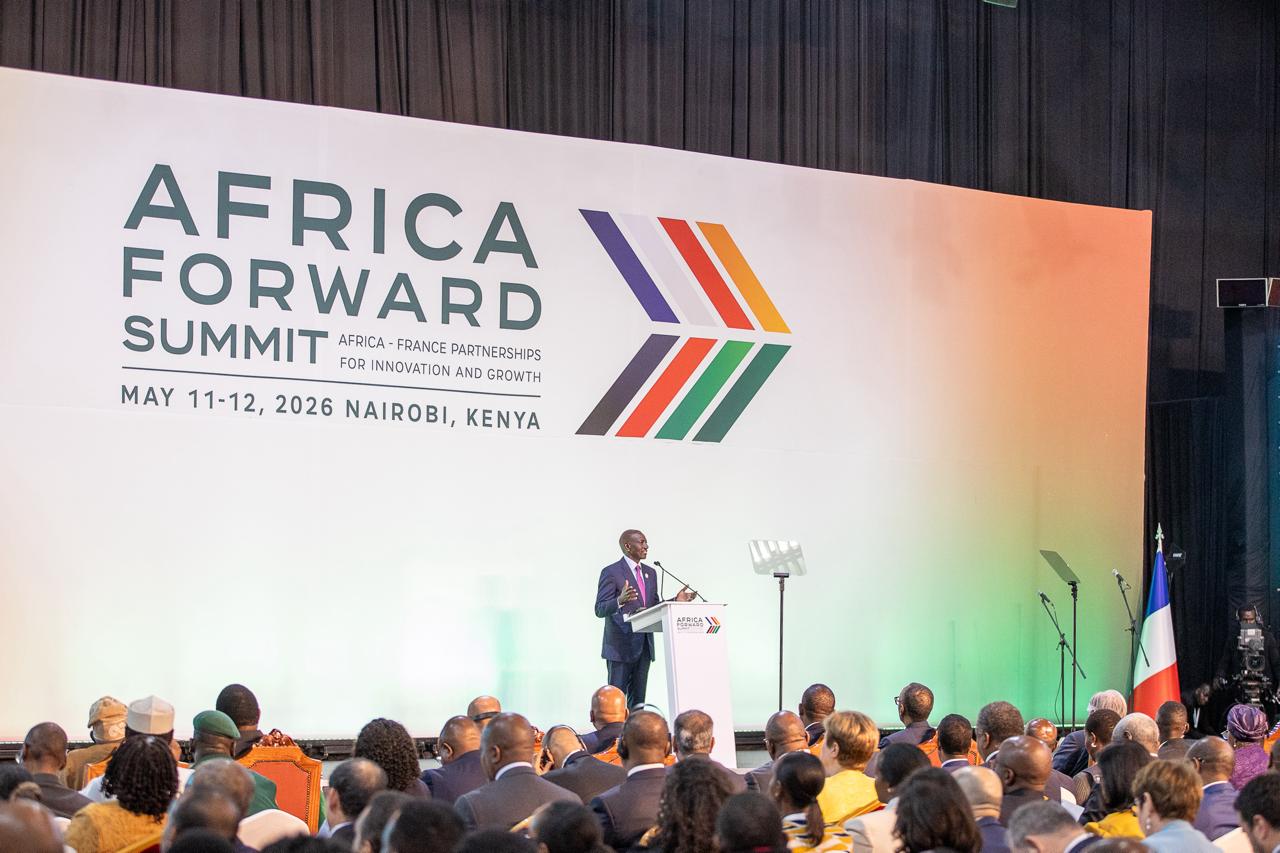
African and French leaders meeting in Nairobi have unveiled an ambitious roadmap aimed at reshaping economic ties, strengthening industrial growth and giving Africa a greater voice in global financial and political systems.
The Africa Forward Summit, held in the Kenyan capital from May 11-12, brought together representatives from African countries and the French Republic under a declaration centred on “growth and innovation”, green industrialisation, digital transformation and financial reforms.
At the heart of the declaration was a strong message that Africa wants to move beyond its traditional role as a supplier of raw materials and become a major player in manufacturing, technology and value-added production.
“We commit to supporting a transition from extractive economic models toward value addition, manufacturing and sustainable production systems,” the declaration states.
The summit declaration repeatedly framed Africa not as a continent in need of aid, but as a strategic economic and political partner with growing global influence.
“We recognise Africa not only as a market of the future but also as a partner in production, innovation and global economic leadership,” the leaders said.
The gathering came at a time of rising geopolitical tensions, growing concerns over global economic imbalances and mounting pressure on African economies from debt, energy costs and climate shocks.
Leaders warned that instability in global markets and overdependence on raw commodity exports continue to expose African economies to serious vulnerabilities.
“We met against the backdrop of rising geopolitical tensions and conflicts such as the ongoing conflict in the Middle East, geo-economic competition and instability, deepening inequalities, increasing global economic uncertainty, fragmentation and global macroeconomic imbalances,” the declaration says.
The summit placed strong emphasis on reforming the global financial system, with African leaders pushing for fairer representation in institutions such as the International Monetary Fund and the United Nations Security Council.
The declaration called for “an adequate realignment of the International Monetary Fund’s quota shares in favour of the most underrepresented countries”.
Leaders also renewed calls for reform of the UN Security Council to make it “more effective and representative” in line with the African Union’s Ezulwini Consensus and Sirte Declaration.
The summit further linked Africa’s economic transformation to industrialisation, energy access and regional trade integration through the African Continental Free Trade Area.
In one of the clearest signals from the meeting, leaders stressed that Africa’s natural resources should benefit local economies through value addition and local manufacturing.
The declaration committed governments to “respect national sovereignty over natural resources including critical minerals; promote local beneficiation, value addition and sustainable processing of Africa’s critical minerals”.
The summit also focused heavily on energy transition and green industrialisation, with leaders pledging support for renewable energy, low-carbon systems and clean energy infrastructure.
“We affirm that access to reliable, affordable, and sustainable energy is essential for development and deliver Africa’s long term developmental agenda through inclusive growth, job and wealth creation,” the declaration reads.
Among the priorities highlighted were hydropower, geothermal energy, waste-to-energy projects and nuclear power.
Leaders also backed the expansion of clean cooking energy and interconnected regional power markets while supporting “technology transfer of green technologies on fair and mutually beneficial terms”.
The declaration stressed that Africa’s energy transition must remain fair and aligned with the continent’s development goals.
The summit also pushed for stronger climate financing and greater African influence in global decision-making on climate policy and financing.
“We commit to advancing just and fair climate and sustainable development financing with greater African voice in global decision-making, governance, standard-setting and rule-making,” the declaration says.
Agriculture emerged as another major pillar of the summit, with leaders seeking to transform the sector into a modern and climate-resilient economic engine.
The declaration outlined plans to support agro-industrialisation, strengthen food systems and improve fertiliser supply chains.
Leaders also committed to promoting agro-processing, cold storage, logistics and regional agricultural trade under the African Continental Free Trade Area.
The summit further highlighted the role of technology and artificial intelligence in shaping Africa’s future economy.
Leaders acknowledged that digital transformation and AI are “reshaping economies, public services, knowledge systems, security, creative industries, and global competitiveness”.
To address this, governments committed to closing digital divides, supporting African-led data systems and strengthening digital sovereignty.
The declaration also called for investment in broadband connectivity, regional data centres, cloud infrastructure and AI systems.
Leaders pledged to support “African language models, local datasets, benchmarks, and open-weight AI systems”.
The summit further recognised growing risks linked to misinformation, cyber threats and AI-generated abuse, calling for stronger international cooperation on digital governance.
Beyond economics, the Nairobi meeting also devoted significant attention to peace and security.
French and African leaders reaffirmed support for African-led peace operations and stronger African Union involvement in conflict resolution.
The declaration backed the implementation of UN Security Council Resolution 2719 to ensure “predictable and sustainable funding” for African Union-led peace operations.
Leaders also expressed concern over terrorism, violent extremism and instability in regions including Sudan, South Sudan, Somalia, the Sahel and the Great Lakes region.
“We underline the link between security and inclusive economic growth, youth empowerment, education, climate resilience and diaspora engagement,” the co-chairs’ declaration stated.
The summit additionally rejected foreign interference and warned against the “privatisation of security by external operators whose interests are not those of Africa”.
On financing, the summit acknowledged that official development assistance alone would not be enough to meet Africa’s growing needs.
Instead, leaders pushed for a new partnership model built on co-investment, private capital mobilisation and country-led development priorities.
“We therefore commit to advancing a renewed approach of international partnerships, moving towards mutually beneficial partnerships based on shared priorities, co-creation, and co-investment,” the declaration says.
The summit also stressed the importance of stronger African financial institutions and local capital markets.
Leaders welcomed efforts by the African Development Bank Group and other global institutions to improve financing access, guarantee systems and investment flows into African economies.
The declaration recognised that Africa faces “a specific constraint on allocation and pricing of risk”, which continues to raise borrowing costs and limit long-term development finance.
It also called for stronger debt transparency, improved restructuring mechanisms and innovative financing tools linked to climate and development goals.
At the same time, leaders warned that global economic imbalances and distortive trade practices continue to undermine Africa’s industrial ambitions.
The declaration noted that “structural overcapacities” and “distortive non-market policies and practices” have weakened African industries and discouraged investment.
The summit further called on major global economies to work together to reduce excessive global economic imbalances.
“We urge the world’s major economies to recognise their shared responsibility in reducing excessive imbalances,” the declaration said.
The Nairobi summit also highlighted Africa’s rapidly growing youth population as one of the continent’s biggest strategic advantages.
“We recognise Africa’s youth as a strategic asset,” the declaration states.
Leaders committed to expanding education, training and innovation ecosystems to create jobs and support entrepreneurship.
The summit repeatedly framed regional integration as central to Africa’s future growth.
“We recognise that connectivity is key to unlocking Africa’s full potential,” the declaration said.
As the summit concluded, leaders adopted the Africa Forward Declaration as what they described as “a shared roadmap for action”.
“Together, we will build a future defined by sustainable growth, resilience and shared prosperity,” the declaration states.