


Livestock farmers are increasingly accessing breeding and vaccination services at their doorstep, thanks to a new mobile veterinary clinic model aimed at boosting productivity.
Dr Moses Olum, acting institute director at the Veterinary Science Research Institute at KALRO Muguga, said the innovation is bridging a long-standing gap in access to specialised veterinary services.
“Many of these technologies have traditionally been confined to laboratories or urban centres, making them inaccessible to smallholder farmers. What we are doing now is taking the lab to the farmer,” he said.
He spoke during an open week at the Kalro Muguga complex, where research institutes showcased innovations in crops, livestock and biotechnology.
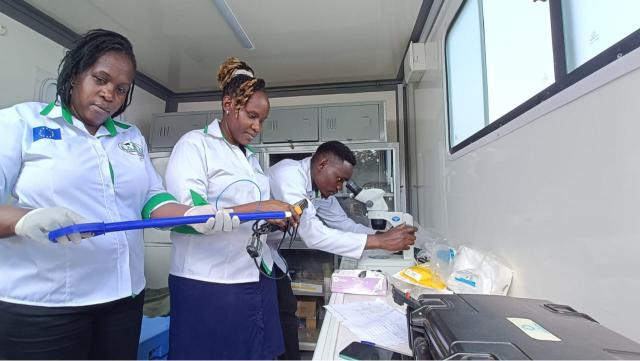
Among the highlights was a mobile reproductive unit — a fully equipped laboratory on wheels delivering artificial insemination (AI), embryo transfer and fixed-time insemination services.
These technologies are critical in improving breeding efficiency.
Ideally, a dairy cow should produce one calf per year, but many farmers fall short due to poor timing and limited access to services.
“With hormonal synchronisation and proper timing, we can ensure cows conceive at the right time, improving calving intervals and increasing milk production,” Olum said.
Kenya’s dairy sector contributes about fout per cent of GDP and supports more than 1.8 million smallholder farmers.
However, productivity remains low, with average yields of six-eight litres per cow per day, compared to more than 20 litres in advanced systems.
Kenya produces about five billion litres of milk annually against a demand of seven billion litres, a deficit targeted by AI-driven genetic improvement.
Government efforts are also ramping up vaccination, targeting more than 22 million cattle and over 50 million sheep and goats against diseases such as Foot and Mouth Disease and Peste des Petits Ruminants.
However, only about 10 per cent of livestock are currently vaccinated, highlighting a major gap in disease control.
The Kenya Animal Genetics Resource Centre supplies about 70 per cent of semen used for AI, but uptake remains uneven.
In some sectors, up to 98 per cent of goat farmers still rely on natural mating due to cost and access barriers.
The mobile clinics aim to close this gap by delivering both breeding and vaccination services directly to farms, alongside farmer training.
For farmers like Peter Njoroge from Kiambu, the impact could be immediate.
“Before, I had to travel long distances for AI services and sometimes the timing was wrong. With the mobile clinic, my cows will conceive on time, improving milk production,” he said.
The model has already been piloted in Transmara, Narok county, improving Sahiwal cattle breeds among pastoralists through synchronised breeding.
Olum said scaling up will require partnerships with county governments, NGOs and farmer groups.
“For sustainability, farmers contribute a small fee to cover logistics and personnel. With the right partnerships, we can reach more farmers and have a bigger impact,” he said.
The institute is also promoting molasses-based mineral blocks to boost livestock nutrition, alongside vaccines for diseases such as East Coast Fever (ECF), which causes annual losses of more than $300 million in sub-Saharan Africa.
“The ECF vaccine is administered once in a lifetime and offers long-term protection, but uptake remains low due to the specialised training required,” Olum said.