



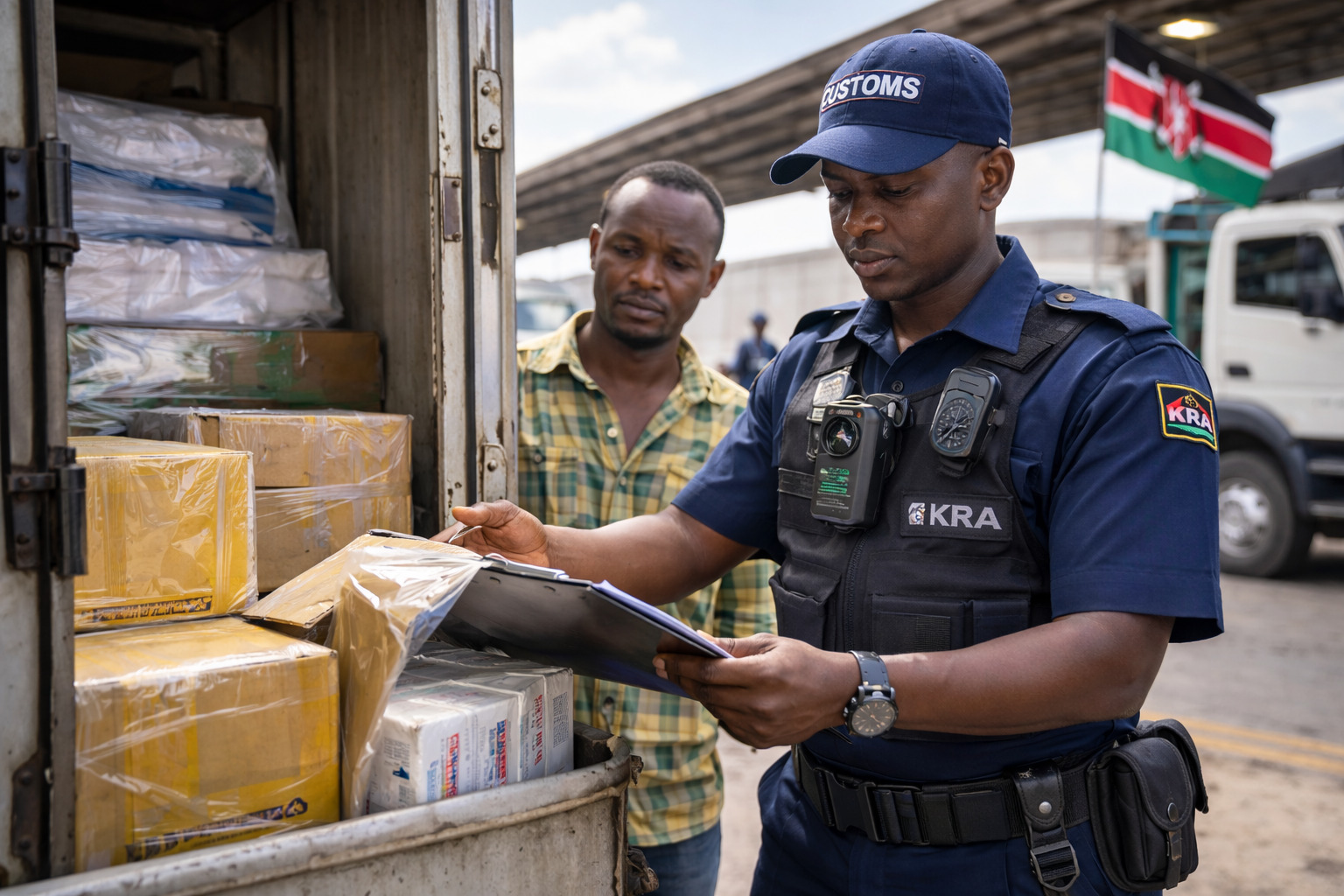
Imagine arriving at a border crossing with goods that have not been properly declared. A customs officer questions you, but instead of guiding you through the proper process, he demands a bribe. You refuse.
Moments later, the narrative shifts. The officer accuses you of carrying contraband—a claim you know is false but one that is now your word against his.
Scenarios like this have long defined the uneasy reality at many border points where interactions between travellers and customs officers are rarely documented.
A trader recently accused a customs official of extortion, sparking a dramatic altercation inside the revenue office that has since gone viral on social media.
That dynamic, however, may soon change as the Kenya Revenue Authority (KRA) moves to introduce body-worn cameras for customs and border control officers.
The tax agency says the cameras will record engagements between officers and travellers, creating an objective record of what transpires during inspections and routine checks.
“This isn’t just technology; it’s a statement,” the authority said, signalling that the initiative is aimed at ensuring every traveller receives a fair, professional and consistent experience at Kenya’s entry points.
“For too long, ‘it’s your word against mine’ has been an uncomfortable reality at border points.”
KRA maintains that the cameras will also protect officers by providing clear documentation of their work. “Every officer deserves a clear, documented record of their work. Integrity is not just a value we preach — it’s one we can now prove,” the agency said.
Customs operations are among the most public-facing functions of government, with officers interacting daily with thousands of travellers, importers and traders passing through airports, seaports and land border posts.
Those interactions, KRA noted, shape perceptions not only of the tax authority but also of the country’s governance and fairness in enforcing trade regulations.
For years, disputes arising from these encounters have often been reduced to conflicting claims between travellers and officers, with limited evidence to determine what actually happened.
“Disputes dragged on. Trust eroded and the officers doing their jobs right had no way to prove it,” the authority said.
Body-worn cameras, according to KRA, will fundamentally change that equation by capturing a verifiable record of each interaction.
“Every interaction is now a verifiable record. No more ambiguity. No more “he said, she said.” Just facts,” the authority said.
Beyond transparency, the agency believes the cameras will act as a powerful deterrent against corrupt practices.
“When the camera is rolling, professionalism isn’t optional; it’s the default. Recorded interactions raise the standard for everyone in the room,” KRA said.
The authority also expects the technology to improve the experience for passengers passing through Kenya’s borders.
Structured and documented interactions, it argues, will help ensure travellers move through checkpoints more efficiently and with greater confidence in the fairness of the process.
The footage will also enable faster resolution of complaints. Cases that previously required weeks of internal investigation could be settled within hours by reviewing recorded interactions.
“A complaint that once took weeks to investigate can now be resolved in hours. Objective footage cuts through the noise and gets to the truth quickly,” KRA said.
Beyond accountability, the recordings are expected to serve as a tool for institutional learning. By analysing footage, the authority hopes to identify gaps in procedures, strengthen officer training and improve service delivery across its border operations.
The cameras will also provide detailed documentation of inspections and enforcement actions, strengthening compliance and enhancing officer safety during potentially contentious encounters.
KRA noted that body-worn cameras have already become standard equipment in several international customs and border agencies, including those in the United Kingdom, Europe and parts of Asia.
Kenya’s adoption of the technology, the authority said, signals a broader commitment to aligning its border management practices with global standards.
“This is about telling every traveller, importer and stakeholder that we are committed to fairness and accountability,” KRA said.
Ultimately, the taxman believes such steps will help rebuild public trust — a factor it considers critical to effective customs administration.
“Public trust is not a soft metric in customs and trade,” the authority said. “It determines whether a border facilitates economic growth or frustrates it.”
For travellers, traders and other stakeholders passing through Kenya’s entry points, KRA insists the message is simple: interactions at the country’s borders are about to become more transparent, more accountable and more trustworthy.