



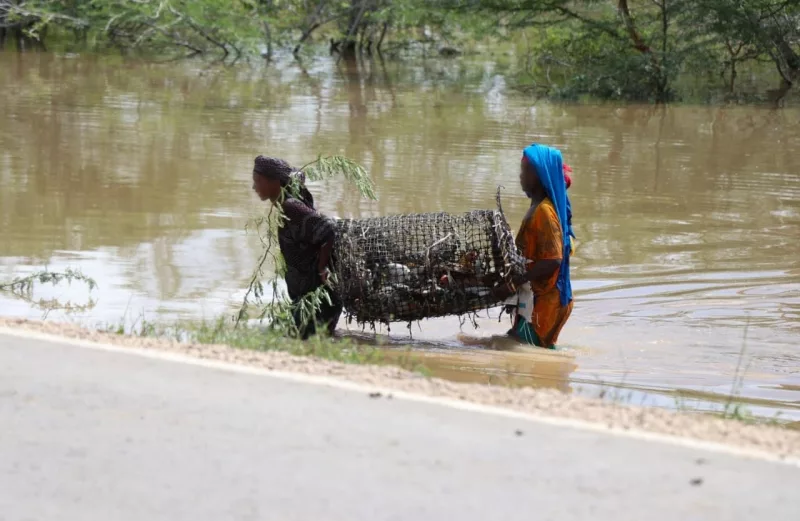
Most parts of Kenya will receive above-average rainfall in November and December, the weatherman has predicted.
Edward Muriuki, the acting director of the Kenya Meteorological Service Authority, also said the whole country would experience warmer-than-normal conditions despite the rains.
This means the uncomfortable nights experienced in recent months are likely to continue.
He said the increased rainfall could cause flooding, damage roads and increase the risk of diseases such as malaria, cholera and typhoid.
The increased rainfall is expected to affect 44 counties, including all the major agricultural regions, as well as much of West Pokot, Samburu and Marsabit.
However, parts of Turkana, West Pokot, Samburu, Baringo and Marsabit are expected to receive near-average to above-average rainfall.
The warmer conditions will vary across regions. Counties such as Nandi, Kakamega, Bungoma, Uasin Gishu, Nakuru and others in western Kenya and the Rift Valley will experience daytime temperatures ranging between 20 and 30 degrees Celsius.
Night-time minimum temperatures will range between eight and 20 degrees.
In Turkana and Samburu, daytime temperatures could reach 38 degrees Celsius.
Similar temperatures are expected in Marsabit, Mandera, Wajir, Garissa and Isiolo. Along the Coast, night-time temperatures are expected to remain between 20 and 25 degrees.
“The evolution, distribution and intensity of rainfall during November are influenced by large-scale climate drivers, including the Indian Ocean Dipole (IOD) and the El Niño–Southern Oscillation (ENSO), intra-seasonal atmospheric systems such as the Madden–Julian Oscillation (MJO), and tropical cyclones over the Indian Ocean,” Muriuki said.
These systems influence the amount, distribution and intensity of rainfall. The Indian Ocean Dipole refers to differences in sea surface temperatures between the western and eastern parts of the Indian Ocean, while El Niño is linked to changes in temperatures in the Pacific Ocean.
The authority said November is an important month in the October to December short rains season. Rainfall during this period supports farming, replenishes water sources and sustains livelihoods.
“November is a key month of the October-November-December short rains season, with rainfall playing an important role in supporting agricultural activities, replenishing water resources and sustaining livelihoods across the country,” he said.
The increased rainfall could improve soil moisture and provide more pasture for livestock following the last three dry months.
However, Muriuki warned that excessive rainfall could create challenges for farmers and disrupt the movement of food from farms to markets.
The forecast also raises concerns about flooding, particularly in areas near rivers, low-lying parts of the Coast, towns with poor drainage and highland areas where heavy rainfall could trigger landslides.
Rural roads could become difficult to use or completely impassable after prolonged rainfall. In towns, poor drainage could lead to flooding and traffic congestion.
“Rural access roads are particularly vulnerable to deterioration and may become impassable following prolonged rainfall, affecting the movement of people, goods and essential services. Urban areas may also experience traffic congestion and transport disruptions where drainage systems are overwhelmed,” the statement said.
The rains could also increase the risk of diseases, particularly in areas where water collects around homes and flooding contaminates drinking water.
“The enhanced rainfall expected during November 2026 may create favourable conditions for mosquito breeding due to increased water accumulation in stagnant pools and poorly drained areas, potentially raising the risk of malaria transmission in susceptible regions. Additionally, flooding and inadequate drainage may contaminate water sources, compromise sanitation facilities and increase the risk of water-borne diseases such as cholera, typhoid and diarrhoeal infections,” Muriuki said.
The forecast offers some relief regarding water supplies, particularly for communities and farmers who depend on rivers, dams, water pans and groundwater.
The authority expects the rains to increase river flows and replenish water storage facilities. This could improve water availability for households, farming and livestock.
However, it cautioned that heavy rainfall could also cause rivers to rise quickly, resulting in localised flooding.
The latest forecast comes after much of the country received below-average to near-average rainfall in October, although some areas recorded significant amounts.
The authority reported that an automatic weather station at Ng’iya Primary School in Siaya recorded the highest monthly rainfall total in October, at 264.4mm.
Some weather stations in Marsabit, Garissa, Mandera, Kisii, Kisumu and Lamu also recorded rainfall above their usual October amounts.
Temperatures were also higher than normal across the country during the month. Kisii recorded the highest increase in average temperature compared with normal conditions, at 2.3 degrees Celsius, while Lodwar recorded a daily maximum of 40 degrees Celsius on October 22.
The meteorological authority advised Kenyans to use the monthly outlook alongside shorter-term weather forecasts, which provide more specific information on expected conditions.
It said county-specific weekly and monthly forecasts were available through county meteorological offices to help farmers and other residents plan their activities.
The authority urged the public to follow weather updates, noting that seasonal forecasts do not mean every area will receive the same amount of rainfall at the same time.