


For nine months, a mother carries a child before finally hearing its first cry.
In Lamu, another kind of birth has begun one that has been given 40 months to take shape and could alter the economic landscape of an entire county.
At Mkokoni, the first signs are already visible. More than 110 pieces of equipment have arrived at the site, with another 400 expected within 60 days as construction of the Dangote East Africa Refinery gathers pace.
By early 2030, Dangote Group President Aliko Dangote says he expects to return to Lamu with African leaders to commission the refinery.
President William Ruto has already made it clear that the deadline will be watched. “A groundbreaking, ladies and gentlemen, is a promise. A refinery is a promise kept,”
For the people living around the project, however, the bigger question is not simply when the refinery will be completed.
It is what will happen to their lives and businesses while it is being built and what will remain after the construction crews leave.
For the mama mboga, the fisherman, the boda boda rider, the young graduate, the hotel owner and the small-business operator, the real refinery story may begin far beyond its gates.
Majisola Ogunleye, a Nigerian citizen familiar with the development around Dangote’s projects, remembers what the area around the Dangote Refinery in Lekki back in Nigeria, looked like when she first arrived.
“When I first came here back in 2013, it was all bush, water, and swamp. But now, women are empowered, the youths are employed, children are being supported in school, the communities are thriving, and the social dynamics is completely different,” she said.
Her recollection offers a glimpse of the transformation Dangote hopes to replicate in Lamu.
The immediate effects of construction could be felt in places that have little to do with refining crude oil.
A boda boda rider could gain more customers. A food kiosk could serve workers. A hotel could accommodate contractors and visitors. A mechanic could service construction vehicles. A local supplier could compete for contracts. A young graduate could find a pathway into technical work.
Evans Odhiambo, Deputy Manager of Operations in Lamu County, says residents should prepare themselves for the opportunities that may emerge.
“I want to tell Kenyans that we are okay; jobs are coming. I have personally stayed here for some time and have seen and I understand this project. It has real benefits, especially for the surrounding community,” Odhiambo says.
For a county whose economy has traditionally depended heavily on fishing, tourism, trade and small businesses, the arrival of a large industrial project represents a different scale of economic activity.
But opportunity alone is not enough. The question is whether local people will have the skills, capital and access needed to participate.
That is why one of Dangote’s earliest announcements may be as important to Lamu as the refinery itself.
The company plans to establish a training school in Lamu that will prepare 1,000 local people for opportunities connected to the refinery and its associated industries. The programme is expected to target people with engineering degrees, diplomas and other relevant qualifications.
“Anyone who has an engineering degree, a diploma or the relevant technical qualifications should know that opportunities will be available,” Dangote said.
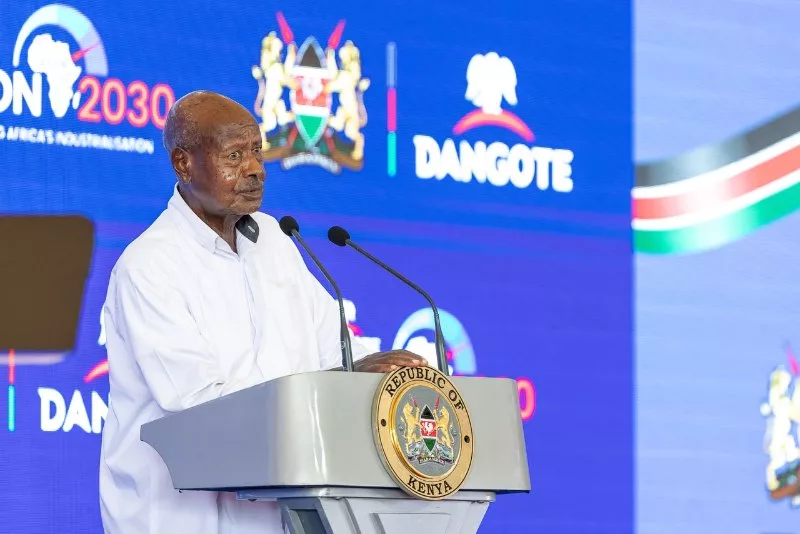
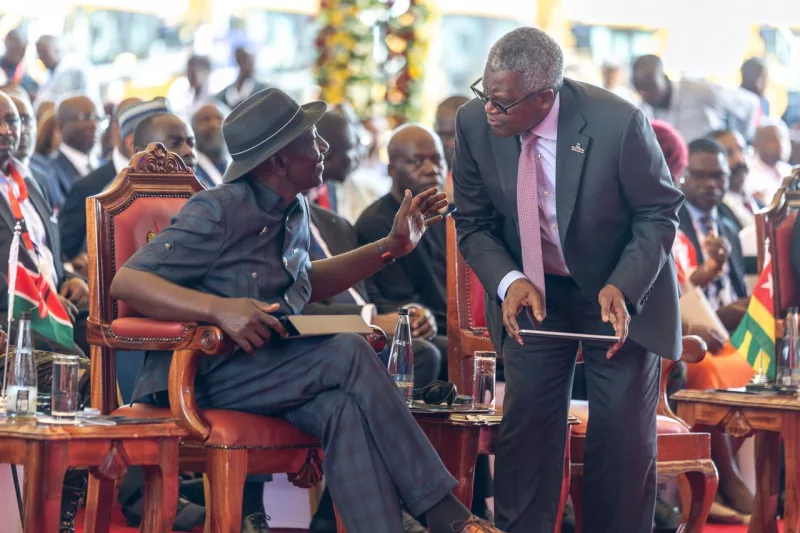
Uganda President Yoweri Kaguta Museveni addresses stakeholders hosted by President William Ruto at the Dangote East Africa Petroleum Refinery ground breaking ceremony in Lamu County
The construction phase could generate employment on a much larger scale.
Dangote has said the project could create about 60,000 jobs, a figure that refers to projected employment associated with the construction and wider project activity rather than 60,000 permanent positions inside the completed refinery.
That distinction is important. The economic story is not simply about how many people will eventually work inside the refinery.
It is also about the companies that could supply it, the workers who will earn incomes, and the businesses that could grow around the expanding workforce.
Dangote has described those possibilities as difficult to fully quantify.
“You build possibilities around it, possibilities that none of us can fully quantify,” he said.
The training programme could therefore become one of the most important links between the investment and the local community.
If young people acquire skills that remain useful after construction, the project’s impact could extend beyond its completion date.
“We must build capacity here,” Dangote said.
President Ruto’s message to Lamu residents was equally direct:
“Biashara hapa itanoga vibaya sana. Sasa nyinyi mjipange.”
The instruction is simple: prepare.
The Lamu project is also drawing heavily on the experience of Nigeria. When Dangote’s refinery in Lekki was being developed, the project faced questions over its scale, financing, engineering and infrastructure.
Dangote’s response was to focus on what could be built rather than what might prevent it.
“They saw obstacles. We saw possibilities.” “They saw risks. We saw opportunity.” “They predicted failure. We delivered history.”
The Lekki experience now forms part of the argument for Lamu.
“Lekki proved that it can be done. Lamu must prove that it can be repeated,” Dangote said.
The proposed Lamu refinery is designed to process about 700,000 barrels of crude oil per day. Dangote has also said the project will include a 1,000-megawatt power component and produce about one million tonnes of polypropylene and base oil.
But Dangote’s pitch is not simply about building another refinery and merely not to build tanks, pipelines, processing units and jetties, but to build an industrial ecosystem.
A refinery of this scale requires more than crude oil and processing equipment.
It needs engineers, transporters, logistics companies, marine services, construction firms, technology providers, food suppliers, accommodation, financial services and thousands of other transactions that can connect a major industrial investment to the wider economy.
This is where economist Joy Kiiru of the University of Nairobi sees a broader economic effect.
“You can imagine the effect of that, the multiplier effects, multiplier effects of about 15 percent of GDP coming directly into the country,” she said.
Her observation points to an economic chain that can be easier to understand in everyday terms.
The first layer is the investment itself money spent on construction, machinery and infrastructure.
The next layer comes through wages, contracts and procurement. Workers and businesses then spend that income on food, transport, housing, accommodation and other services. Suppliers purchase from other suppliers. New businesses emerge to meet new demand.
In economic terms, those successive rounds of spending are part of what is described as the multiplier effect.
Kiiru’s 15 per cent figure should therefore be understood as her characterisation of the potential wider economic impact, rather than as a measure that the refinery itself will simply add 15 per cent to Kenya’s GDP.
The distinction matters because the project is still at the beginning of its construction journey. But the broader proposition is clear: the economic footprint of a major industrial investment can extend well beyond the facility that initially attracts the money.
That is the thinking behind the Government’s effort to link the refinery to Lamu Port and the wider Lamu Port-South Sudan-Ethiopia Transport Corridor.
The State Department for Transport says the project could strengthen Lamu’s role as a regional transport and logistics hub and stimulate economic activity along the LAPSSET Corridor.
Yet the economic promise comes with another responsibility: ensuring that development does not leave behind the people who already call Lamu home.