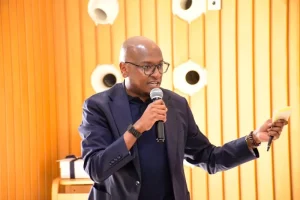



Lamu Governor Issa Timamy has called for stronger partnerships between local governments, communities and international actors to build lasting peace and safety.
He said Lamu has shown peace-building is an effort that can directly lead to development, as investors now flock to the county to harness its untapped opportunities.
“Peace is beginning to translate into an investment dividend for Lamu. There is now a growing interest in Lamu as a place where investors can plan for the long term,” Timamy said.
He spoke in New York, US, on Thursday, where he was a keynote speaker at the Open Society Foundations (OSF) side event during the 81st United Nations General Assembly (UNGA 81).
President William Ruto was present.
The governor highlighted opportunities in industrial development, oil refining by Nigerian billionaire Aliko Dangote, palm-oil processing and other private-sector investments as a direct result of the peace-building efforts in the county.
“When a place becomes more peaceful and predictable, investors begin to see opportunity rather than risk,” he said.
The governor was sharing Lamu’s perspective on “Local Multilateralism for Peace and Safety”.
He said “everyday safety is shaped locally”, noting that peace, security, access to services, trust in institutions and social cohesion are ultimately experienced by people within their communities.
“Lamu’s experience demonstrates that peace is built where people live, through approaches that place communities, trust, resilience and partnerships at the centre of governance,” Timamy said.
The governor also challenged the traditional understanding of international cooperation, emphasising that partnerships should not only be about what local governments receive from the international community, but also about sharing local knowledge, experience and solutions with the world.
“Local governments should not only be recipients of global knowledge. We can also be producers of global knowledge,” he said.
Lamu county disaster risk management and peace-building director Shee Kupi said peace-building is a process, not an event, and takes time.
Kupi works mostly behind the scenes to ensure the peace-building efforts bear fruit.
He said taking Lamu’s experience to the global stage is paramount for Kenya’s image, demonstrating that even local solutions can have major global impacts.
“Having Lamu’s locally-led peace-building experience effectively positioned within the global conversation on peace, safety and local multilateralism is testament to what Kenya can do on the global stage,” he said.
The engagement builds on Lamu’s growing international recognition, including its UCLG Peace Prize 2026, and provides an opportunity for the county to share its experience while learning from other local governments, communities and international partners.
He said for Lamu, this means more than capital coming into the county.
“It means the potential for jobs for young people, opportunities for local businesses, improved infrastructure, stronger supply chains and greater economic integration,” Kupi noted.
Timamy described the UCLG Peace Prize not simply as recognition of what Lamu has achieved, but as “an economic asset and a responsibility”, noting that peace creates the conditions in which development and investment can take root.
He called for greater recognition of the role of local governments in global peace and development conversations, emphasising the importance of moving from local experience to knowledge exchange, partnerships, scaling solutions and global contribution.
“Let us make local multilateralism a practical system for sharing solutions, building trust and preventing violence—starting with the communities we serve.
“For Lamu, the UNGA engagement represents not only an opportunity to speak to the world, but also to exchange ideas, learn from others and build partnerships capable of translating local solutions into broader impact,” Timamy said.