
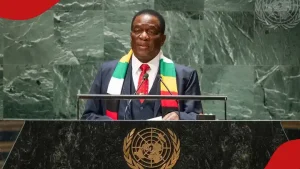


Zimbabwe has declared September 15 an annual national public holiday, coinciding with President Emmerson Mnangagwa’s birthday. Zimbabwe President Emmerson Mnangagwa speaking during a past UN session. Photo: Emmerson Mnangagwa. Source: Twitter The new holiday was established through Statutory Instrument 148 of 2026, which designates September 15 every year as Munhumutapa Day. New Zimbabwe reported that the government published the notice on Wednesday, formally adding the date to Zimbabwe’s list of public holidays. Details of Zimbabwe’s Munhumutapa Day The regulation was issued under the Public Holidays and Prohibition of Business Act and states that September 15 will henceforth be observed annually as Munhumutapa Day. Munhumutapa is a title historically associated with rulers of the Mutapa Empire, a powerful Shona kingdom that existed between the 14th and 17th centuries. The government said the holiday would celebrate Zimbabwe’s pre-colonial heritage, although it did not explain why September 15 was selected for the annual commemoration. The declaration comes as Mnangagwa prepares to mark his 84th birthday on the same day Zimbabweans will celebrate the new national holiday. What did Mnangagwa say about his future? Hours after the government announced the new holiday, Mnangagwa appeared to hint that he could remain politically active beyond 2030, despite his current presidential term being expected to end that year.
Speaking on Thursday, the president said he would “still be around” in nine years. “I will still be around; I do not know about you,” he was quoted as saying. His remarks come months after he signed legislation extending the presidential and parliamentary terms from five to seven years. In July, Mnangagwa signed the constitutional amendment that moved the end of his current term from 2028 to 2030, amid criticism from opponents and civil society groups. The president had previously described himself as a constitutionalist and pledged to respect Zimbabwe’s presidential term limits. The changes have nevertheless sparked fresh concerns over the country’s political future. Zimbabwe President Emmerson Mnangagwa. How has Zimbabwe changed its presidential elections? The constitutional changes also abolished Zimbabwe’s direct presidential election. Under the new system, voters will elect members of parliament, who will subsequently choose the president. Critics have warned that the changes could strengthen Mnangagwa’s ruling ZANU-PF party, which has governed Zimbabwe continuously since independence from Britain in 1980. Mnangagwa came to power in 2017 after Robert Mugabe was forced out following military intervention, ending his nearly four-decade rule. He subsequently won the 2018 and 2023 presidential elections, both of which were disputed by opponents.