


Kenya’s mounting waste challenge is emerging as an industrial opportunity, with recycling, composting, repair and reuse capable of turning discarded materials into inputs for businesses and manufacturers.
The Africa Green Jobs and Skills Toolkit, which examines opportunities across the continent, identifies circularity and waste systems as a potential source of industrial green jobs.
The toolkit by Government of Kenya, African Union and the Jacobs Ladder Africa says the opportunity lies in treating “waste as economic asset” and linking circular manufacturing with regional trade to create industrial value.
But the report warns that Kenya’s recycling economy remains constrained by fragmented value chains, limited financing, weak infrastructure and uncertain demand for recovered materials, making it difficult for small businesses to move from informal collection into higher-value manufacturing.
“Circular value chains remain fragmented, informal and insufficiently financed, Waste workers, aggregators, recyclers and small circular enterprises remain trapped in low-margin activity without growth capital or stable market links,” the study says.
According to Invest Kenya, the country generates approximately 22,000 tonnes of waste every day, yet only around 4 per cent of waste is currently recycled, leaving a significant share untapped for reuse and recycling.
The state agency says translating this waste into value across five sectors could unlock over $700 million (Sh90.6 billion) in economic value and contribute approximately 0.5 per cent to Kenya’s GDP by 2030, while supporting job creation and strengthening domestic supply chains.
The waste economy potential comes as the country grapples with rising waste volumes. Kenya generates about 22,000 tonnes of waste every day, equivalent to roughly 8 million tonnes annually.
The Africa Green Jobs and Skills report notes that waste workers, aggregators, recyclers, composters, repair businesses and e-waste operators already form part of the circular economy, but many lack access to capital for equipment, storage, technology, working capital and expansion.
This creates a business gap that banks, investors, county governments and producers could help close by financing the infrastructure needed to collect, sort and process waste into commercially useful materials.
The toolkit identifies plastics, organic waste, e-waste, textiles, construction waste and packaging as value chains where jobs can be created or upgraded.
This points to opportunities for firms that can aggregate materials consistently, improve quality and supply manufacturers at scale over time across Kenya.
However, it says demand for recycled products remains inconsistent because of quality concerns, weak standards and competition from conventional materials.
For Kenyan recyclers, the challenge is therefore not simply collecting more waste. It is creating reliable markets for what they recover.
The report points to public procurement as one way of creating that demand, recommending quotas for recycled-content products and compost in public purchasing.
“The report also recommends that procurement quotas specifically create demand for “recycled-content products and compost”, with finance ministries, procurement authorities and local governments identified as the relevant actors,” the tool kit states.
Such measures could give recyclers predictable buyers while encouraging manufacturers to incorporate recovered materials into their production.
Regional trade could provide another avenue for growth. The toolkit calls for harmonised standards for plastics, recycling, e-waste and circular manufacturing to support trade under the African Continental Free Trade Area.
Standardisation would allow Kenyan enterprises to sell recovered materials and circular products beyond the domestic market.
Financing, however, remains one of the biggest barriers. Circular businesses are often considered high-risk because they lack collateral, formal records, credit histories and predictable revenues, according to the report.
“Circular SMEs and informal-sector enterprises are viewed as high-risk because they lack collateral, formal records, credit histories and predictable revenue streams. Circular businesses cannot access finance for equipment, storage, technology, working capital or expansion, limiting jobs in recycling, composting, repair and manufacturing,”
The toolkit proposes patient and blended finance, EPR funds, green bonds, concessional capital and guarantees tailored to small recyclers and other circular enterprises.
By recovering materials that would otherwise be lost, Kenya can create new industries, strengthen manufacturing value chains, and reduce reliance on imported raw materials.
It focuses on opportunities that could accelerate Kenya’s circular economy transition over the next three to seven years, highlighting where private capital can benefit from and support scalable solutions.
It also recommends building investment-ready business pipelines instead of relying on donor-funded pilots.
Informal waste workers are central to this transition. The report says they should be integrated into municipal and producer-responsibility systems through contracts, cooperatives and formal supply chains rather than displaced as the sector becomes more organised.
Kenya is trailling its East African peers of Rwanda, Uganda and Tanzania on solid waste management, according to a World Bank report.
This, as the global lender projects much of the growth in global waste generation over the coming decades will be in Sub-Saharan Africa, with an increase from approximately 230 million tonnes to over half a billion tonnes by 2050.
This increase will largely be driven by a rise in population as the per capita rate increase in the Sub-Saharan Africa region, currently standing at 26 per cent.
The report dubbed “What a Waste 3.0”, global snapshot of solid waste management toward circularity until 2050, notes that municipal solid waste generation in Sub-Saharan African countries is on the rise.
Kenya is ranked 38 in solid waste generation and management in sub-Saharan Africa. Tanzania is ranked sixth with Uganda coming in ninth.
Of the 231 million tonnes of municipal solid waste per year generated in the Sub-Saharan Africa region, 160 million tonnes were uncollected, 54 million tonnes taken to dumpsites and the remaining 17 million tonnes either taken to controlled landfills or recycling.
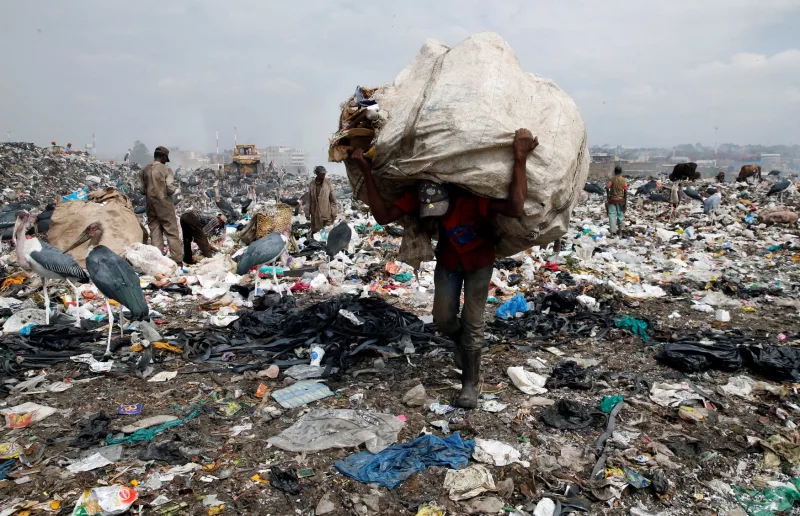
Dandora remains the biggest dump site in Kenya and one of the largest in Africa.
Food waste tops the composition of municipal solid waste in Sub-Saharan Africa (44.2%) followed paper and cardboard (11.9%) and plastic (9.6%).
Waste generation and projections by country or economy shows that Kenya generates approximately 3.6 million tonnes of waste per year with an estimated population of 53.7 million people.
This is expected to go up to 5.2 million tonnes by the year 2030, with the populations expected to have hit 62.5 million people by then.
By the year 2050, Kenya will be generating at least 10.7 million tonnes of waste, according to the World Bank.