
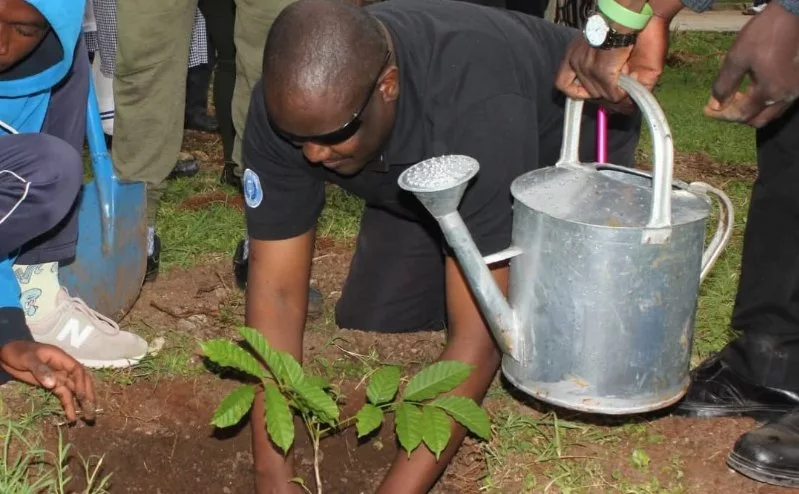
Rather than allowing his own disability to define him, Ezekiel Wafula chose to become part of the solution by joining The Blind Go Green, a community organisation that empowers persons with disabilities to take an active role in environmental conservation and climate action.
Popularly known as ‘Karithongo’, a nickname that loosely translates to ‘the one blinded guy’, Wafula has embraced the name as a badge of resilience rather than shame.
“They joke that I’m the king of the blind, coming from the saying that ,’In the company of the blind, the one-eyed person is king,'” he said.
“I have embraced that to help those around me. I was not born with it, but it just came.”
Several years ago, Wafula was struck by a falling tree while walking along a road, leaving him with partial loss of vision in one eye.
Today, his affected eye sees only blurred images and tears frequently, forcing him to wear spectacles to protect it from sunlight. Despite the challenges, he has remained committed to serving his community.
Recalling the devastating floods that hit Mathare, Wafula says the experience exposed just how vulnerable persons with disabilities are during climate-related disasters.
“There was a time it rained so heavily and there were floods everywhere. For us who live in the slums, especially Mathare, we were severely affected because we live next to the river. The river overflowed and carried away people and our hard-earned investments,” he said.
“When there were floods, I wanted to help evacuate people but I could not. Some told me to stay away because I could also be affected.”
Wafula says persons with disabilities, particularly those who are blind or physically challenged, often face greater risks during emergencies because rescue efforts rarely consider their unique needs.
That experience strengthened his resolve to become involved in conservation activities aimed at mitigating the effects of climate change.
Through The Blind Go Green, Wafula and other volunteers have participated in tree planting, environmental restoration and community awareness campaigns, both in Nairobi and rural parts of the country.
“We have been planting trees in institutions, especially primary school. In Mathare, we have planted vegetation along riparian land to help mitigate harsh climatic conditions. We are also using art through poetry and short skits to educate people on environmental conservation,” he said.
He says members are actively involved in cleaning neighbourhoods, collecting waste and engaging communities in practical environmental activities.
The physical work, however, comes with its own challenges. Long hours under the scorching sun quickly affect his eyesight, often forcing him to stop while his colleagues continue working. Yet, he says, teamwork has made those hurdles easier to overcome.
For persons with disabilities, conservation has become a platform to challenge stereotypes and prove that disability is not inability.
Through tree planting, environmental restoration and climate action, they are protecting nature while inspiring their communities.
FROM PREDATOR TO PROTECTOR
At the same time, another unlikely group is driving conservation from a different path: former poachers who have traded bows and arrows for environmental stewardship, showing that rehabilitation and education can be just as powerful in saving Kenya’s endangered wildlife.
For years, the forests surrounding Homa Bay offered Zacchaeus Okoth, 32, more than just trees and wildlife, they provided an easy source of meat.
What began as idle curiosity and peer influence slowly drew him into poaching, a practice that would contribute to the decline of one of Kenya’s rarest wildlife species, the Roan antelope.
Okoth recalls how groups of young men would respond to the sound of barking dogs chasing antelopes through the forest. The excitement of the hunt and the promise of fresh meat were enough to lure them into the wilderness armed with dogs and arrows.
The first time he tasted Roan antelope meat, he says, there was no turning back.
“When I discovered it had a sweet taste, I never looked back, and the desire to go into the forest in search of it pushed me into poaching. When we lacked money to buy meat, we could just take our dogs and arrows and head to the forest,” he said.
Okoth says a single hunting expedition would attract at least 10 men from the village. The dogs would chase down the antelope before the hunters killed it and shared the meat among themselves.
“It all began as a joke, not work, but later evolved into something huge that impacted our wildlife and the environment,” he said.
“The hunting of the Roan antelope was solely for our consumption and not for commercial use because we were discouraged from selling it.
“The poaching led to the decrease of the Roan antelope, and it was discouraging tourists from visiting our communities. Before, we could meet foreigners walking around, but we did not know they were there because of this wildlife.”
His turning point came when he joined anti-poaching counselling, where they were taught about wildlife conservation, the economic importance of tourism and alternative ways of earning a living.
The sessions also included regular follow-ups to encourage participants to stay away from poaching.
Three years later, Okoth says the programme has transformed not only his life but also his community. Today, Okoth earns a living through jua kali work, using his skills to provide for his family instead of relying on the forest.
Looking back, he says the counselling sessions changed his mindset and helped him appreciate the value of protecting wildlife.
MISSION TO RESTORE NATURE
For four years, human rights defender and conservationist Diana Ongira has been mobilising women and communities in Kasarani to protect the environment through tree planting and conservation.
Ongira, from the Kasarani Social Justice Centre, said her passion for conservation was born out of the water shortages her community experienced after widespread tree cutting contributed to prolonged drought.
“We were suffering because of lack of water. When we learnt that cutting down trees was among the causes of drought, it became a wake-up call,” she said.
She began the initiative alone before five women joined her. Today, the group has grown to 25 women, who take part in environmental conservation activities.
Ongira said women have become key drivers of conservation because they are committed to community responsibilities and are increasingly embracing environmental protection.
The group also works with people living with disabilities, encouraging them to participate in conservation activities.
Beyond planting trees, members clean areas along rivers before restoring the surrounding environment with indigenous and fruit trees.
She said the group has also received training on wildlife conservation, particularly on endangered indigenous species, such as the Hirola and Roan antelopes, and hopes to work with relevant stakeholders to support their conservation.
Despite challenges in accessing seedlings and sustaining voluntary work, Ongira said the initiative has transformed the area, leading to the establishment of a clean community park where families now gather and relax on weekends.
The Kenya Wildlife Service has partnered with community-based organisation Blind Go Green to boost conservation efforts for the endangered Hirola and Roan antelopes through public awareness and community engagement.
KWS outreach officer Michael Ophiel said the two species remain under threat due to declining numbers, making conservation efforts more urgent.
“They are very rare species that we have around us. We can say they are very endangered because there are very few of them left,” Ophiel said.
“Conservation requires a joint effort. They have been creating awareness, particularly about the uniqueness of the antelopes we have around. This helps people understand that these antelopes exist here and why they need protection.”
Ophiel acknowledged that the population of the two species has declined, although KWS is still collecting data to establish their exact numbers.
DISABILITY NOT INABILITY
At a time when persons with disabilities are often seen as among the most vulnerable to climate change, a group of visually impaired and differently abled Kenyans is helping protect some of the country’s rarest wildlife from extinction.
Through The Blind Go Green, members are restoring habitats, rehabilitating former poachers, planting indigenous trees and protecting the critically endangered Hirola and Roan antelopes.
Co-founder Dennis Orengo Juma said the organisation was born after witnessing how floods and droughts disproportionately affected persons with disabilities.
“Whenever floods or landslides occurred, the numbers reported in the news were statistics. For us, they were our neighbours, friends and community members,” he said.
The group initially focused on improving climate resilience for persons with disabilities before expanding into conservation after recognising the link between healthy ecosystems and community livelihoods.
One of its flagship initiatives is an anti-poaching counselling programme that addresses the root causes of wildlife crime.
“We realised many poachers kept returning after arrest. We decided to listen to their stories. Poverty and cultural practices were major drivers,” Juma said.
So far, 113 former poachers have undergone counselling, with many shifting to alternative livelihoods.
The organisation also works with women-led conservation groups and uses solar-powered Tenzi monitoring systems to detect forest fires and illegal activities in protected areas.
“Seeing these species recover demonstrates that persons with disabilities can play a significant role in conservation and help prevent species extinction,” Juma said.