
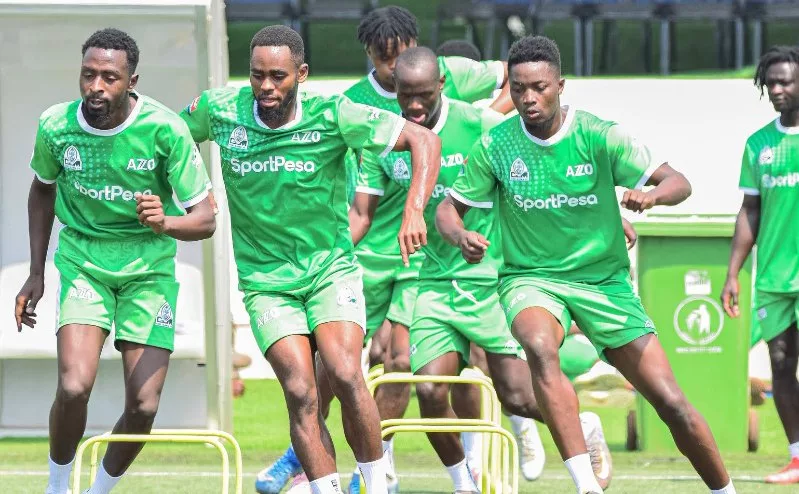
Gor Mahia face their toughest test of the CECAFA Kagame Cup campaign on Tuesday when they take on Sudanese giants Al-Hilal SC in a high-stakes semi-final at Kigali Pelé Stadium.
The clash promises a strategic duel between two managers with contrasting philosophies: Gor Mahia’s Charles Akonnor, who favours attacking intensity and flexibility and Al-Hilal’s Guy Bukasa, who relies on defensive structure and game management.
Although the Kenyan champions reached the knockout stage with a squad stretched by injuries, Akonnor remains confident that his approach has prepared his team for the moment.
Gor Mahia topped Group A on goal difference, though their run was accompanied by debate over Akonnor’s decision to rotate heavily.
The Ghanaian tactician defended his selection policy, insisting squad depth is essential during a demanding campaign.
“I know exactly what I am doing. People can criticise because they don’t understand the bigger picture,” Akonnor said. “We needed every player ready because this tournament is demanding. Rotation was necessary, not optional.”
The former Ghana international added that his main duty is building a side capable of competing on multiple fronts.
“There are people who want to create unnecessary pressure around the team,” he noted. “My responsibility is to prepare Gor Mahia to compete and win trophies.”
However, injuries have severely tested Gor Mahia’s depth. Winger Samuel Kapen suffered an ACL injury against Djibouti’s Garde Républicaine, captain Sylvester Owino is out for two months with a calf sprain and new signing Patrick Essombe is sidelined with a ligament issue — leaving Akonnor with limited attacking options.
“The schedule has been difficult. We have lost players through injuries and fatigue and that affects every coach,” Akonnor said. “Player welfare must always come first because these players have a long season ahead.”
Gor Mahia are expected to rely on wide play in this semi. Akonnor’s 4-3-3 system encourages full-backs Daniel Sakari and Mohammed Siraj to push forward and deliver crosses while wide attackers exploit space behind the defence.
Breaking down Al-Hilal will be no easy task. Bukasa has built a disciplined unit that operates in a compact 4-1-4-1 setup, with Mohamed Rawah serving as the defensive shield in front of the back four.
The Congolese tactician believes managing player workloads during the group stage was key to reaching the knockout phase fresh.
“We made choices that were important for the future rather than that particular match,” Bukasa explained. “We needed to manage minutes, avoid unnecessary suspensions and keep players fresh because the competition only becomes tougher from this stage.”
Bukasa expects a tougher contest against the Kenyan champions and is ready to field his best lineup.
“The group stage allowed us to evaluate many options. The semi-final is different,” he said. “We respect Gor Mahia because they are champions of Kenya, but we are coming to compete with our strongest possible team.”
He brushed off claims that Gor Mahia’s off-pitch issues could give Al-Hilal an advantage.
“What happens outside their dressing room is not our concern. We prepare for the team we will face on the pitch,” Bukasa added. “We know they have quality players and we expect a very difficult match.”
The midfield battle is expected to dictate the tempo. In the absence of Alpha Onyango, who serves a suspension following his red card against Garde Républicaine, Jackson Dwang and Enock Machaka face the dual challenge of bypassing Al-Hilal’s midfield screen while halting counter-attacks.
For Al-Hilal, Rawah’s positioning will be vital in disrupting Gor Mahia’s build-up play and forcing them wide.
Al-Hilal are likely to test Gor Mahia’s restructured defence. With Owino ruled out, Michael Kibwage and Frank Odhiambo are set to partner at centre-back—a pairing Bukasa could look to exploit with physical pressure and intelligent movement.
Captain Abdelrahman Mohamed may drop deep to open up lanes for late runners, while Al-Hilal’s aerial threat, led by defender Ousmane Diouf, makes set pieces a primary weapon.
Gor Mahia will need far greater discipline defending corners and free-kicks after showing vulnerability in the air throughout the tournament.