



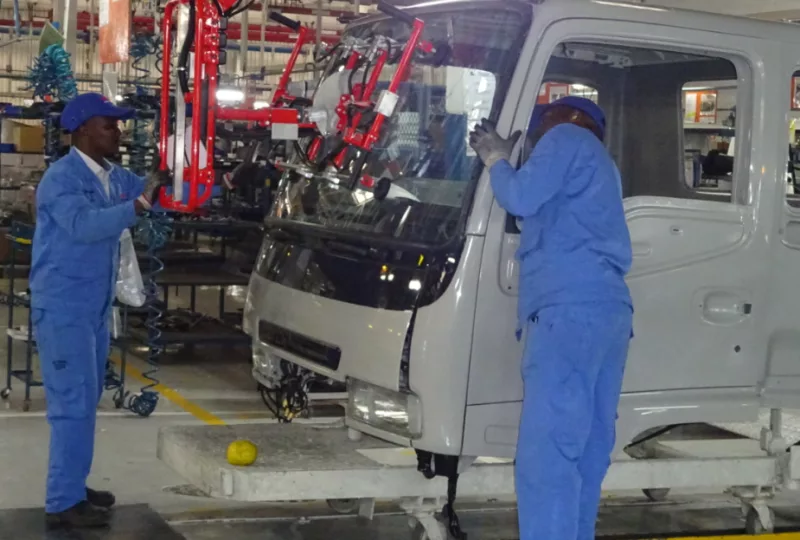
A vibrant economy and falling lending rates revved up up new vehicle sales in the first-half of 2026, to a record 7,819 units in six months.
This is a 23 per cent increase compared to the 6,360 new vehicles (zero-mileage) sold in a similar period last year.
The demand was mainly sustained by demand from the agriculture sector, long-distance and public transport, construction, manufacturing and trade, among others.
Kenya Motor Industry Association (KMIA) data shows trucks, mainly used in transportation and public utilities, wholesale and retail trade, services, manufacturing, construction, agriculture, energy and mining sectors were the most sought type of vehicles.
During the review period, the 11 dealers in the country sold a total of 3,521 units most being taken up locally and a few exports.
This was followed by pickups (both double a single cabin) with 2.095 units being bought from showrooms across the country.
Other notable sales were in buses commonly used in the matatu industry and corporate transport.
Here, 985 new units were sold, with prime movers (heavy-duty, motorised vehicle designed exclusively to pull large semi-trailers) coming in fourth with 547 units sold, depicting demand for trucking business.
“This growth was driven by a resilient economic environment characterised by stable exchange rates, easing interest rates and lower fuel prices,” KMIA said in its monthly update.
Sales were further bolstered by increased economic activity in construction (Affordable Housing, SGR extension to Malaba), road maintenance, and favourable weather conditions for agriculture.
Kenya National Bureau of Statistics latest data indicates in the first quarter of 2026, the economy recorded an improved performance compared to the corresponding quarter of 2025, with stable macroeconomics into the second quarter despite the Middle East war’s impact on economies.
Real GDP grew by 5.3 per cent in the first quarter of 2026 compared to a growth of 4.9 per cent in the corresponding quarter of 2025.
All the sectors of the economy recorded positive growths in the quarter under review, though at varying rates.
Notably, manufacturing sector’s growth accelerated to 4.4 per cent in the first quarter of 2026 compared to 2.8 per cent growth in the same quarter of 2025.
Other sectors that recorded notable growths included accommodation and food service (14.7%), mining and quarrying (9.1%), construction (6.6%), financial and insurance (6.3%), and information and communication (5.0%). Agriculture, forestry and fishing sector expanded by 4.9 per cent.
The Central Bank Rate (CBR) was progressively revised downwards to 9.00 per cent in January 2026 and further to 8.75 per cent in March 2026, which has since been retained, compared to 11.25 per cent in January 2025 and 10.75 per cent in March 2025.
According to the Central Bank of Kenya, growth in commercial banks’ lending to the private sector improved to 9.3 per cent in May 2026, compared to 7.1 per cent in April 2026 and negative 2.9 per cent in January 2025.
“Growth in credit to key sectors of the economy, particularly trade, building and construction, agriculture, and consumer durables remained strong, reflecting improved demand for credit in line with the decline in lending interest rates,” CBK governor Kamau Thugge notes.
According to Isuzu East Africa board chair and managing director Rita Kavashe, last mile distribution of parcels, retail shops and wholesalers cement and construction materials especially on affordable housing cement delivery have been key drivers of new vehicle uptake.
This is in addition to the full recovery of public transport sector from effects of Covid and economic slowdown.
The school curriculum has also stimulated demand for micro and medium buses, mainly for junior schools and kindergarten which are common in estates.
Isuzu retained its market dominance with a 51 per cent share of total sales, followed by CFAO (30.5%) and Simba Corporation (7.9%).
Meanwhile, central bank’s CEOs Survey and Market Perceptions Survey conducted in March 2026 revealed sustained optimism about business activity and economic growth prospects for the next 12 months.
The optimism was attributed to expected favorable weather conditions which are expected to support agriculture, increased infrastructure spending, increased digital innovations, stable exchange rate, and improved private sector credit growth.
Nevertheless, the optimism was moderated by concerns about increased global uncertainties attributed to the conflict in the Middle East, high cost of doing business, inflationary pressures, and low consumer demand.