



The Central Bank has cut Kenya’s economic growth projection for 2026 by 40 basis points, on account of rising global fuel prices due to the ongoing war in the Middle East.
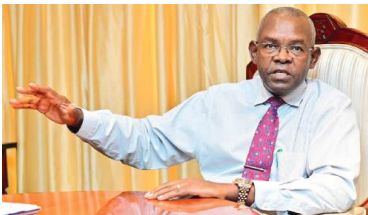
Addressing journalists at a post Monetary Policy Committee (MPC) briefing on Wednesday, Central Bank of Kenya boss, Kamau Thugge, said the economy is expected to expand by 4.9 per cent compared to an earlier projection of 5.3 per cent.
“This outlook is subject to risks, particularly a prolonged conflict in the Middle East, and elevated trade policy uncertainties,’’ Thugge said.
According to him, the conflict in the Middle East has disrupted global supply chains and led to a sharp increase in energy prices and transportation costs, resulting in higher inflation and moderated global growth prospects.
“This is a global phenomenon. World’s growth is projected at 3.1 per cent in 2026, down from 3.4 per cent in 2025, due to the effects of higher inflation and reduced demand arising from higher energy prices and elevated uncertainties.”
He added that elevated trade policy uncertainty and the Russia-Ukraine conflict remain key risks to growth.
The growth of the Kenyan economy moderated to 4.6 per cent in 2025 from 4.7 per cent in 2024, due to a slowdown in the growth of the agriculture and services sectors.
However, growth in the industrial sector recovered strongly, supported by construction. Leading indicators of economic activity point to resilient performance in the first quarter of 2026.
The Central Bank has also asked Kenyans to tighten their belts as it expects inflation to keep rising due to oil price shocks.
He said that this is a global trend, with inflation expected to increase to 4.4 per cent in 2026 from 4.1 per cent in 2025 on account of higher energy prices and transport costs attributed to supply chain disruptions from the Middle East crisis.
He noted that inflation rates in most major economies have increased and remained above their respective targets in recent months, due to elevated energy prices and stickiness in core inflation.
To soften this, central banks in the major economies have remained cautious and kept their policy rates unchanged as they continue to assess the impact of the conflict in the Middle East on their inflation and growth outlooks.
He revealed that this was the major reason why the MPC held Kenya’s base lending rate at 8.75 per cent.
“This is appropriate to ensure that inflation expectations remain anchored within the target range, and the exchange rate remains stable.”
The country’s overall inflation increased to 6.7 per cent in May 2026 from 5.6 per cent in April due to higher energy prices arising from the elevated global oil prices, but remained within the target range of 5±2.5 percent.
Core inflation rose to 3.2 per cent in May from 2.8 per cent in April, mainly driven by higher inflation for transport items, arising from higher fuel prices.
Processed food inflation remained relatively stable, supported by lower prices of sugar and maize products.
Non-core inflation increased sharply to 16 per cent in May from 13.4 per cent in April, on account of higher energy prices, particularly fuel and gas prices.
Additionally, prices of some vegetables, particularly tomatoes and cabbage, remained elevated.
Thugge said that overall inflation is expected to remain within the target range in the near term, assuming a de-escalation of the conflict in the Middle East.
“This will be supported by: appropriate monetary policy actions; government interventions including subsidies and temporary reduction of VAT on fuel; expected stability in food prices due to favourable weather conditions; and a stable exchange rate.”
According to CBK, the majority of respondents to the May 2026 Agriculture Survey expect some upward pressure on inflation in the near term, mainly due to higher energy prices arising from elevated international oil prices attributed to the conflict in the Middle East.
However, respondents expect inflation to remain within the target range in the near term, supported by stable food prices attributed to favourable weather conditions, and stability in the exchange rate.
The CEOs Survey and Market Perceptions Survey conducted in March 2026 revealed sustained optimism about business activity and economic growth prospects for the next 12 months.
The optimism was attributed to expected favourable weather conditions, which are expected to support agriculture, increased infrastructure spending, increased digital innovations, a stable exchange rate, and improved private sector credit growth.
“Nevertheless, the optimism was moderated by concerns about increased global uncertainties attributed to the conflict in the Middle East, high cost of doing business, inflationary pressures, and low consumer demand.”
The current account deficit is estimated at 2.6 per cent of GDP in the 12 months to April 2026, compared to 1.7 per cent of GDP in a similar period in 2025, due to a higher trade deficit, and lower services and secondary income transfers as a share of GDP.
Goods exports increased by 4.2 per cent, driven by horticulture, tea, coffee, food, and machinery and transport equipment. Imports increased by 8.5 percent, reflecting higher imports of food, intermediate and capital goods and mineral fuels.
The deficit is projected at three per cent of GDP in 2026 compared to 2.1 per cent of GDP in 2025, reflecting the higher international oil prices, lower receipts from services, slower growth in remittance inflows, and reduced exports.