


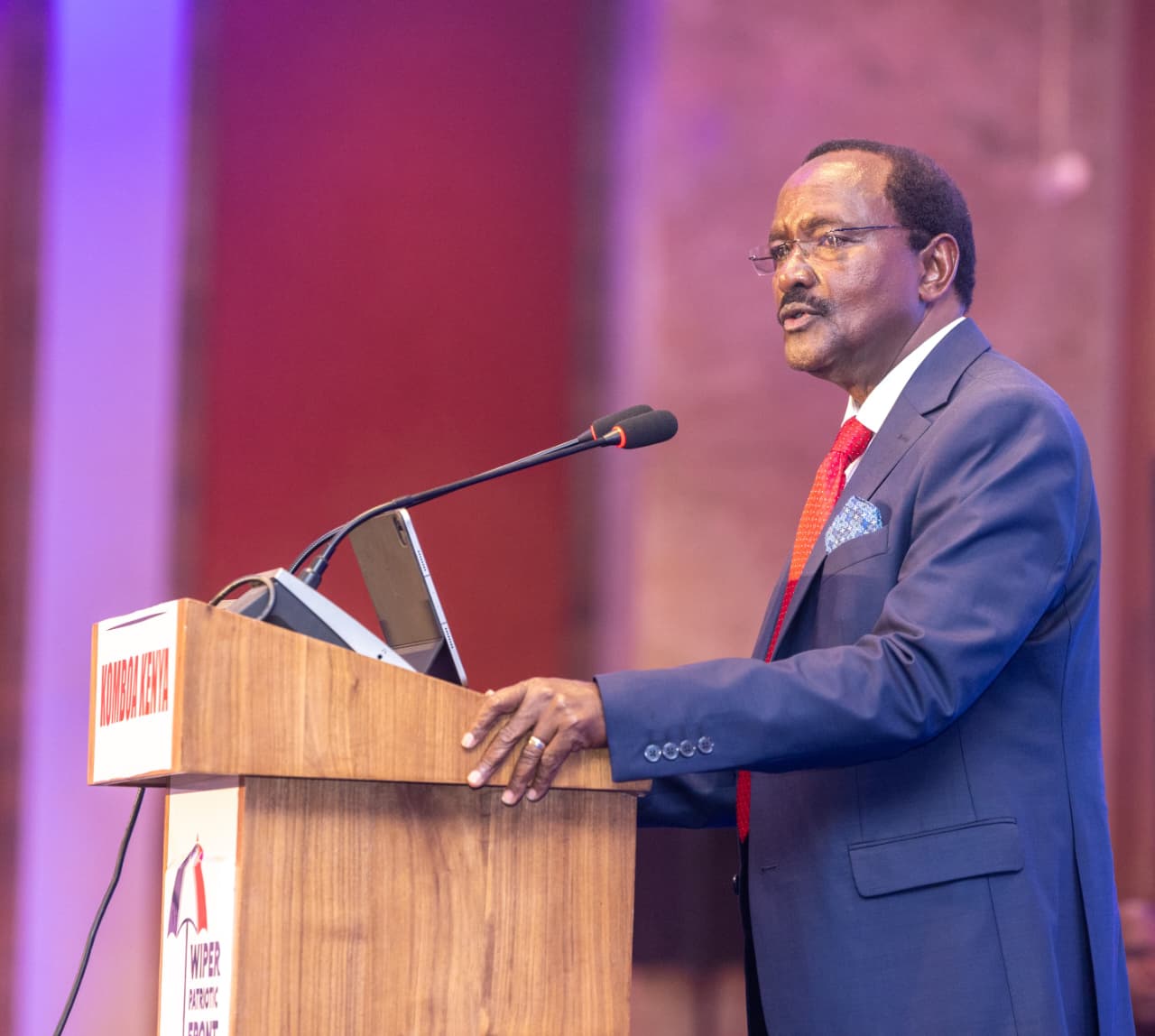
As dusk settled over Nairobi National Park on Saturday evening, Stephen Kalonzo Musyoka stood before supporters and political allies to unveil a campaign website.
Yet the launch of Komboa Kenya was never really about a website.
The platform—part digital archive, part citizen engagement forum, part fundraising engine and part campaign headquarters—was designed to introduce Musyoka’s bid for Kenya’s presidency in 2027. But it also offered something more revealing: a glimpse into how one of the country’s longest-serving political figures intends to present himself to a nation increasingly impatient with traditional politics.
For decades, Musyoka has occupied a distinctive space in Kenya’s public life. He has served as foreign minister, vice president, opposition leader, coalition negotiator and regional peace envoy. He has participated in some of the country’s most consequential political transitions, witnessed constitutional reforms and remained a fixture in national politics through successive administrations.
In an era when political longevity is often treated as a liability, Musyoka is attempting a different argument.
His message is that experience, institutional memory and constitutional fidelity are not relics of a bygone political era but assets Kenya urgently needs.
“This website offers more than information; it offers a glimpse into history,” Musyoka told guests gathered at the launch. Through photographs, campaign memorabilia, policy proposals and personal reflections, the platform chronicles decades of public service while inviting citizens to help shape the future through direct participation.
The symbolism appeared deliberate.
Rather than distancing himself from his political past, Musyoka embraced it. The platform presents his public record not as a chapter that has closed but as a foundation upon which a new political project can be built.
At the same time, the launch reflected an acknowledgement that Kenya itself has changed.
The generation that fought for multiparty democracy and constitutional reforms is gradually sharing the national stage with younger citizens whose political priorities are shaped by economic anxiety, technological connectivity and demands for greater accountability.
Throughout the evening, Musyoka repeatedly returned to the idea of a bridge between those two realities.
He spoke of the sacrifices made by earlier generations, the promise embodied in the Constitution of 2010 and the responsibility of preserving democratic gains. He also invoked the energy of Gen Z, the possibilities of artificial intelligence and the need for continuous dialogue between leaders and citizens.
“This website is a bridge between what previous generations fought for and what our generation must now salvage and build,” he said.
At the heart of Komboa Kenya is an AI-powered engagement system intended to allow citizens to submit concerns, contribute ideas and interact directly with the campaign. Supporters can also make financial contributions through a grassroots fundraising platform that Musyoka described as evidence of a people-powered movement.
The architecture reflects a growing recognition across African politics that voters increasingly expect more than campaign rallies and periodic speeches. They want access, responsiveness and participation.
For Musyoka, however, the platform serves another purpose. It seeks to address one of the defining questions of his candidacy: whether a politician whose career spans decades can still persuade younger voters that he represents the future rather than the past.
The answer may depend less on technology than on trust.
Unlike many of his contemporaries, Musyoka’s public image has long been associated with diplomacy, coalition building and restraint. Supporters view him as a steady hand, an experienced leader who has largely avoided the scandals, political turbulence and personal controversies that have consumed many careers in Kenyan politics.
Critics, meanwhile, have often argued that those same qualities can appear overly cautious in moments that demand urgency and confrontation.
The tension reflects a broader debate unfolding within Kenya itself.
At a time of rising public frustration, economic hardship and growing skepticism toward political institutions, many citizens are demanding dramatic change. Musyoka’s proposition is that meaningful change does not require political chaos.
Again and again during the launch, he returned to themes of constitutionalism, accountability and dignity.
He criticized what he described as the erosion of constitutional norms and argued that Kenya’s challenges stem less from a lack of laws than from a failure to uphold them. Leadership, he suggested, must be measured not by rhetoric but by adherence to principles and institutions.
The evening also moved beyond campaign politics.
Musyoka addressed the recent spate of unrest and tragic fires in Kenyan schools, calling for mandatory safety audits, expanded mental health support and stronger accountability mechanisms for school administrators and public officials.
The remarks underscored a theme running throughout the event: that governance should be judged by how it treats ordinary people.
Whether discussing students, taxpayers or young citizens seeking a voice in public affairs, Musyoka repeatedly framed politics as a matter of dignity.
That emphasis may ultimately prove as important as any policy proposal unveiled during the launch.
As Kenya moves toward the 2027 election, the country faces mounting economic pressures, growing public discontent and a restless electorate searching for credible leadership. Many politicians are attempting to channel anger. Others are promising disruption.
Musyoka is pursuing a different path.
His campaign is built around the proposition that Kenya does not need to choose between experience and renewal, between institutional stability and reform, or between its democratic past and its digital future.
Komboa Kenya, for all its technology and campaign infrastructure, is ultimately an expression of that argument.
It is both an archive and aspiration. A repository of political memory. And an invitation to write the next chapter.