



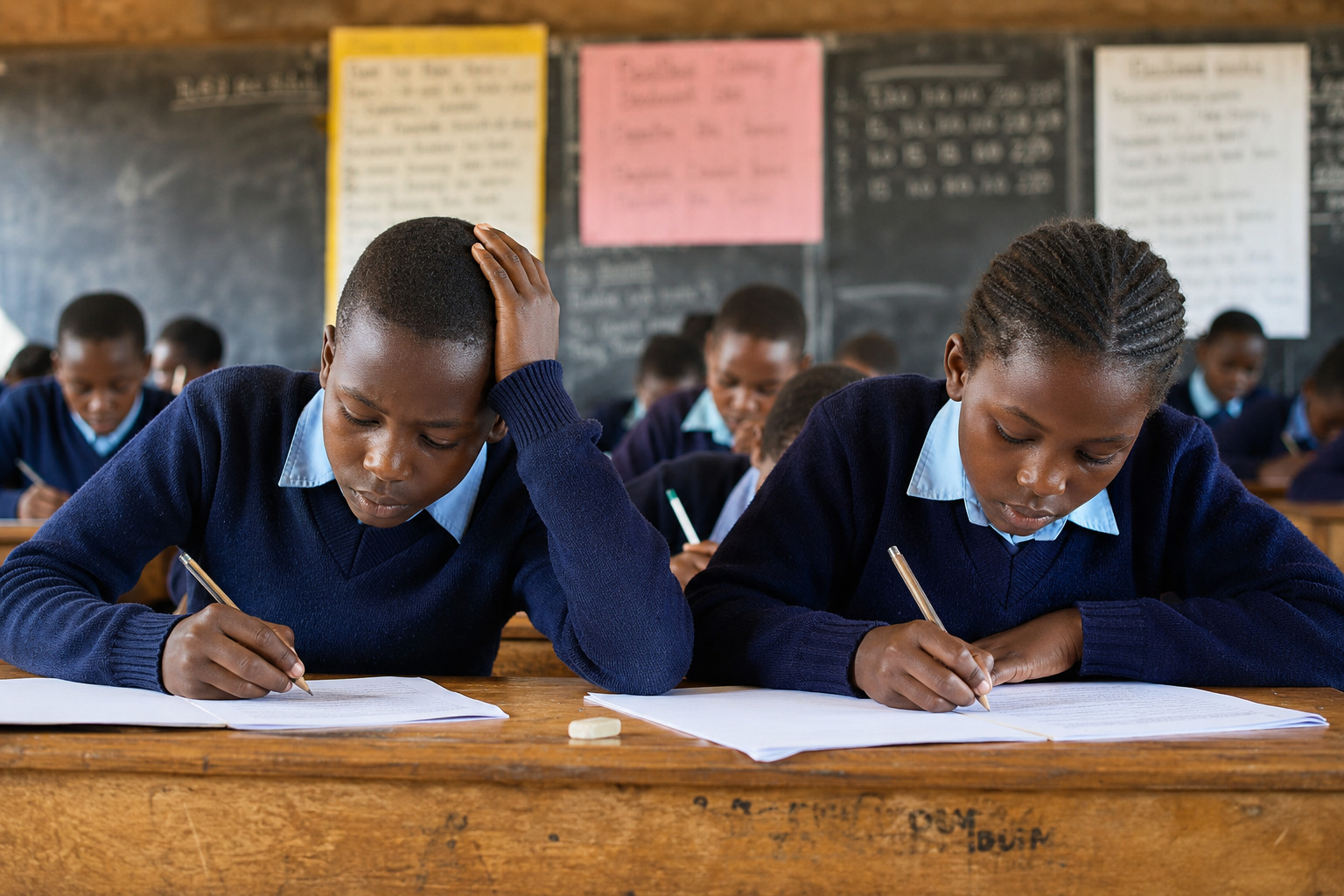
Despite boys being generally better resourced and performing better at the secondary school level, a new survey has found that girls outperform them in foundational literacy and numeracy assessments at the primary level.
The findings by Usawa Agenda show that more boys than girls in Grade 6 are unable to read for comprehension a Grade 3-level English story or solve a Grade 3 numeracy assessment.
Contained in the organisation’s second report on Gender Equality in and through Education in Kenya, the study builds on the findings of the Foundational Literacy and Numeracy Assessment (FLANA) report released in January.
The report comes at a time when national education priorities are evolving, making it critical to examine how gender equality is being addressed through ongoing reforms, policy implementation and sector planning.
According to the report, girls record higher enrolment rates in primary school and consistently outperform boys in foundational learning assessments, even as boys tend to have better access to educational resources later in the system.
The FLANA 2025 survey was conducted in June and July 2025 and assessed 49,835 children aged between 10 and 15 years, both in and out of school, as well as learners in Grades 3 to 9 aged up to 17 years.
The assessment covered 1,527 public and private primary and comprehensive schools with a combined learner population of 1,017,910.
Of these, 530,704 learners were enrolled in primary school, while 340,691 were in junior school.
Researchers evaluated whether Grade 4 and Grade 6 learners completing primary education could read and comprehend a Grade 3-level English story and solve Grade 3-level numeracy tasks.
Nationally, only 19 in 100 Grade 4 boys and 22 in 100 Grade 4 girls were able to complete both the literacy and numeracy tasks, underscoring wider concerns over foundational learning outcomes across the country.
The study also found that girls in private primary schools outperform boys by a wider margin than those in public schools.
However, the trend shifts in refugee communities where boys perform slightly better than girls.
In these areas, 14 in 100 boys and nine in 100 girls were able to read and comprehend a Grade 3 English story and solve a Grade 3 numeracy problem.
Urban schools posted relatively stronger outcomes overall compared to rural schools. Nationally, 31 in 100 Grade 4 learners in urban areas demonstrated proficiency in both literacy and numeracy compared to 28 in 100 learners in rural areas.
“Grade 4 girls outperform their male counterparts across both geographies in English and Mathematics proficiency,” the report states.
In rural schools, 29.2 per cent of girls demonstrated proficiency compared to 27.1 per cent of boys. In urban schools, 31.8 per cent of girls demonstrated proficiency compared to 29.5 per cent of boys.
Among Grade 6 learners in public primary schools, 40.4 per cent of boys were unable to read for comprehension a Grade 3-level English story compared to 33.3 per cent of girls.
The pattern, however, reverses in private and refugee schools. In refugee community schools, nearly half of Grade 6 girls, at 47.5 per cent, were unable to read for comprehension a Grade 3-level English story.
Private schools recorded better outcomes overall, but 27.8 per cent of girls demonstrated lack of proficiency compared to 20 per cent of boys.
The disparity was also evident across rural and urban settings, where boys consistently recorded lower literacy proficiency levels than girls.
In rural schools, 41.6 per cent of boys, compared to 35.9 per cent of girls, were unable to comprehend a Grade 3-level English story.
In urban schools, 31 per cent of boys failed the assessment compared to 26.6 per cent of girls.
The findings are likely to raise fresh concerns over the effectiveness of foundational learning interventions under ongoing education reforms, particularly in public primary schools where literacy and numeracy gaps remain pronounced.
Education stakeholders have increasingly warned that weak foundational skills at lower levels of learning could undermine learner transition, competency acquisition and performance in higher levels of education if not addressed early through targeted support programmes.