


Africa could significantly reduce its growing debt burden if it curbs Illicit Financial Flows (IFFs), a report by the Coalition for Dialogue on Africa has revealed.
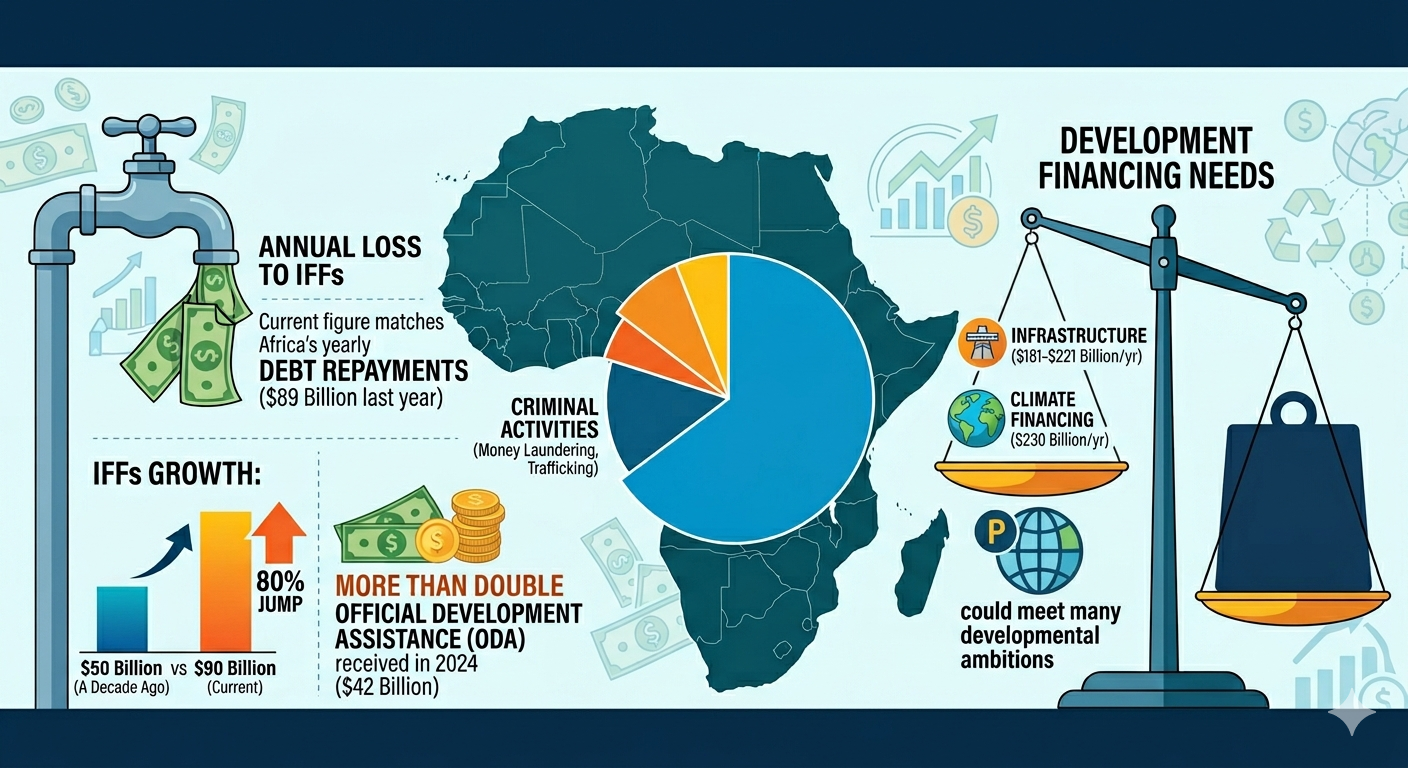
Dubbed the ‘Successes and Challenges of Implementing the Recommendations of African Union High Level Panel on Illicit Financial Flows, an initiative of the African Union, estimates that the continent loses about $90 billion (Sh11.67 trillion) to IFFs every year.
This marks an 80 per cent jump from a decade ago when the annual losses were capped at about $50 billion (Sh6.5 trillion).
Notably, the current figure matches the continent’s yearly debt repayments.
The report estimates that the continent spent about $89 billion (Sh11.54 trillion) on debt servicing last year alone.
Additionally, it reckons that the figure lost to IFFs is more than double the roughly $42 billion (Sh5.45 trillion) the continent received in official development assistance in 2024.
The report attributes the losses mainly to a mix of commercial, criminal, and corrupt activities.
Commercial activities such as transfer pricing, trade mispricing, misinvoicing of services and intangibles, and aggressive tax avoidance account for the largest share of the illicit flows.
These are reinforced by criminal activities including money laundering, human trafficking and drug trafficking, while corruption and abuse of office act as key enablers.
The magnitude of these losses is stark when compared to Africa’s other development financing needs.
The Mo Ibrahim Foundation estimates that the continent requires between $900 billion (Sh116.7 trillion) and $1.3 trillion (Sh168.5 trillion) annually, while the African Development Bank places infrastructure-financing needs at between $181 billion (Sh23.5 trillion) and $221 billion (Sh28.6 trillion) each year.
Climate financing further adds to the pressure, with estimates showing Africa requires about $230 billion (Sh29.8 trillion) annually for adaptation and mitigation.
Overall, the continent faces a financing gap of about $402 billion (Sh52.1 trillion), limiting its ability to drive structural transformation and deliver basic services.
“When contrasted with the fact that Africa loses $90 billion per annum in IFFs, Africa could have met many of its developmental ambitions by putting in place the right legal, policy and institutional responses to contain IFFs.”
The report emphasises that these outflows represent not just lost money but a significant opportunity cost for the continent’s 1.5 billion people.
On efforts to tackle the vice, the report further reckons that despite progress in setting up financial intelligence units, transfer pricing offices and beneficial ownership registers, gaps remain in coordination and enforcement.
It thus calls for stronger continental and national mechanisms, improved data systems, and a unified response to stem illicit flows, noting that effective action could enable Africa to finance its own development sustainably.