




PS State Department of Livestock Development, Jonathan Mueke, De Heus Kenya Livestock Feed, Chairman Co de Heus, Agriculture and Livestock Development CS Mutahi Kagwe and Machakos Governor Wavinya Ndeti during the official launch of De Heus Kenya Livestock Feed Factory in Athi River, Machakos County./HANDOUT.
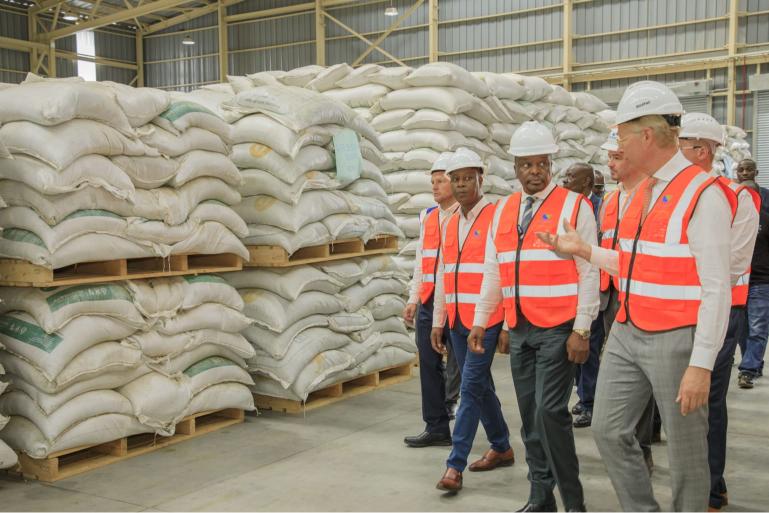
De Heus Kenya Livestock Feed Chairman, Co de Heus, takes Cabinet Secretary of Agriculture and Livestock Development Mutahi Kagwe, and PS State Department of Livestock Development Jonathan Mueke for a tour of the factory during the official launch of the factory in Athi River./HANDOUT.
Farmers may soon face higher animal feed costs as shortages of key raw materials threaten to push prices up.
Dairy and poultry farmers could be forced to dig deeper into their pockets as industry players warn that feed prices may rise due to the limited availability of essential ingredients.
Without intervention to ease maize supply and stabilise costs, farmers risk even higher production expenses.
“When dairy meal goes up, everything collapses,” said Jane Wanjiru, a smallholder dairy farmer in Githunguri, Kiambu county.
“I have reduced the amount of concentrate feed I give my cows and increased napier grass and silage to cope. Milk output has dropped, but I cannot afford the current prices.”
Wanjiru said she now plants more fodder and preserves silage because only those who grow their own feed will survive if prices continue to rise.
In Eldoret, poultry farmer Peter Kiptoo has cut his flock by nearly a third. “Layers mash is now too expensive. I’m mixing my own rations using maize germ and sunflower cake when I can find them,” he said.
“But even these ingredients are scarce and costly. We need affordable feed and reliable quality because without that, livestock farming becomes too risky.”
Feed millers have warned that prices could rise further in the coming months due to shortages of maize and other by-products used in feed manufacturing.
According to the Association of Kenya Feed Manufacturers (AKEFEMA), maize germ, soybean meal, canola and sunflower cake, which are key protein and energy sources in livestock feeds, are becoming scarce.
Currently, a 70-kilogramme bag of dairy or layers feed averages about Sh3,500, though prices vary by brand and region.
Feed millers warn that raw material shortages could push prices higher if imports remain costly and local supply remains constrained.
Kenya relies heavily on maize and oilseed by-products from local milling industries, while soybean meal is largely imported. Fluctuating global prices and foreign exchange costs continue to affect availability and pricing.
According to the Kenya National Bureau of Statistics, animal feeds and fodder prices rose significantly between 2022 and 2024, mainly due to rising maize costs and the impact of drought.
Feed accounts for 60–70 per cent of livestock production costs, making price increases especially painful for farmers.
The concerns come as Agriculture and Livestock Development Cabinet Secretary Mutahi Kagwe commissioned a new Sh3 billion animal feed manufacturing facility in Athi River, Machakos county.
The Athi River plant has an annual capacity of 240,000 tonnes. It incorporates laboratory testing, automated production systems and batch verification to ensure consistency.
De Heus Kenya managing director Wiehan Visagie said the factory aims to rebuild farmer confidence.
“For too long, feed has felt like a gamble,” he said. “We are committed to delivering consistent nutrition backed by laboratory testing and technical support to farmers.”
Kagwe said Kenya aims to double annual milk production from 5.2 billion litres to 10 billion litres while positioning itself as a net exporter of livestock and meat products.
“We will not achieve this by merely increasing the number of cows. We will achieve it by increasing productivity per animal. The future of Kenya’s dairy and meat sector lies in efficiency, nutrition, genetics, animal health and, most critically, quality feed,” he said.
The commissioning of the new De Heus Animal Nutrition facility comes at a time when the feed industry faces increased scrutiny.
Farmers have raised concerns over inconsistent formulations, diluted products and fluctuating performance between batches.
To address this, Kagwe said the government will strengthen enforcement and introduce a feed quality index to protect farmers.
“Substandard formulations designed to maximise profits at the expense of productivity will not be tolerated,” he said. “Farmers must get value for their money.”
He added that government reforms are running parallel to private investment to address feed raw material shortages.
Under the Land Commercialisation Initiative, Kenya is planning to expand structured production of yellow maize and soybeans, key feed ingredients, on government land, while integrating smallholder farmers through contract farming.
“The government is also constructing 50 dams to expand irrigation and reduce reliance on rain-fed agriculture. Feed security must be localised. Kenya must reduce dependence on imports,” Kagwe said.
County governments are also being encouraged to establish feed reserves to cushion farmers during drought periods.
Kenya is Africa’s second-largest milk producer after Egypt, according to the Food and Agriculture Organization, and demand for dairy and meat products continues to grow domestically and regionally.
The CS noted that modern feed formulation improves milk yield, enhances butterfat and protein levels, strengthens immunity and improves fertility. These are key factors in productivity and export competitiveness.
Kagwe said Kenya is moving towards quality-based milk pricing, where farmers producing higher butterfat and protein content will earn better prices.
De Heus Kenya board chairman Co de Heus said the presence of the new factory will also create new demand for farmers who grow local crops such as maize and soybeans.
“We look forward to cooperating with them and their organisations. We are confident we can deliver a major contribution to boosting the efficiency and productivity of local poultry, dairy, pig, sheep, goat and beef farmers, lowering their costs and increasing their incomes,” he added.