



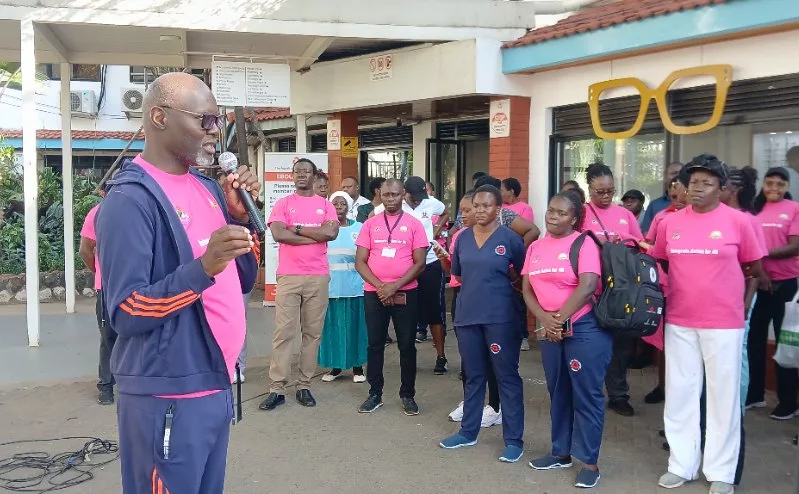
Kisumu has expanded its capacity to detect and treat breast cancer, but only 12 per cent of women of reproductive age have undergone a breast examination.
Health authorities say the trend has exposed a worrying gap between available services and their uptake.
The figure, from a 2022 survey, has renewed calls for breast screening to be integrated into routine healthcare given more than 75 per cent of breast cancer patients in Kenya are diagnosed at advanced stages.
Kisumu health CEC Gregory Ganda said the findings of the 2022 survey showed a major gap in breast cancer screening, with uptake significantly lower than that of cervical cancer screening.
“When we look at the KDS survey, which was done in Kisumu in 2022, we found that only 12 per cent of women of reproductive age had ever been examined for breast cancer,” Ganda said.
He said about 25 per cent of women had undergone cervical cancer screening, meaning more women were accessing cervical screening than even basic breast examinations.
“We have twice as many women who have cervical cancer screening than those who have just a normal breast examination,” he said.
Ganda spoke during a breast cancer awareness walk organised by Aga Khan Hospital in conjunction with the Kisumu county government, where health stakeholders called for greater emphasis on early detection.
Dr. Alfred Mayani, the consultant oncologist at Aga Khan Hospital Kisumu, said breast cancer is the most common cancer among women, with about 7,000 cases diagnosed annually in Kenya.
More than 75 per cent of patients are diagnosed at Stage Three or Four, when treatment becomes more difficult with little chances of success.
“The main problem is not even about diagnosis. It is about at what stage these patients are being diagnosed,” Mayani said
Ganda said the situation was concerning because breast cancer can be detected through screening before it advances.
“We know that when we detect cancer early, we are able to treat it early and our outcomes are much better than if we discover it later,” he said.
The county has invested in improving its ability to manage breast cancer, raising the question of how to get more residents to use the available services.
Kisumu now has two mammography machines, while the county has also increased the number of breast surgeons, oncologists, sonographers and specialised pathologists.
“A few years ago I was the only oncologist, then we were two, now I think we are six,” Ganda said.
He said the county previously lacked mammography equipment and specialised personnel for some breast cancer services, but this capacity has since improved.
“Our capacity has improved and so we need to now get our people to come so that they benefit from all this capacity that we have created over time,” he said.
Ganda encouraged women aged 40 and above to consider mammography, saying regular screening could help detect disease before it spreads.
He also called for breast screening to be incorporated into other health services rather than treating it as a stand-alone activity.
“When we do cervical cancer screening, let us also incorporate the breast,” he said.
Dr. Simon Onsongo, medical director at Aga Khan Hospital Kisumu, reinforced this approach, noting that every health facility visit should serve as an opportunity for early detection.
“We want to encourage everyone, from all corners of this county and the country at large, to come forward and be screened for cancer,” Onsongo said.
He said the hospital will continue working with the county government and other stakeholders to support cancer screening and treatment.
The hospital also highlighted the role of the Social Health Authority (SHA) in helping patients access treatment, diagnostics and medicines.
For cancer survivor Laura Akinyi, the consequences of discovering breast cancer late are not merely statistics.
Akinyi, who was diagnosed with Stage Three breast cancer said treatment was physically and emotionally demanding.
“Though I was found at a later stage, Stage Three, I went through my treatment with a lot of struggle, especially with the side effects,” she said.
She said chemotherapy left her weak and affected her appetite, making it difficult to maintain the strength required to continue with treatment.
“Because chemo shuts down your whole system, it becomes very hectic. You are always told to eat well and sleep well, but again, chemo takes away all the appetite and the strength,” she said.
Akinyi urged women not to ignore unusual changes or allow fear to keep them away from screening.
“Actually, always go for testing,” she said.
She said discovering cancer while it is still at an early stage gives patients a better opportunity to receive timely treatment.
Health officials said Kisumu is also seeking to integrate screening into its wider wellness programme, including through digital health platforms that can remind residents about services recommended according to their age and risk factors.
Ganda said the county’s long-term goal is to shift from treating disease after it becomes advanced to identifying health risks and conditions earlier.
“That is what we are aiming towards so that we move away from illness to wellness, from late detection to early detection,” he said.
Women attending the awareness event were also offered free breast ultrasound screening as health stakeholders sought to translate the awareness campaign into actual screening.