



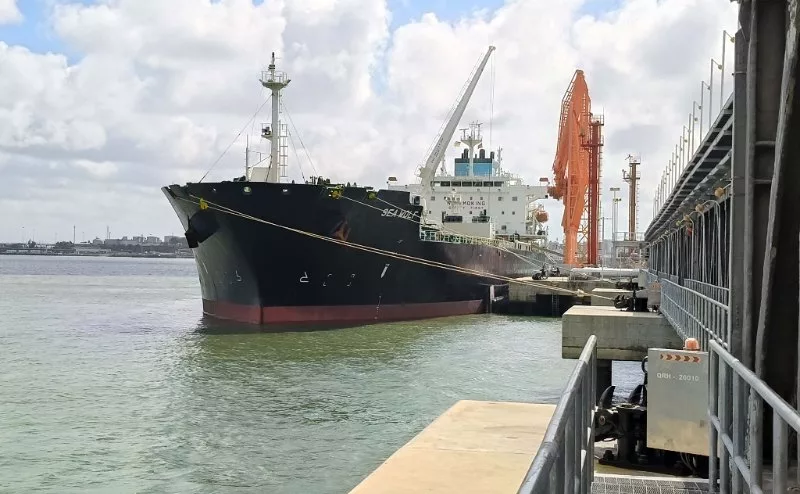
Kenya has officially activated the transit route for Rwandan petroleum imports.
Under a new energy cooperation framework expected to yield mutual economic benefits for both East African Community (EAC) member states, Rwanda will import refined petroleum products via the Port of Mombasa through the Rwanda National Energy Company (RNEC).
Senior Kenyan and Rwandan officials gathered at the Kipevu Oil Terminal 2 (KOT2) to receive a maiden 40,000-tonne consignment of diesel and petrol.
The delegation was led by Energy and Petroleum CS Opiyo Wandayi and his Rwandan counterpart, Armand Zingiro. They were joined by Kenya Ports Authority managing director Captain William Ruto and Kenya Pipeline Company acting managing director Pius Mwendwa.
Wandayi said Kenya is fully prepared to serve as Rwanda’s gateway to the global energy market and the primary transit corridor for its petroleum imports.
“This is a vote of confidence, not just in a pipeline or a port, but in Kenya as a nation, in our institutions, in our regulatory environment, and in our ability to deliver on our word,” the CS said.
He said Kenya would provide a secure transit environment guaranteeing the long-term reliability of bulk refined product supplies.
Wandayi emphasised that fuel security is a shared regional concern, noting that Kenya’s commitment aligns with broader EAC integration objectives.
He said a predictable supply of petroleum products to Rwanda supports commerce, industry and livelihoods across the EAC, thereby strengthening all member states.
“We can no longer afford to operate in silos. As member states of the EAC, it behoves all of us to work closely with one another and operate in unison to reap the fruits of cooperation,” Wandayi said.
He said Kenya will soon handle refined products from the Lamu refinery.
The bilateral agreement on the bulk importation of refined petroleum products for Rwanda was formally signed on June 29.
Zingiro observed that market instabilities occurring far beyond regional borders are swiftly felt by consumers at local fuel pumps.
He said the Rwandan government is deliberately diversifying its import corridors to safeguard supply resilience as a landlocked country.
The minister said the cooperation framework enables Rwanda to build its national fuel reserves, complemented by ongoing expansions of domestic storage capacity.
“The storage terms Kenya has offered us provide further operational flexibility while that capacity comes on stream,” Zingiro said.
He reassured Rwandans of a stable fuel supply, noting that Rwanda has directly invested in KPC following its listing on the Nairobi Securities Exchange.
Captain Ruto described the event as a landmark moment for both the KPA and the broader EAC, noting three vessels docked simultaneously at KOT2 to discharge fuel products designated for Kenya, Uganda and Rwanda.
“All the ships are carrying different petroleum products. Ours is carrying jet fuel, Uganda’s is carrying AGO [Automotive Gas Oil, or diesel], and Rwanda’s is carrying AGO and PMS [Premium Motor Spirit, or petrol],” he said.
Captain Ruto highlighted KPA’s role in facilitating regional trade, noting recent major operational milestones across KPA-managed ports.
“For our Lokichar crude oil project, we have a ship in port offloading rigs. On Saturday, we welcomed a vessel for Dangote, which was offloading project cargo and equipment for the construction of the Dangote oil refinery in Lamu,” he said.
Captain Ruto said the Sh40 billion KOT2 facility, commissioned in 2022 by former President Uhuru Kenyatta, can handle four vessels simultaneously, unlike the legacy KOT1 terminal, which handles only one vessel at a time.
“Today, we are able to handle three ships simultaneously, with our fourth berth reserved for future expansion,” he said, noting the increased capacity significantly lowers operational costs and enhances maritime efficiency.
The MT Sea Wolf, which carried the maiden Rwandan consignment, arrived at the Port of Mombasa at 6am on Tuesday and docked immediately upon arrival. The vessel is expected to complete discharge within 15 to 20 hours.
KPC’s Mwendwa affirmed the company’s readiness to support the framework.
“Our pipelines, our depots, and our staff stand ready,” he said.
He said KPC has invested heavily in its 1,342-kilometre pipeline network, which has an annual throughput capacity of about 14 billion litres.
KPC maintains 1.138 billion litres of storage capacity nationwide, with 63 per cent located in Mombasa and the remainder distributed across depots in Nairobi, Nakuru, Eldoret and Kisumu.
“From Mombasa, we pump the product to upcountry destinations for onward road conveyance,” Mwendwa said.
He highlighted that KPC also operates a marine loading facility at the Kisumu Oil Jetty, offering a cost-effective waterborne route towards Rwanda via Uganda.
For nearly a decade, the majority of Rwanda’s fuel was transported via the Central Corridor, with Kenya’s Northern Corridor handling barely 10 per cent of that market.
Under the new framework, Rwanda-bound transit volumes through Kenya are projected to grow from roughly 60,000 cubic metres to 600,000 cubic metres annually, according to Mwendwa.
He said the collaboration aims to scale up trade not only between Kenya and Rwanda, but across the entire EAC block, noting that KPC is currently constructing an additional 30,000-cubic-metre storage facility in Western Kenya to enhance operational delivery.