![Six Kenyan Creatives Win Sh4.5M in Capture the Good Challenge [Details]](https://www.breakingkenyanews.com/wp-content/uploads/2026/09/cfbe48b2-fc56-43e3-93d4-3a1de9043bf5-300x200.webp)

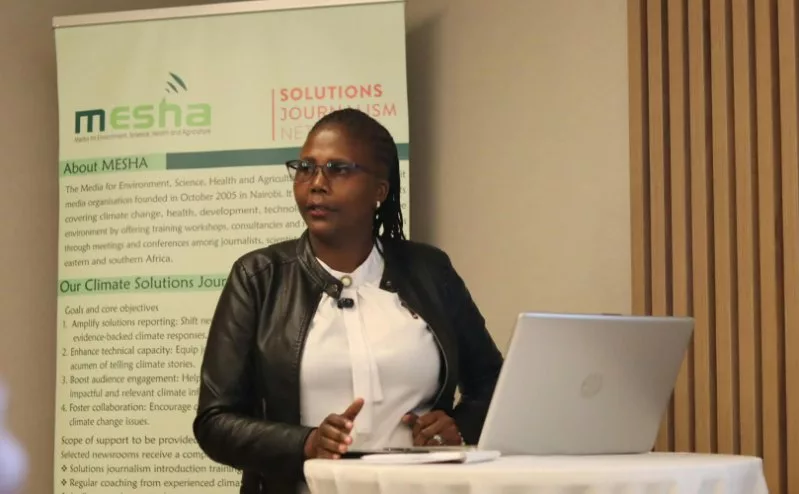
Journalists have been urged to change how they cover climate-related disasters by moving beyond reporting deaths, destruction and emergency response to examining preparedness, early warnings, solutions and accountability.
Climate scientist Christine Maswi of the Kenya Meteorological Service Authority said journalists often arrive when disasters have already happened and leave before examining why communities were exposed and what can be done to reduce future risks.
Maswi was speaking to editors and journalists from different African countries attending the Climate Beacons Newsroom Initiative inception meeting in Nairobi.
The initiative is being implemented by the Media for Environment, Science, Health and Agriculture (MESHA) in partnership with the Solutions Journalism Network (SJN).
Her presentation, titled “From disaster reporting to evidence-based climate solutions,” focused on how newsrooms can strengthen coverage ahead of and during the October-December rains.
Maswi said the approach should be particularly important as journalists prepare to cover the enhanced October-December 2026 rainfall season.
The Kenya Meteorological Service Authority has forecast above-average rainfall over about 80 per cent of the country during the season, with prolonged wet spells and occasional isolated storms expected in several areas.
The forecast also points to possible risks including flash floods, waterlogging, landslides and damage to infrastructure in vulnerable areas.
But Maswi said the forecast itself should not be the end of the story.
Instead, journalists should ask what the forecast means for people living in areas exposed to floods and other climate risks.
“The media captures the current event, and it clears very fast, when something else comes, the journalist moves there,” she said.
According to Maswi, this tendency leaves important questions unanswered.
She said journalists should investigate whether communities were vulnerable, whether forecasts and warnings were issued, whether the warnings reached the people at risk and whether communities understood what action they needed to take.
They should also examine whether infrastructure and institutions were prepared and what needs to change before the next event.
“A disaster is an event, climate risk is a continuing story,” Maswi said.
Follow the story before and after the disaster
Maswi said a climate story should not begin when floodwaters enter homes or when drought has already killed livestock.
It can start with a prediction and continue through preparedness, the experience of affected communities, responses, solutions and accountability.
She said journalists should connect these stages rather than treating each disaster as an isolated event.
Among the questions journalists should ask, she said, are: What did the forecast say? Who was exposed? Was infrastructure prepared? What action was taken? What reduced the risk? And what should be done differently in future?
This approach would also give newsrooms opportunities to produce stories before disasters happen.
Rather than waiting for casualties, journalists should examine preparedness measures in flood-prone communities, the effectiveness of early-warning systems, evacuation plans, drainage infrastructure, shelters and communication channels.
They can also follow up after an event to establish whether promised interventions were implemented and whether communities became safer.
Maswi said governance and finance should therefore form part of climate reporting.
Journalists should investigate who is responsible for preparing communities, what resources have been allocated and whether the resources are being used for their intended purpose.
The focus, she said, should not only be on the occurrence of a disaster but also on the systems that determine how communities experience it.
Warnings must reach vulnerable communities
Maswi placed particular emphasis on early warning and communication.
She said meteorological agencies can provide forecasts, but the information has limited value if it does not reach people who need to act on it.
“I can give proper forecast and prediction, but due to lack of proper preparations, including communicating to the vulnerable, a disaster strikes and gets many unaware,” she said.
The challenge, according to Maswi, is therefore not simply whether a forecast exists.
It is also whether the warning reaches the right people, in a form they understand, early enough for them to take action.
She cited flash floods in Tana River as an example of the type of risk that journalists should understand better.
Newsrooms, she said, need to understand the relationship between rainfall in one location and flooding downstream, including the risks faced by communities living in low-lying areas.
This requires journalists to develop what she described as risk knowledge.
Instead of simply reporting that heavy rains have fallen, journalists should explain where the water is likely to move, which communities are exposed, what infrastructure is vulnerable and what residents can do to protect themselves.
The Kenya Meteorological Department says its seasonal forecasts are designed to support planning and preparedness across sectors including agriculture, health, water, energy, disaster management and transport. It also provides county-level forecasts intended to support local planning and response.
This creates an opportunity for journalists to translate technical forecasts into information that ordinary people can use.
From technical forecast to public information
Maswi said journalists should make meteorological information easier for communities to understand.
The key questions should be: What does the forecast mean? Who is at risk? What action needs to be taken? And who should take that action?
This would require journalists to go beyond reproducing technical statements from meteorologists.
For example, a forecast of above-average rainfall should prompt questions about the areas likely to experience flooding, the state of roads and bridges, drainage systems, schools, health facilities and settlements located in vulnerable areas.
It should also prompt questions about whether county governments and other responsible agencies have acted on the forecast.
The World Bank has previously identified floods and droughts as among Kenya’s most significant and recurring disaster risks.
Its Kenya disaster risk profile estimated that about 150,000 people are affected by flooding each year on average, while drought affects millions.
More recent World Bank work also identifies Kenya as highly exposed to climate risks, including floods, drought and high temperatures, with the Lake Victoria Basin, Rift Valley, Tana River Delta, low-lying coastal areas and parts of northern and north-eastern Kenya among areas exposed to flooding risks.
For journalists, such information can provide context for individual disaster stories.
It can help explain why a particular community is vulnerable and whether the vulnerability can be reduced.
Why people may ignore weather warnings
Maswi also challenged journalists to examine the relationship between forecasts and public trust.
She said some members of the public do not take meteorologists seriously and may dismiss forecasts as inaccurate.
She said journalists therefore have a role in helping communities understand meteorological information and its relevance to their daily decisions.
Rather than only quoting a meteorologist after a disaster, journalists can follow forecasts over time.
They can examine what was predicted, what happened, how communities responded and what lessons can be drawn.
Such reporting can also help identify where communication breaks down.
A forecast may be scientifically sound but fail to protect people if the information does not reach them, reaches them too late or is not communicated in a way that is useful to them.
Kenya is also developing new ways of taking forecasts closer to users. In September, the meteorological service announced a Forecast-to-Farmer pilot that will provide more localised four-week weather outlooks and link forecast information to practical agricultural advice through established communication networks.
This kind of development provides another potential area for journalists to investigate.
They can ask whether the information reaches farmers, how farmers use it, what decisions they make from it and whether the system improves preparedness.
Solutions should be backed by evidence
Maswi said solutions journalism does not mean reducing coverage of disasters.
Instead, it means producing better journalism before, during and after disasters.
“The goal is not less disaster journalism, it is better journalism before, during and after disaster,” she said.
She challenged journalists to identify and examine responses that reduce climate risks.
This could include community preparedness systems, improved warning mechanisms, flood-resistant infrastructure, better land-use planning, water management, climate-smart agriculture or locally developed adaptation measures.
But such interventions should not simply be presented as solutions because authorities, organisations or communities describe them as such.
Journalists should examine evidence showing whether they work, who benefits, what challenges they face and whether they can be replicated elsewhere.
For Maswi, accountability is an important part of continuing a climate story.
If a forecast warned of a risk, journalists should be able to return to the same community after the event and examine what happened.
They should ask whether warnings were received, whether people acted on them and whether government agencies fulfilled their responsibilities.
If a flood-control project was announced, journalists should follow up to establish whether it was completed and whether it reduced flooding.
If a community preparedness programme was introduced, journalists should examine how it works, whether residents participate and what evidence exists of its impact.
This creates journalism that goes beyond documenting suffering.
It also gives communities information that can help them understand risks and possible responses.
Maswi said the media should therefore resist the tendency to treat climate disasters as short-lived news events.
“Climate story should not end with disaster; it should continue into risk, response, solutions, evidence and accountability,” she said.
This is central to the solutions journalism approach being promoted through the Climate Beacons Newsroom Initiative.
According to MESHA, the programme was created to help newsrooms move from problem-focused climate reporting towards reporting evidence-based responses to climate challenges.
Six newsrooms from five African countries were selected from 133 applications for the inaugural programme.
They include The Star/Radio Africa Group from Kenya, Water Journalists Africa and Media Challenge Initiative from Uganda, Social Voices from Nigeria, Habitat Media from Tanzania and Zodiak Broadcasting Station from Malawi.
The seven-month programme includes solutions journalism training, coaching, audience and community engagement training and impact tracking.
MESHA chief executive officer Aghan Daniel said the initiative seeks to strengthen climate reporting while shifting coverage towards evidence-based responses.
“The initiative brings together newsrooms from across English-speaking Africa to strengthen climate reporting, deepen newsroom capacity and shift coverage beyond problem-focused reporting towards evidence-based responses to climate challenges,” Daniel said.
SJN Africa Initiative Manager Caroline Karobia said the partnership would support newsrooms to regularly produce climate solutions stories that highlight responses that are credible, replicable and actionable.


![Six Kenyan Creatives Win Sh4.5M in Capture the Good Challenge [Details]](https://www.breakingkenyanews.com/wp-content/uploads/2026/09/cfbe48b2-fc56-43e3-93d4-3a1de9043bf5-768x512.webp)