![Six Kenyan Creatives Win Sh4.5M in Capture the Good Challenge [Details]](https://www.breakingkenyanews.com/wp-content/uploads/2026/09/cfbe48b2-fc56-43e3-93d4-3a1de9043bf5-300x200.webp)

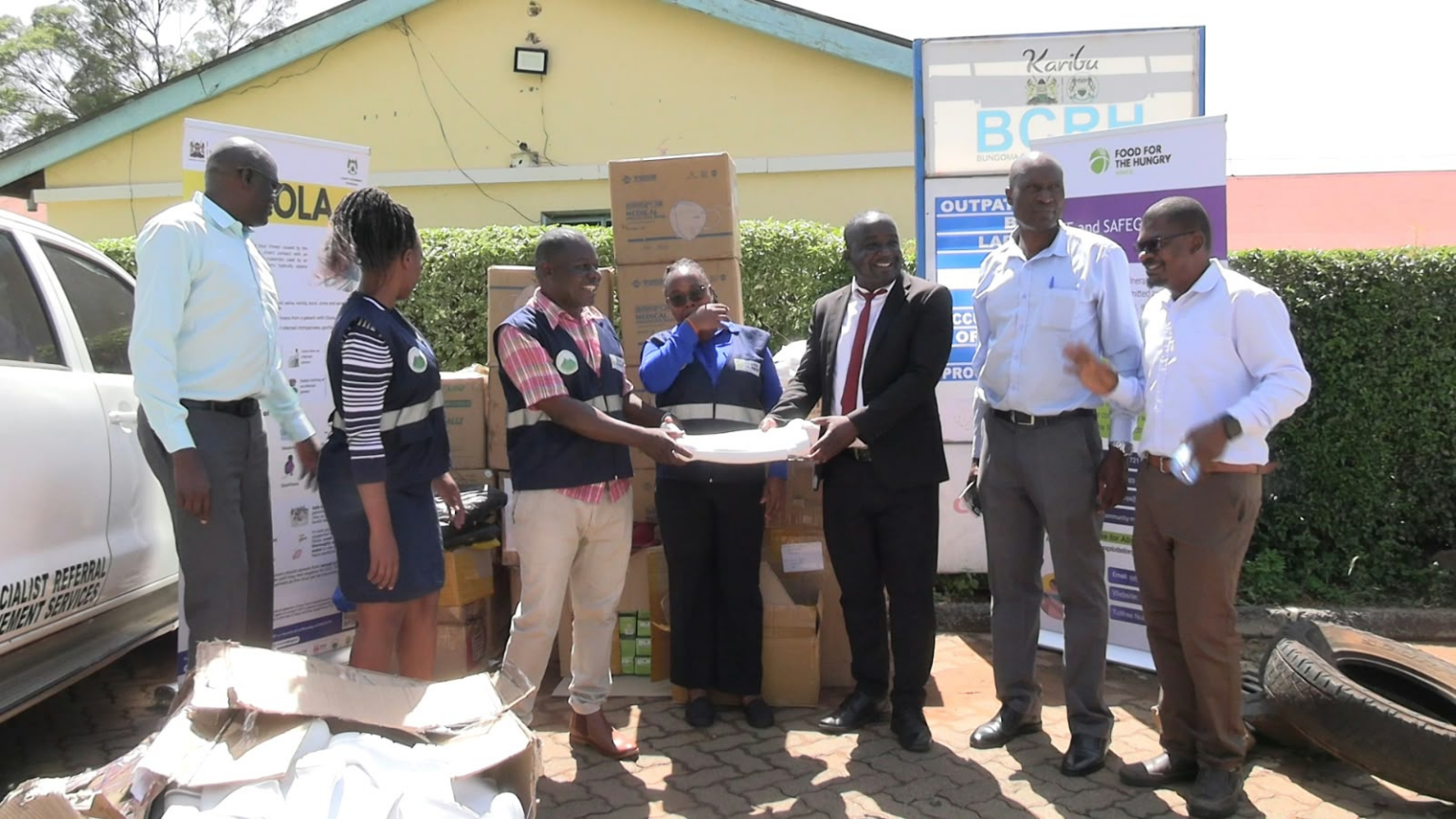
Bungoma County has received a consignment of personal protective equipment (PPEs) to strengthen its preparedness and response capacity against a possible Ebola outbreak.
The PPEs were received at Bungoma County Referral Hospital (BCRH) by the County Director for Health and Sanitation, Dr. Caleb Watta, during an event attended by health officials and representatives of Food for the Hungry which donated the equipment.
Speaking to the press at the facility, Dr. Watta said the donation forms part of the county’s preparedness measures to prevent and contain the spread of Ebola, particularly given Bungoma’s proximity to Uganda.
He commended Food for the Hungry for supporting the county not only with protective equipment but also with capacity building for healthcare workers, community health promoters (CHPs) and members of the public on Ebola prevention and preparedness.
“Given that Bungoma is one of the high-risk counties, this support is very key in sensitizing the community, community health promoters and healthcare providers on Ebola,” Dr. Watta said.
The consignment includes gloves, gumboots, facemasks and other protective equipment intended to help frontline health workers protect themselves while responding to suspected cases.
Dr. Watta said the equipment would be distributed to health facilities across the county, with part of the consignment being reserved for points of entry where screening and surveillance activities are ongoing.
“These PPEs will be distributed to health facilities within Bungoma, with some taken to our points of entry,” he said.
He added that the county had continued to strengthen screening and surveillance at its points of entry as part of efforts to detect and contain any suspected Ebola cases before the virus could spread within the community.
Watta noted that Bungoma has not recorded any confirmed Ebola case, although the county has previously handled travellers arriving from countries affected by Ebola outbreaks.
“So far, Bungoma has not recorded any Ebola case, but we have had suspects who travelled from Ebola-affected countries. Those who travelled from those countries were tested and they turned out to be negative,” he said.
He said continued surveillance, early detection and adequate protection of healthcare workers remained critical in preventing the spread of the virus.
Emmanuel Were, Director of Programmes at Food for Hungary’s Bungoma Ebola response programme, said the organization decided to support Bungoma because of the county’s proximity to Uganda, which makes preparedness particularly important.
Were said the organization is implementing a three-month Ebola response project in the region focusing on strengthening awareness and preparedness among communities and frontline institutions.
He said the programme targets communities, institutions, healthcare providers and CHPs, who play an important role in disease surveillance, public awareness and linking households to health facilities.
“We are focusing on sensitizing the community, institutions, healthcare providers and community health promoters because Ebola is not yet over,” Were said.
He noted that the Democratic Republic of Congo (DRC) continues to face Ebola outbreaks, making it necessary for neighbouring countries to maintain high levels of preparedness and vigilance.
“Ebola is not yet over. DRC Congo is still battling the dangerous outbreak. Even Uganda lost healthcare providers because they were not fully prepared to handle the cases. That is why, as an organization, we have taken up this mandate to ensure that our community understands the disease and knows how to prevent its spread,” he said.
Were said the availability of PPEs was particularly important in protecting healthcare workers, who are often among the first people exposed when dealing with suspected infectious disease cases.
He said the organization would continue working with county health authorities and communities to strengthen awareness, preparedness and response mechanisms.


![Six Kenyan Creatives Win Sh4.5M in Capture the Good Challenge [Details]](https://www.breakingkenyanews.com/wp-content/uploads/2026/09/cfbe48b2-fc56-43e3-93d4-3a1de9043bf5-768x512.webp)