



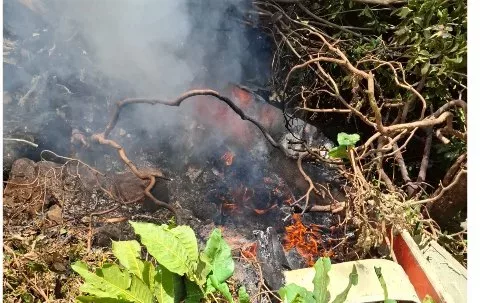
The helicopter that crashed at Mount Ololokwe in Samburu County, killing all seven people on board, struck a rock formation near the summit while conducting a low-level flight close to the cliff face, a preliminary report released by the Aircraft Accident Investigation Department (AAID) on Friday says.
The helicopter crashed at about 9:13 am on August 19, 2026, descending the mountainside and over a cliff before hitting the ground.
As a result, it was destroyed by the impact and a post-crash fire.
“First responders accessed the hilly crash site and located the burning wreckage. Tragically, all seven occupants suffered fatal injuries. The helicopter was destroyed by impact forces and post-crash fire,” a statement said.
The victims included the pilot Josh Outram, former Ecuadorian Chief of Intelligence Michele Sensi Contugi, his wife, Stephany Holihan, Roger Edward Duarte, José Alberto Suárez, Adam Hlavaty and Henry Parra.
Ground marks consistent with an impact by the landing gear skid were identified at the scene.
The bodies of the victims were flown to their countries for burial.
Following the ground contact, the helicopter likely tumbled down the steep slope and fell over the cliff.
There were two distinct wreckage sites: one on the steep slope, the point of impact, covering an area of approximately 25m by 50m, and another at the base of the cliff, the main crash site, measuring approximately 25m by 15m, the report says.
A landing gear skid, door gas strut and the left cargo door were recovered 1m, 6m and 40m, respectively, from the point of impact.
Paint transfers left on the rocks indicated that the fuselage impacted the terrain while sliding down the slope.
Furthermore, debris patterns and strike marks on the surrounding vegetation and rocks indicated that the main rotor had struck the ground.
Some parts, including the sliding door, dummy door and a landing gear skid, were moved to a central place at the top of the mountain by local first responders.
The remaining wreckage fell down the cliff and was destroyed by impact forces and the ensuing fire.
The main rotor blades, although broken, were found attached to the mast. The tail rotor and boom were the only parts that survived fairly intact.
Transport Cabinet Secretary Davis Chirchir said that, in accordance with the provisions of Annex 13 to the Convention on International Civil Aviation, investigators from the AAID were immediately deployed to undertake an onsite investigation into the circumstances surrounding the accident.
Chirchir further assured the public that aviation safety remains its highest priority and expressed commitment to continued engagement with all the parties affected until the investigation is concluded.
“The investigation is ongoing to determine the circumstances, probable causes, and contributing factors of the accident. The sole objective of the investigation of an accident or incident shall be the prevention of accidents and incidents. It is not the purpose of this activity to apportion blame or liability,” the report said.
The report said the Kenya Civil Aviation Authority (KCAA) notified the Aircraft Accident Investigation Department (AAID) in the State Department for Aviation and Aerospace Development (SDAAD) in the Ministry of Roads and Transport of the accident.
AAID investigators were deployed to the site to conduct an initial onsite investigation and witness interviews.
After the initial on-site investigation phase, the occurrence was classified as an “accident” in accordance with the International Civil Aviation Organization’s (ICAO) Annex 13 provisions.
Subsequently, in accordance with ICAO Annex 13 protocols, the AAID notified the Bureau d’enquêtes et d’analyses pour la sécurité de l’aviation civile (BEA), France, as the aircraft accident investigation authority of the State of Design and Manufacture of the helicopter and engine.
The BEA assigned an Accredited Representative (ACCREP) under ICAO Annex 13 to support the AAID investigation.
The Junta Investigadora de Accidentes of the Republic of Ecuador, the National Transportation Safety Board (NTSB) of the United States of America, the Air Accident Investigation Branch (AAIB) of the United Kingdom, the Agenzia nazionale per la sicurezza del volo (ANSV) of Italy, as the aircraft accident investigation authorities of the States that suffered fatalities to their citizens, and the International Civil Aviation Organization (ICAO) were also informed.
Airbus Helicopters, the airframe manufacturer, Safran Helicopter Engines, the engine manufacturer, and the European Union Aviation Safety Agency (EASA) were notified, and each assigned a Technical Advisor to support the investigation.
Additionally, the NTSB, AAIB and ANSV each assigned an expert under the provisions of ICAO Annex 13. The Junta Investigadora de Accidentes of the Republic of Ecuador opted not to appoint an expert and requested that a copy of the Final Report be sent once it has been completed, the report says.
On August 19, the helicopter departed Loisaba Conservancy in Samburu County with one pilot on board to position at Suyian Conservancy for a scheduled scenic flight.
The helicopter subsequently picked up six passengers at Suyian and departed for the Ewaso Nyiro River before continuing to Mount Ololokwe, where the passengers were scheduled to have breakfast.
Upon arrival at Mount Ololokwe, the helicopter conducted a low-level flight along the cliff face, apparently to facilitate sightseeing and photography.
“During a subsequent manoeuvre involving a climb above the ridgeline followed by a 180-degree left turn down the steep slope, the helicopter’s landing-gear skid struck a protruding rock formation near the summit.”
“The impact resulted in the separation of the landing-gear assembly, after which the fuselage and remaining aircraft structure descended the mountainside and over the cliff, coming to rest at its base. The helicopter was destroyed by impact forces and a post-crash fire,” the report says.
All seven occupants, comprising the pilot and six passengers, sustained fatal injuries.
The accident occurred during low-level manoeuvring in close proximity to mountainous terrain.
At the time of the accident, Visual Meteorological Conditions existed in the region, the report says.
The investigation to identify the probable causes and contributing factors of the accident is ongoing, the report said.
On the previous day, the pilot had flown a total of 28 minutes, landing back at Loisaba at 0718 (1018).
The helicopter landed at Suyian Conservancy approximately 10 minutes later at 0349 (0649), where the pilot shut down the engine to facilitate passenger boarding.
After remaining on the ground for approximately 35 minutes, the helicopter took off at 0424 (0724) with six passengers and the pilot bound for the Ewaso Nyiro River in Samburu County and landed there at 0449 (0749).
The helicopter remained on the ground for 48 minutes while the passengers disembarked to view the area.
These segments of flight were uneventful.
At 0537 (0837), it took off for Mount Ololokwe in Samburu County, where the passengers were scheduled to have breakfast on the mountain’s flat top.
Flight tracking provided by the operator indicated that the helicopter arrived at the mountain at 0612 (0912) and proceeded to fly parallel to the cliff face, presumably to allow the passengers to take photographs before ascending to the summit.
The pilot circled back along the cliff face, executed a right turn and climbed above the ridgeline.
Subsequently, the pilot initiated a 180-degree left turn, directing the helicopter down the steep slope.
At 0612:34 (0912:34), the helicopter was recorded at coordinates 0° 49’ 22.95” N, 37° 32’ 13.43” E, at an altitude of 6,185 ft Above Mean Sea Level (AMSL). At that time, the helicopter was flying on a heading of 271°T at a groundspeed of 65 knots.
The helicopter was last tracked at 0613:12 (0913:12), at coordinates 0° 49’ 24.15” N, 37° 31’ 52.11” E, at an altitude of 6,500 ft AMSL. At that time, the helicopter was flying on a heading of 75°T at a groundspeed of 49 kts.
Ground marks consistent with an impact by the landing gear skid were identified on a protruding rock formation near the summit. The impact resulted in the shearing and separation of the landing-gear assembly, with portions of the skids remaining at the initial point of contact.
Following the impact, the fuselage and remaining aircraft structure descended uncontrollably down the steep mountainside and over the cliff precipice, coming to rest approximately 1,196 ft from the initial point of impact at the base of the cliff.
The helicopter sustained extensive structural damage and was subsequently destroyed by the impact forces and a post-crash fire, the report says.
Visual meteorological conditions (VMC) prevailed at the time of the accident.
About the pilot
Records provided by the operator indicated that the 36-year-old pilot held a valid Commercial Pilot License (Helicopters), issued by the Kenya Civil Aviation Authority (KCAA) on December 7, 2025, and valid until December 6, 2026.
The pilot’s licence endorsed helicopter type ratings for the Robinson R44, Robinson R66 and Airbus EC130 helicopters.
The pilot also held a valid Class 1 Medical Certificate without limitations, issued on November 4, 2025, and valid for twelve months up to December 3, 2026.
The pilot’s recorded flying experience was 5,201.3 flight hours, of which 3,453 were on fixed wing.
The helicopter is a light, single-engine helicopter powered by a Turbomeca Arriel 2B1 turboshaft engine and is equipped with a three-bladed main rotor and a shrouded Fenestron tail rotor system comprising 10 blades, which provides directional control while reducing external noise.
The helicopter has a typical seating configuration for one pilot and six passengers, although higher-capacity configurations may be permitted under approved modifications. The maximum take-off weight is 2,427kg.
It is fitted with three main cabin doors.
The two forward cabin doors are hinged and open outward, while the rear cabin is accessed through a large sliding door that moves rearward along a track. In addition to the main cabin doors, the helicopter is equipped with two separate doors providing access to the baggage compartments.
The helicopter is fitted with skid-type landing gear and a horizontal stabiliser positioned forward of the Fenestron tail rotor assembly.
The report says the probe will focus on whether the mass and centre of gravity (CG) at relevant stages of the flight were within the applicable limitations prescribed by the aircraft manufacturer and the approved aircraft documentation.
The assessment will consider the aircraft’s loading configuration, fuel quantity and distribution, payload, and any changes in mass and CG during the relevant phases of operation, in order to determine whether the aircraft was operated within the applicable mass and balance limitations at the time of the accident.
A review of the aircraft maintenance records provided by the operator indicated that the most recent maintenance inspections and checks had been carried out by Lady Lori Engineering Ltd, an Approved Maintenance Organization (AMO) based at Wilson Airport (HKNW) and contracted to provide the operator with maintenance services.