
For athletics enthusiasts, hosting the World Athletics Championships is a privilege.
For the athletes themselves and the legendary stars who have worn the Kenyan singlet, it means something far more profound. It is the priceless privilege of chasing world glory before the very people who first believed in them: friends, siblings, parents and fellow countrymen.
With every deafening roar from the stands, their weary legs are lifted, quickening every stride and carrying them toward the possibility of history. Kenya has witnessed that magic before in 2017 and 2021.
In 2017, a packed Moi International Sports Centre, Kasarani, ignited the dreams of youngsters during the World Under-18 Championships as thousands of fans transformed the stadium into one of the most vibrant athletics arenas the sport had ever seen.
The penultimate day attracted nearly 88,000 spectators across two sessions, setting the record as the best-attended age-group athletics event in history, as the electric atmosphere inspired athletes from every corner of the world. Kenya finished fourth overall with 15 medals, comprising five gold, two silver and eight bronze.
While the 2021 World U20 championships lacked the mammoth crowd of athletics enthusiasts, Kenyan youngsters still outperformed themselves, finishing top of the standings with a 16-medal haul comprising eight gold, one silver and seven bronze. However, as remarkable as 2017 and 2021 were, they are pale in comparison to the honour awaiting Nairobi in 2029.
On Tuesday, World Athletics President Sebastian Coe announced that Nairobi had won the right to stage the 2029 World Athletics Championships, making history as the first African city to host the sport’s premier event.
It was a landmark declaration that sent ripples across the global athletics fraternity after Nairobi defeated powerful European challengers London, Rome and Munich.
For Kenyan athletes, this is not merely another championship coming home. It is a once-in-a-lifetime chance to chase world glory before the people who watched their journeys begin. “We have been going outside to the USA, Europe and Asia but now we finally have a chance to compete in front of our own fans,” former world 800m champion Mary Moraa says. African 10,000m champion Diana Wanza believes home advantage must translate into medals.
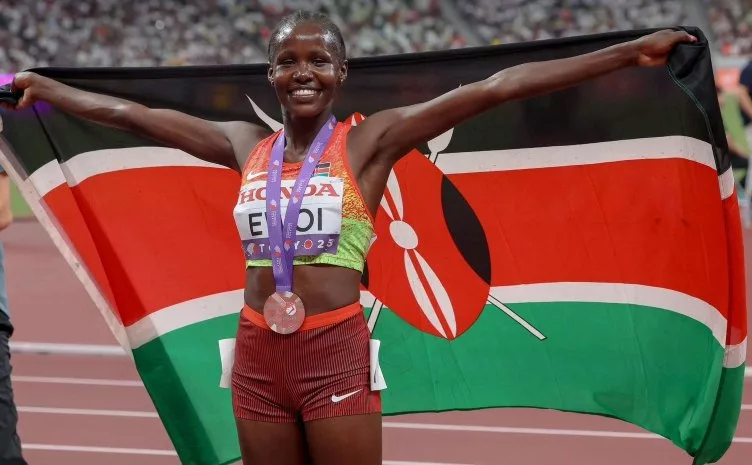 Dorcus Ewoi at the Tokyo World Championships/ FILE
“This is a chance to ensure the medals remain at home. As athletes, we can’t imagine having such an event on home soil and then win no medals.”
Former marathon world record holder Patrick Makau says one of Kenya’s greatest obstacles will also disappear. “Most of the time we go out to compete, and our athletes are affected by weather conditions. Come 2029, it will be about waking up and going to dominate on the track.”
Beyond the medals and the packed stadiums, athletes see Nairobi 2029 as an investment in Kenya’s future. The 2022 London Marathon champion Amos Kipruto believes the championships should become the foundation for the next generation.
“This is a landmark moment for Kenyan sports and a powerful recognition of our place on the global athletics stage.”
“The 2029 Championships should leave more than memories behind. It should strengthen facilities, nurture young talent and create lasting legacies for generations.”
The World Athletics Championships is no ordinary competition. It is the third-largest sporting event in the world after the Olympic Games and the FIFA World Cup, bringing together more than 2,000 elite athletes from over 195 nations every two years.
Further, at the Olympic Games, athletics is the biggest sport in the multi-event showpiece. So if one nation’s identity is inseparable from the championships, it is Kenya.
The country sits second on the all-time World Championships medal table with 182 medals, with 72 gold, 60 silver and 50 bronze, trailing only the United States’ remarkable haul of 469. Kenya sits as the highest-ranked nation in Africa, with Ethiopia following in sixth with 108 medals, while South Africa is 22nd with 28.
While America leads the medal standings, it’s Kenyan athletes who have repeatedly caught global attention and captivated at the global showpiece.
In the men’s 3,000m steeplechase, the nation has amassed an unrivalled 33 medals (13 gold, 12 silver and eight bronze) with Ezekiel Kemboi standing alone as the only athlete to win four consecutive world titles in Berlin, Daegu, Moscow and Beijing.
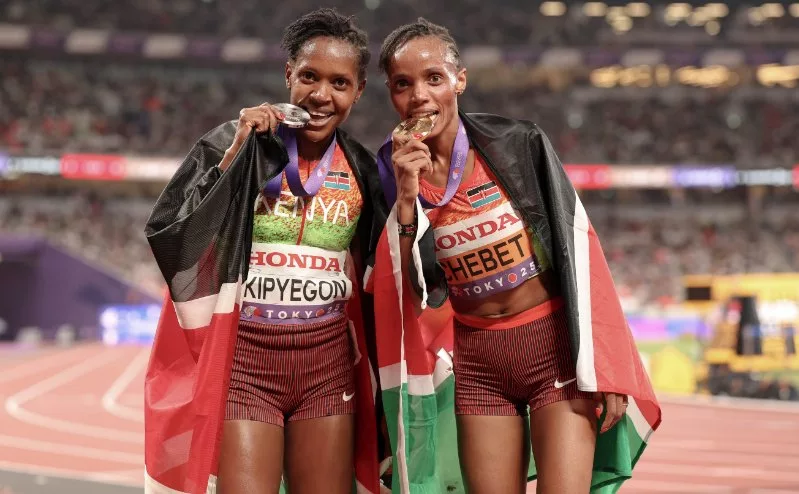
The same authority is evident over 1,500m, where Kenya tops both the men’s and women’s all-time standings, as the marathon remains another symbol of enduring excellence, particularly in the women’s race where Kenya has collected an astonishing 22 medals, including 16 gold. Few athletes have carried Kenya’s colours more proudly than Faith Kipyegon and Beatrice Chebet.
Kipyegon is a four-time world 1,500m champion after conquering London in 2017, Eugene in 2022, Budapest in 2023 and Tokyo in 2025, while also adding the 5,000m crown in Budapest 2023. Her collection also includes world silver medals from Beijing in 2015, Doha in 2019, both over 1,500m and Tokyo 2025 over 5,000m.
Chebet, meanwhile, etched her name into history in Tokyo by completing the 5,000m and 10,000m double, adding to the silver she won in Eugene 2022 and bronze from Budapest 2023, both over 5,000m. For Chebet, Nairobi 2029 represents the fulfilment of a dream shared by generations of Kenyan athletes. “History is coming home. Nairobi will host the 2029 World Athletics Championships, the first African city to do so.”
“What a proud moment for Kenya, Africa and every athlete who has carried their dream onto the world stage.”
Athletics Kenya athletes’ representative and 2013 world steeplechase champion Milcah Chemos says the championships will allow Kenya to showcase much more than sporting excellence. “Hosting the World Athletics Championships on Kenyan soil will provide an incredible opportunity to showcase our athletes, our sporting talent, our culture, and the hospitality of our great nation to the world.”
“This is a historic and proud moment for our nation and a great recognition of Kenya’s contribution to the development of athletics globally.”
Javelin legend Julius Yego, whose career has spanned seven World Championships, captured the emotion of the moment. “Yes, finally it’s home and this time bigger, Nairobi is officially the 2029 host city for the World Athletics Championships. What a time to be alive.”
Yego’s appearances at the global stage include: 2013 in Moscow finishing third, 2015 in Beijing winning gold, 2017 in London finishing 13th, 2019 in Doha finishing eighth, 2022 in Eugene finishing 14th, 2023 in Budapest finishing 17th and 2025 in Tokyo placing sixth.
“I am so excited for this news. Thank you, World Athletics, for granting us this noble opportunity to host the best of the best in athletics in track and field for the first time in Africa.”
Africa’s fastest man Ferdinand Omanyala believes Kenya’s unmatched athletics culture ultimately distinguished Nairobi from its European rivals. “We tried against Tokyo in 2025, and we didn’t get it. Our bid this year was against very formidable countries.”
“London hosted the World Championships a couple of times; Munich is one of the biggest cities in the world,” Omanyala told BBC.
“But if you put that aside and look at the culture and what brings the fan zones and the athletics vibe around the country, I think Kenya stands out the most of these countries.”
For Moraa, the announcement answered a prayer shared by countless African athletes. “As athletes, we have been praying for this, and finally we have it at home. We are grateful to the bid committee who fought hard to ensure Kenya secured the slot.”
She also acknowledged President William Ruto’s support throughout the bidding process. “We are also grateful to President William Ruto because he has been there supporting the whole process.”
But with the celebrations underway, Moraa insists the responsibility now shifts to the athletes. “The work now is on us athletes to ensure we strive for excellence to be ready for the championship to deliver.”
Moraa had one final message for the rest of the world. “To the global athletes, we welcome you all to come to Kenya and run and experience everything about Kenya.”
The impact of 2029 extends well beyond one fortnight of competition. Wanza believes the championships will accelerate the modernisation of Kenya’s athletics infrastructure.
“As athletes, we know that hosting the event in 2029 means our stadiums will now have standardised running tracks that conform to the World Athletics standards.”
“Kasarani, as the host, will have a world-class running track and even a proper warm-up track.”
She also described the event as a powerful source of inspiration. “This is a big achievement for our country. It has been a prayer for us, and God has heard our prayers.”
“This is a great thing for our country. Kenya is known for athletics. Many of our athletes have won medals. Having the championships here will be a morale booster for us as athletes,” Wanza says.
Makau believes Kenya earned the right to host because of decades of excellence. “The bid came because Kenya is a powerhouse in athletics. Our athletes have left their mark on the world stage.”
He also expects the championships to provide a major economic boost. “This is also a big economic boost for the country because the whole world will be coming to Kenya.”
Middle-distance coach and a certified World Athletics coach, Alex Sang called for early investment to ensure 2029 success for Kenyan stars.
“The ministry of sports should now ensure they provide proper facilities to ensure that our athletes start preparing early. We won the overall World Championships in 2015; this time it is coming to Kenya, we have to be ready,” Sang said.
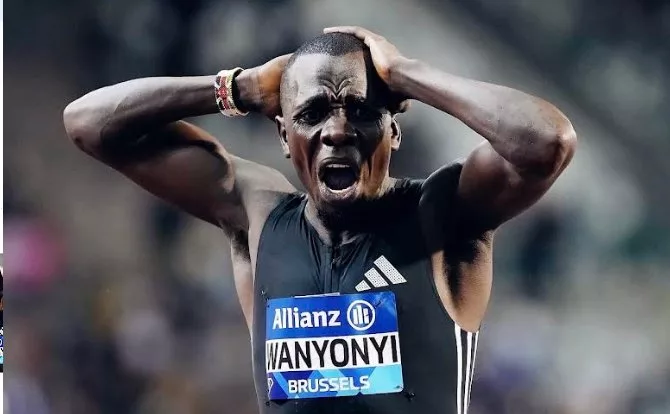
Emmanuel Wanyonyi
A victory for all of Africa
The celebrations of the 2029 triumph quickly spread beyond Kenya’s borders. Legendary Ethiopian distance icon Haile Gebrselassie, whose career was shaped by unforgettable duels with Kenyan greats, described Nairobi’s victory as a triumph for the entire continent. “I am here to congratulate you (Kenya). When I congratulate Kenya, I am indirectly congratulating the whole of Africa.”
He called the decision a defining moment in African sporting history. “The World Athletics Championships is coming to African soil for the very first time. This is wonderful news. I am so proud of Kenya to have been awarded this championship.”
Gebreselassie also thanked members of the World Athletics Council for backing Nairobi’s bid. “I thank those who voted for Nairobi. Voting for Nairobi was an indirect vote for all Africa.”
Even as celebrations continued, the Ethiopian legend urged Africa to focus on delivering an unforgettable event. “The next two years, let’s prepare together and hope we can host the best championship here in Africa.”
The Botswana Athletics Association echoed that continental pride, posting: “Congratulations, Kenya. See you in 2029 as you host the world.”
Chemos believes unity will now determine the championships’ success. “We commend everyone who played a role in making this achievement possible. This is not only a victory for athletics, but a victory for Kenya as a whole.
“As athletes, officials, coaches, administrators and stakeholders, let us work together with unity, commitment, and patriotism to ensure that Kenya 2029 becomes one of the most successful World Championships ever held.”
As the celebrations gradually settle, bid committee chairman Ibrahim Hussein says winning the vote was only the starting line. “Now we have to sit down and set up the Local Organising Committee. Getting the right people on board will be very key because there are technical areas you simply cannot compromise.”
“We also have to start advertising early throughout every county. We want to ensure that two years before the championships, we have already started selling tickets.”