

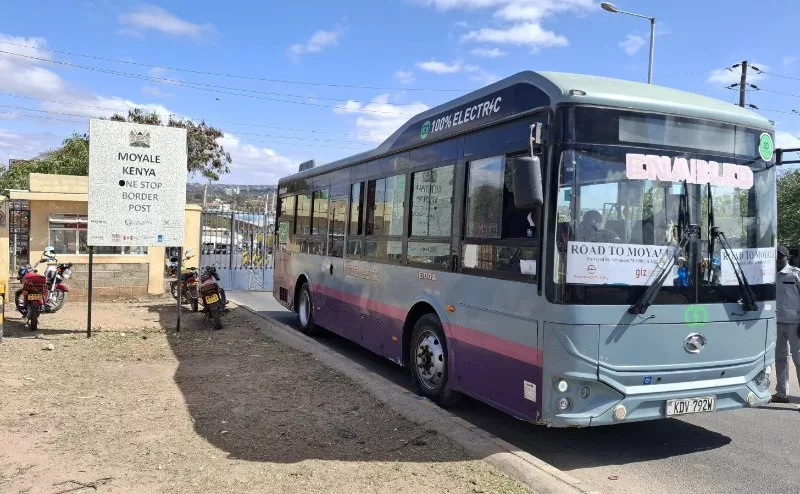
Three electric buses have successfully covered 776 km from Nairobi to Moyale in a rare test of electric mobility.
The trip was part of the Road to Addis Ababa expedition, which concluded at the Nordic-Africa EV Summit in Addis Ababa.
The three-day summit included high-level dialogue, industry engagement, practical workshops and collaboration advancing Africa’s electric mobility transition between September 14 and 16.
The expedition was organised by GIZ and Advanced Mobility and it put electric mobility to the test, showing what is possible when EVs are supported by the right charging infrastructure.
BasiGO Kenya said the buses were recharged at their fast DC charging stations in Thika and Nanyuki, while a portable charger supported charging in Marsabit.
“It’s a practical demonstration of what an expanding charging ecosystem can unlock. As charging infrastructure reaches beyond major cities and along key travel corridors, electric vehicles can go further and take on long-distance routes. After the 776 km, the road to longer-distance electric transport is looking a lot less daunting.”
Headquartered in Nairobi, BasiGo is pushing for a sustainable mobility revolution in Africa.
The firm brings together experts in electric vehicles, public transport, the power sector, asset finance, software and data science.
BasiGO says Africa can be a global leader in the transition to inclusive and sustainable public transport.
Over 70 per cent of the electricity in East Africa already comes from renewable sources such as hydropower, geothermal, solar and wind.
BasiGO says replacing a diesel bus in East Africa with an electric bus has greater social, environmental, and climate impact than anywhere else in the world.
“Africa has the opportunity to become global leaders in the transition to inclusive, sustainable public transport.”
The road trip comes even as experts calls for a sustainable transport as a key to Africa’s prosperity.
Already, experts from around 50 organisations across Africa are shaping a strategy for climate-neutral transport and green industrialisation.
During the event that took place in Berlin on September 2, 2026, experts said the development of sustainable transport systems in Africa not only secures future mobility, but also paves the way for economic growth, social justice and climate action on the continent.
This is emphasised in a strategy paper by representatives of around 50 organisations across Africa – including the African Union, national ministries, city governments, academia, the private sector and civil society, as well as the United Nations Environment Programme (UNEP) and the African Development Bank (AfDB).
This strategy report is the result of a co-creation process coordinated by Deutsche Gesellschaft für Internationale Zusammenarbeit (GIZ) GmbH and the German think tank Agora Verkehrswende under the Rethinking Transport project.
The paper identifies twelve turning points as key levers to more sustainable transport systems across African countries.
The stakeholders recommend that African governments prioritise sustainable transport as a cross-ministerial task and secure its long-term funding through earmarked budgets.
Furthermore, action plans for popular transport (demand-based public transport operated by private providers; also referred to as paratransit) are necessary.
Recommended measures also include the establishment of special economic zones and investment and innovation hubs, regional pooling of funds for sustainable transport infrastructure, and integrated corridors for clean and more efficient freight transport powered by renewable electricity.
Prioritising the expansion of domestic financing for electric mobility through dedicated credit systems is essential.
In her foreword to the publication, Lerato Dorothy Mataboge, Commissioner for Infrastructure and Energy at the African Union, highlights the added value of the proposed measures for Africa’s economic development:
“These turning points have the potential to trigger a broader process of change – for a sustainable future with diverse benefits for our continent.”
Among other things, Mataboge sees the measures as an opportunity to strengthen regional trade, build green industries and increase energy security.
For society, they offer a way to reduce inequality, improve public health and create decent jobs.
According to the strategy paper, a high-level advisory board could facilitate and accelerate the market take-up of electric mobility through common standards, aligned investment and the development of regional automotive value chains.
A pan-African master plan on renewable energy for electric mobility could reduce the costs of the energy transition – through sector coupling, the expansion of generation capacity and electricity grids, and smart charging infrastructure.
The endorsement of the Continental Framework for E-Mobility by the African Union at the end of April already marks a key turning point in accelerating the electrification of road transport across the continent.
Working together on a shared, prosperous future According to Christian Hochfeld, Director of Agora Verkehrswende, Europe should cooperate with Africa in the transformation towards sustainable transport:
“Germany and the EU have the opportunity to promote mutually beneficial investment partnerships with African countries in the field of sustainable transport. The electrification of road transport and rapidly growing demand for electric mobility in Africa will create new markets that will also facilitate the necessary transformation of industry in Germany and Europe.
Working together on the shift to electric mobility is a win for the economy, society and livelihoods – in Africa, Europe and worldwide. Cooperating in the protection of global public goods such as the climate also contributes to international security.”
“There is a strong trend towards more electric buses, electric motorbikes and electric cars in a growing number of African nations,” says Daniel Bongardt, Team Leader for Infrastructure and Mobility at GIZ.
Bongardt said many countries have adopted measures to promote electric mobility, and the African Union is also committed to this course.
“This momentum can now be harnessed to take further decisive steps in implementation. We are delighted that cooperation on sustainable transport is becoming increasingly intensive, both on the African continent and between Africa and Germany.”