


Kenya is a ripe destination for long-term capital.”
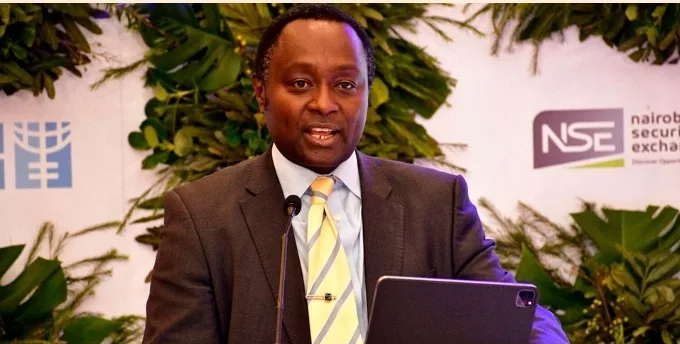
This is the key message by the Nairobi Securities Exchange (NSE) boss Frank Mwiti as he leads a delegation of top capital markets executives to the Bullish Africa 2026, an executive side event happening next week at the 81st UN General Assembly (UNGA) week in New York.
“As a capital market, we want to be the preferred destination for long-term capital.”
“If you look at developed economies, their capital markets consistently attract investment horizons of 20 to 30 years. Markets such as ours should be able to do the same,” Mwiti said.
The Kenyan delegation is dotted with top financial market honchos, among them: NCBA Group MD John Gachora and his Absa Kenya counterpart Yusuf Omari.
Others Wall Street Africa co-founders Eric Asuma (CEO), and Andrew Barden (President); John Mwendwa, CEO of Invest Kenya; and Mercy Randa, CEO of P&L Consulting Group.
The forum to be held on September 22 brings African issuers into direct engagement with institutional investors, financial institutions, regulators, stock exchanges, development finance institutions (DFIs), and other capital markets stakeholders.
It seeks to accelerate capital flows into African enterprises by strengthening market intelligence, improving issuer readiness, and facilitating direct engagement between companies seeking capital and the institutions that allocate it.
“Three key strategies are at play. Work with the government to align policy and regulatory framework, enagge long term financiers and mobilise domestic capital, both in Kenya and across Africa,” Mwiti told The Star.
According to him, Kenya has huge unexpolited capital but lacks the plumbing: the ability to mobilise and direct the substantial assets already held by local institutional investors.
“Deepening our markets is essential if we are to unlock long-term capital at scale.”
The African delegation will share the stage with global industry leaders, including Jeremy Allaire, co-founder and CEO of Circle; Jessica Froats, head of Relationship Management at the New York Stock Exchange (NYSE);
Others are Anna Sophie Herken GIZ board member; and David Awad, Principal Investor at Dubai Future District Fund.
The Nairobi team is flying to the New York meet heads high as the country’s capital markets enter middle of a historic, back-to-back bullish run.
This is driven by upside corporate earnings, a macro shift toward lower fixed-income rates, and landmark listings, total market capitalization surpassing the historic Sh4 trillion.
Led by banking heavy weights and multi- billion blue-chip like Safaricom, the stock market has seen investors’ paper wealth rise by Sh2.21 trillion in two years after it closing 2022 at Sh1.93 trillion.
Mwiti has termed 2026 a breakout year for Kenya’s capital markets, with the exchange projecting a market capitalisation of over Sh5 trillion by the close of the year.
The bourse is actively exploring new secondary vehicles to allow private equity funds and development finance institutions to seamlessly exit their portfolios.
The market rally has also been highly supported by new entries that broke a decade-long initial public offering (IPO) drought, notably the Kenya Pipeline Company (KPC) and Family Bank.
Major benchmarks indices like NSE 20, NSE 10, and the Nairobi All Share Index (NASI) have extended their year-to-date returns past 25 per cent.
The timing of the meeting is significant. Africa attracted about $70 billion (Sh9.05 trillion) in foreign direct investment in 2025, according to UN Trade and Development, making it the continent’s third-highest annual inflow since 1990.
Although this was below the exceptional $94 billion (Sh12.1 trillion) recorded in 2024, inflows remained about one-third above Africa’s long-term average.
Yet the continent continues to capture only a fraction of the global capital available to investors.
The problem, African executives argue, is not simply a shortage of money.
They are attributing this to inability to connect capital with credible, investible opportunities and provide investors with enough information to assess and price risk.
“Ultimately, we do not lack capital. What we lack is the plumbing,” Mwiti said, referring to the mechanisms needed to mobilise and direct domestic savings into productive investment.
The NSE is pursuing three broad strategies, including closer cooperation with government on policy and regulation, engagement with pension funds, asset managers, sovereign wealth funds and DFIsl.
It is also gronting the development of structured investment products such as infrastructure funds.
But Mwiti says the biggest effort will be directed at domestic capital.
About 80 per cent of the NSE’s effort, he said, is focused on mobilising capital within Kenya and across Africa.
The OECD estimates that African pension funds and insurance companies collectively hold about $775 billion in assets.
Yet their contribution to capital markets remains limited, with pension assets equivalent to about 22.6 per cent of GDP compared with 33.9 per cent globally.
Insurance penetration is also only 3.5 per cent of GDP, roughly half the global average.
Much of this institutional money remains concentrated in government securities rather than being channelled into equities, corporate bonds, infrastructure and other productive assets.
That represents both a challenge and an opportunity for African exchanges.
Mwiti also wants to address another major weakness — the difficulty faced by private equity and development finance investors when trying to exit their investments.
“Capital is already flowing into growth companies, primarily through private equity firms and DFIs. The challenge has been exits,” he said.
The NSE is working with the East Africa Venture Capital Association to develop a listed investment vehicle that could function as a secondary fund, providing private equity investors with a clearer exit route.
The logic is simple: easier exits would allow investors to recycle their capital into new businesses, potentially creating a continuous investment cycle.
Investors remain concerned about political instability, currency volatility, regulatory uncertainty, fragmented markets and weak liquidity.
African executives argue that these risks are real but often amplified by inadequate information.
Bullish Africa organisers describe the problem as an “intelligence gap”.
Eric Asuma, chief executive of Wall Street Africa, says investors often lack the research, market intelligence and quality information needed to make and defend investment decisions.
That assessment is echoed by global market participants.
“African markets have made meaningful progress in expanding access to capital. The next challenge is comparability,” said Jessica Froats of the New York Stock Exchange (NYSE).