



A call that would cost only a few shillings at home can attract international roaming charges abroad, while receiving a call on a Kenyan number can also trigger charges for the traveller.
Data, meanwhile, can disappear quickly when charged on a pay-as-you-go basis.
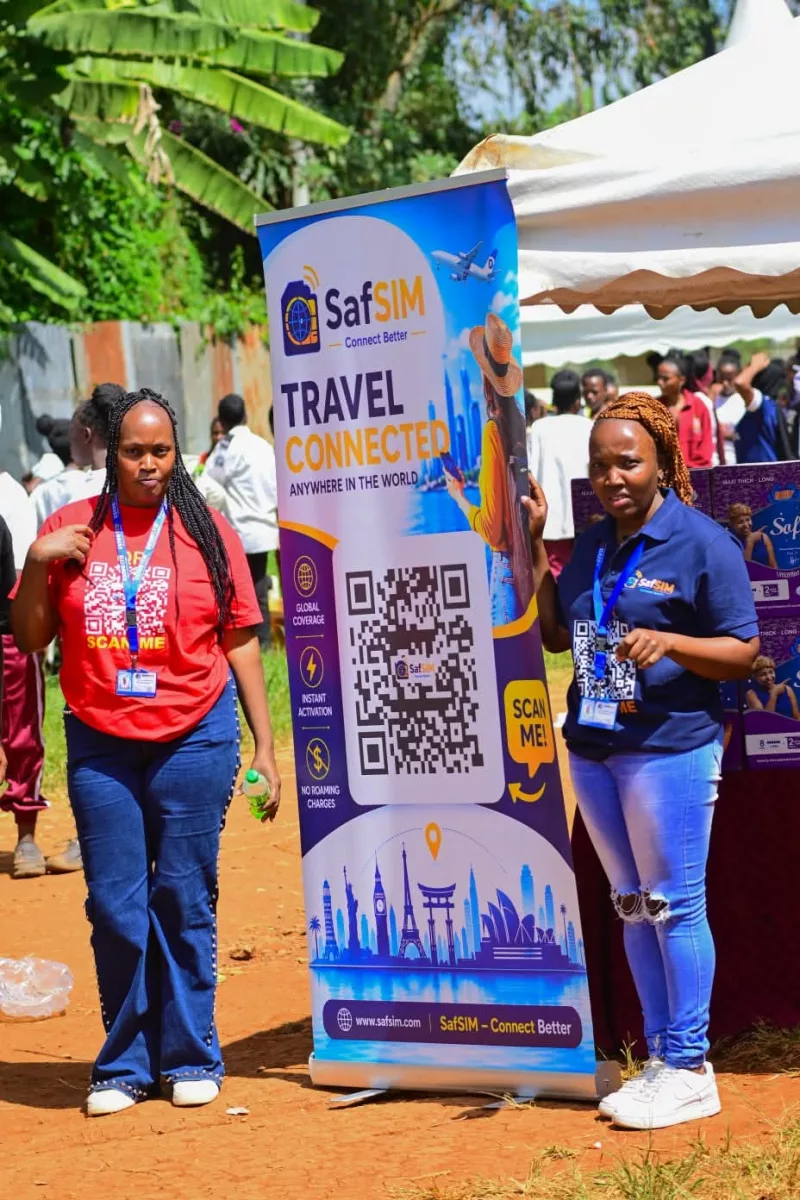
It is a problem a Nairobi-based travel technology startup, SafSIM, is betting it can largely eliminate.
Developed by Esivo Limited, SafSIM says its technology can cut the cost of calls, internet, and SMS for international travellers by up to 90 per cent, using eSIM technology and partnerships with hundreds of mobile network operators worldwide.
The proposition comes as mobile use continues to deepen in Kenya.
The latest available Communications Authority of Kenya (CA) sector data show that the country had 78.4 million mobile subscriptions by December 2025, with smartphones accounting for 48.7 million connected devices.
Mobile data subscriptions stood at 62 million.
The same CA data shows the scale of cross-border communication.
Between October and December 2025, Kenyan networks recorded 184.9 million minutes of international outgoing mobile voice traffic and 172.8 million incoming minutes.
Kenyans roaming abroad generated 7.7 million outgoing voice minutes and 156.8 million incoming minutes during the quarter.
Yet the cost of staying connected overseas remains a deterrent.
For example, Airtel Kenya’s current roaming offers include a global package costing Sh800 for 10 minutes, equivalent to Sh80 a minute, meaning a five-minute call would effectively cost Sh400 before considering the value of bundled data and SMS.
A larger Sh6,000 package gives 50 minutes, equivalent to Sh120 a minute when the bundle is allocated across voice.
The actual cost varies by destination and package.
Safaricom’s published roaming terms similarly warn that incoming and outgoing calls and SMS while roaming can attract charges from the visited network in addition to the operator’s charges.
That creates a peculiar two-sided burden.
A Kenyan abroad who calls home can pay a roaming rate, while a Kenyan family member calling the traveller may also be placing an international call.
If the traveller answers on a roaming line, the person abroad can incur an incoming-call charge as well.
Airtel, for instance, explicitly states that customers can be charged for receiving calls while roaming in destinations outside its regulated East African arrangements.
For travellers, the result is often predictable: shorten calls, avoid answering unfamiliar numbers, switch off mobile data or hunt for Wi-Fi.
SafSIM founder Geoffrey Mbuthia says it was precisely this vulnerability that inspired the business.
In 2024, Mbuthia went to the airport to collect a friend whose flight was supposed to arrive at 5:45 pm.
When she failed to appear, he eventually discovered that the flight had been pushed to 10:45 pm.
The explanation had already been sent to him on WhatsApp at about 3 pm, but he never received it because his friend had moved beyond Wi-Fi coverage.
“The problem was not that the information had not been sent; the problem was that the connection had been lost,” Mbuthia said.
That experience became the starting point for SafSIM.
The platform uses an eSIM, an electronic version of a SIM card embedded in a compatible phone, to give travellers access to mobile networks without physically replacing their Kenyan SIM card.
Instead of landing and searching for a local SIM or accepting potentially expensive roaming charges, users can arrange connectivity before travelling.
The company began developing the platform in 2025, tested it between January and March 2026 and launched publicly in April.
It says it has since connected more than 500 customers and established partnerships with 20 tours and travel businesses in Kenya.
Its strategy is also shifting towards travel companies, with connectivity packaged into holidays, business trips and other travel arrangements so that a customer can be connected before stepping off the plane.
The approach reflects a broader push to make roaming more affordable across Africa.
The International Telecommunication Union has developed a regional framework aimed at reducing the high cost of mobile roaming, while the GSMA says competition, roaming alliances and regional packages have produced price reductions of up to 90 percent in some markets.
SafSIM’s challenge is now to turn that promise into mass adoption.
Not all Kenyan phones support eSIM technology, potentially locking out travellers using older or lower-cost handsets.
The company says it is working on a solution for incompatible devices, with a September 2026 target.
If successful, the significance could extend beyond cheaper calls.
“With Kenyans increasingly dependent on mobile data for navigation, payments, messaging, work and travel arrangements, reliable connectivity has become part of the journey itself,’’ Mbuthia says.