

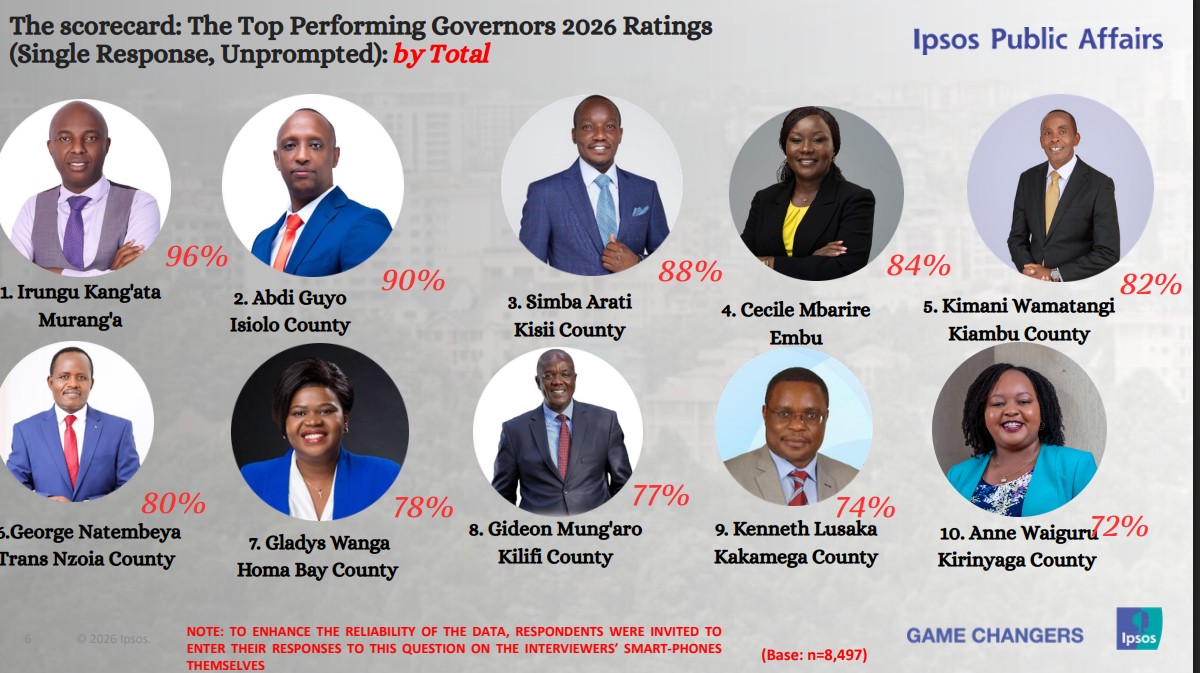
Ipsos Public Affairs has released its latest ranking of Kenya’s top-performing governors, placing Murang’a Governor Irungu Kang’ata at the top of the national leaderboard with an impressive 96 percent approval rating.
The findings, contained in the SPEC Barometer report titled “Power, Presence & Political Punch: Ranking Kenya’s Top Performing Governors in 2026,” paint a picture of an electorate increasingly focused on performance, accountability and service delivery rather than political rhetoric.
According to the survey, Kenyans are rewarding governors who have demonstrated tangible results in infrastructure development, healthcare, education, economic empowerment and effective governance.
Kang’ata emerged as the clear frontrunner, with respondents citing his administration’s consistent implementation of development projects, digitization of public services and commitment to transparency in county governance.
His leadership has earned widespread recognition from residents who believe the county is moving steadily in the right direction under his stewardship.
Coming in second was Isiolo Governor Abdi Guyo, who garnered a remarkable 90 percent approval rating. Residents credited his strong grassroots presence, accessibility and swift response to local challenges as key factors behind his impressive performance.
His administration has been widely praised for maintaining close contact with wananchi and ensuring county services remain responsive to public needs.
Kisii Governor Simba Arati secured the third position nationally with an 88 percent approval score. Arati’s rating reflects public appreciation for his efforts in promoting economic empowerment, supporting agricultural activities and maintaining direct engagement with residents across the county.
Embu Governor Cecile Mbarire ranked fourth with an 84 percent approval rating, making her the highest-ranked female governor in the country.
Her administration was recognized for improvements in healthcare infrastructure, enhanced service delivery and initiatives aimed at strengthening local revenue generation and economic growth.
Kiambu Governor Kimani Wamatangi occupied fifth place with 82 percent, receiving praise for investments in road construction, expansion of water infrastructure and youth empowerment programmes.
Residents acknowledged the visible impact of ongoing development projects despite prevailing economic challenges.
In sixth position was Trans Nzoia Governor George Natembeya, who recorded an 80 percent approval rating.
Respondents commended his emphasis on transparency, prudent utilization of county resources and active public participation in governance, qualities that have continued to strengthen public confidence in his administration.
Kilifi Governor Gideon Mung’aro followed closely in seventh place with 78 percent, reflecting strong public support for his efforts to improve healthcare services, boost agricultural productivity and modernize municipal infrastructure across the county.
Homa Bay Governor Gladys Wanga secured the eighth spot nationally with a 77 percent approval rating. Her administration was recognized for investments in healthcare facilities, automation of county revenue collection systems and sustained grassroots engagement that has kept her closely connected to residents.
Veteran administrator and Bungoma Governor Kenneth Lusaka ranked ninth with 74 percent, earning positive ratings for continued support to education programmes and the steady implementation of development projects aimed at improving livelihoods across the county.
Completing the top ten list was Kirinyaga Governor Anne Waiguru, who attained a 72 percent approval rating.
Respondents cited her administration’s healthcare improvement programmes and economic empowerment initiatives targeting women and youth as key contributors to her performance score.
The survey assessed governors using indicators that directly affect the daily lives of citizens, including infrastructure development, healthcare and education services, economic welfare programmes and governance effectiveness.
Researchers sought to measure not only the visibility of county leaders but also the impact of their policies and projects on local communities.
Fieldwork for the survey was conducted between April 15 and May 18, 2026, involving 8,497 registered voters drawn from both urban and rural areas across all 47 counties.
The interviews were conducted face-to-face at household level, with respondents providing unprompted evaluations of their governors.
The findings underscore the growing maturity of Kenya’s devolved governance system, where citizens are increasingly judging leaders by what they deliver rather than what they promise.
As counties continue to play a critical role in healthcare, infrastructure, agriculture and economic development, performance remains the defining benchmark for public approval.