

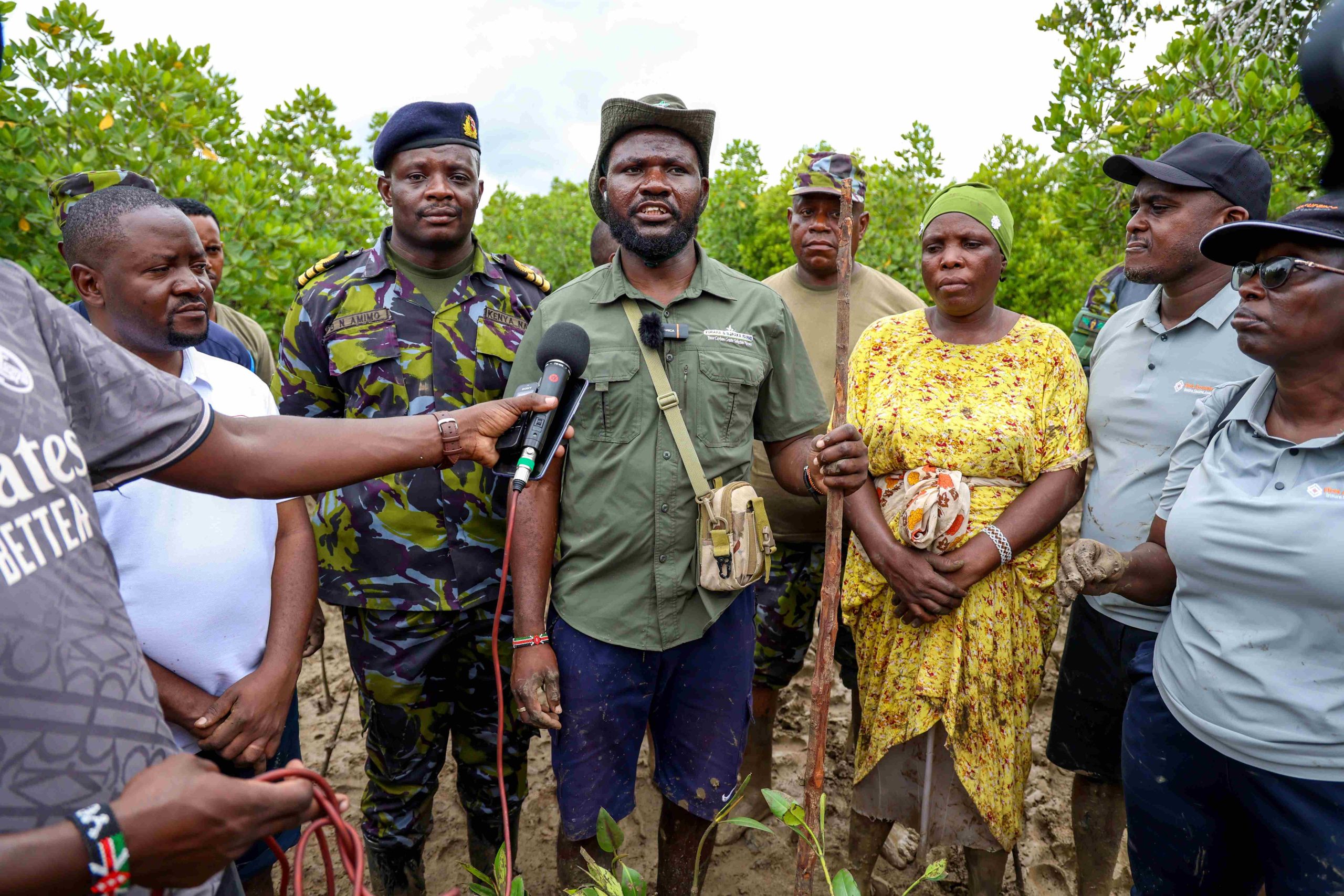
The Kenya Navy has planted nearly 3.2 million trees along the Coast in partnership with stakeholders, as part of the national push towards the government’s target of 15 billion trees by 2032.
On Tuesday, the Navy joined Furaha and Baraka Farms, Absa Bank and First Assurance in planting 10,000 mangrove seedlings at Tsunza in Kwale county, in a continued effort to restore degraded coastal ecosystems.
The Kenya Defence Forces (KDF) was nominated by President William Ruto as the lead agency in achieving the national reforestation agenda, with the Kenya Navy spearheading implementation in the coastal region.
Kenya Navy Lieutenant Colonel Boniface Amimo said the service remains committed to achieving its targets while prioritising the protection and restoration of mangrove forests, which play a critical role in sustaining marine biodiversity.
“As the Kenya Navy, we are determined to hit the mark and ensure protection of trees, especially mangroves, which also help the marine ecosystem where we are heavily invested,” he said.
Amimo said the Navy’s target for the 2025-26 financial year is eight million trees, adding that 3.2 million seedlings have been planted. The mix includes mangroves, indigenous trees and fruit trees.
He said mangroves remain the main focus due to their ecological importance, including acting as fish breeding grounds and supporting the regeneration of marine ecosystems.
“Mangroves are also a source of livelihoods, especially for communities that harvest seedlings. We also engage communities when planting so that they support us with logistics,” he said.
The Tsunza mangrove restoration programme is being implemented on an estimated 4,500-acre site in Kwale county, with partners describing it as one of the largest coastal rehabilitation efforts in the region.
Furaha and Baraka Farms corporate communications officer James Sakwa said mangroves are among the most effective trees in carbon absorption and play a major role in climate change mitigation.
“Mangroves absorb more carbon than any other trees, making them highly effective in carbon sequestration,” he said.
Sakwa said so far, about three million mangroves have been planted in the Tsunza area over the past two years, with significant potential for expansion.
“We still have space to plant another 30 million trees here to cover the whole area. We have been working with the Kenya Forest Service, which has allowed us to plant mangroves here,” he said.
He called on more stakeholders and sponsors to support the restoration drive, warning against continued destruction of forests.
Sakwa also cautioned against indiscriminate tree felling, saying alternatives exist for firewood and timber use.
“If it is firewood, it can be found without felling trees. There are natural ways trees shed usable wood without cutting them down,” he said.
He further linked deforestation to flooding in urban areas, saying environmental degradation affects everyone.
“The floods affect everyone. They do not choose only those who fell the trees,” he said.
First Assurance’s Samuel Muthomi said environmental conservation is a shared responsibility that requires collaboration between the private sector, government and communities.
“We are one with nature. That is why we are joining the community today to ensure sustainability of the ecosystem around the mangroves,” he said.
The company has set a target of planting at least two million trees along the Coast.
Absa Life Assurance’s Brian Khamadi said the company is also investing in climate action through large-scale tree-planting initiatives.
He said increasing carbon levels in the atmosphere continue to threaten environmental stability, making mangrove restoration critical.
“We are trying to capture as much carbon as possible so as to maintain clean and quality air for people to breathe,” he said.
Khamadi said Absa is also supporting local communities by purchasing seedlings from them, creating an income stream linked to conservation.
“As Absa Life, last year we planted 10,000 trees. This year we started by planting 50,000, and today, partnering with KDF, First Assurance and Furaha and Baraka Farms, we are planting another 10,000,” he said.
He said the company aims to plant 1.5 million mangrove trees within Tsunza and other coastal areas over the next five years.
Resident Khadija Kodi said mangrove restoration has become an important source of livelihood for the community, as residents grow and sell seedlings to conservation partners.
“We plant and sell the seedlings that these people come and buy from us. We then use the money to educate our children and feed our families,” she said.
She, however, warned against tree cutting, saying mangrove restoration is labour-intensive and requires long-term commitment.