

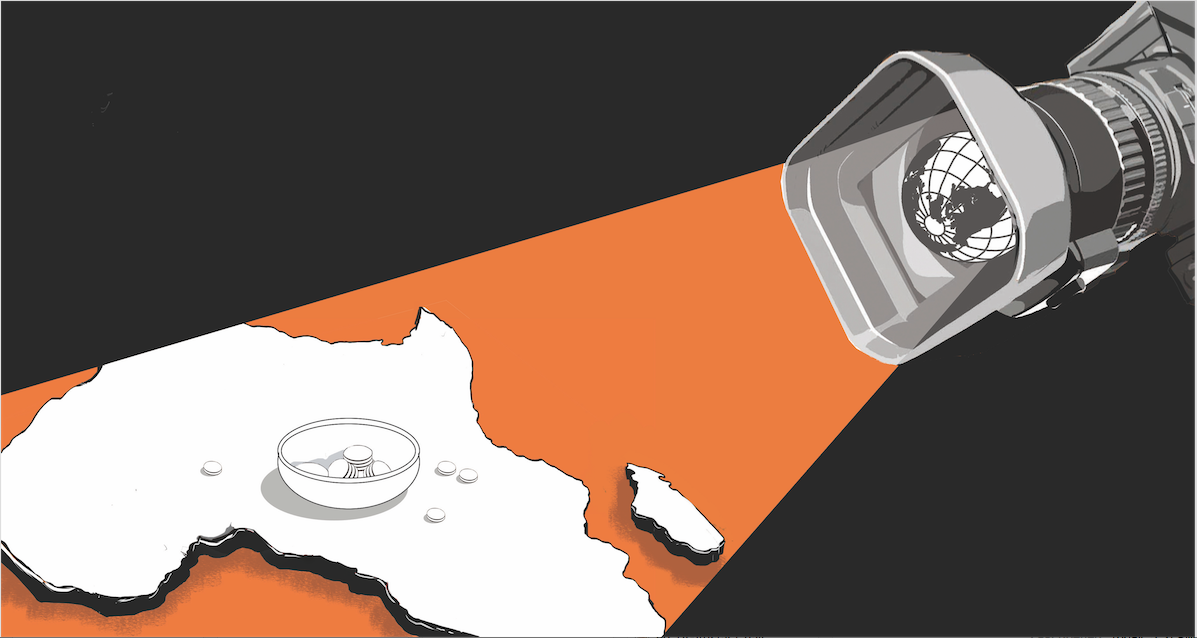
The Office of the United States Trade Representative, which keeps playing by the old and outdated African Growth and Opportunity Act (AGOA) handbook, despite a shifting global order, has now awakened. It invited proposals for the modernisation of AGOA. The deadline was May 15, 2026.
AGOA, which was enacted in 2000, is the core of US trade policy with Africa. It provides duty-free access to the US market for 1,800 products on top of the more than 5,000 products that are also eligible for duty-free access under the Generalized System of Preferences (GSP) programme. Eligibility is subject to a plethora of imperialistic conditions.
On September 30, 2025, the previous authorisation for AGOA expired. On February 3, 2026, President Trump signed into law legislation that reauthorises the AGOA trade preference programme through December 31, 2026, with retroactive effect to September 30, 2025. These numerous political reviews create uncertainty, and make AGOA unattractive to investors.
Unlike China, which provides tariff-free access to Chinese market for all products from 53 of the 54 African countries (effective May 1, 2026), only 32 of the 49 sub-Saharan African (SSA) countries are eligible for AGOA.
In his brief, Jeffrey Goettman, Deputy United States Trade Representative, has correctly pointed out that SSA’s share of total US goods imports has been insignificant over the life of the programme. This is despite the fact that, SSA’s total goods and services imports have surged five-fold to $570 billion (Sh73.7 trillion) since 2000.
He confirms that “US total imports under the AGOA programme (including GSP) followed a downward trend for a decade starting in 2011 and, despite the rise in recent years, 2025 goods imports were 90 per cent lower than 2011 levels.”
According to him, this is happening at a time when China, the EU and India have captured more of Africa’s fast-growing market. In 2023 “the European Union and China captured 20 percent and 19 percent of sub-Saharan Africa’s goods imports, with $87 billion (Sh11.3 trillion) and $81 billion (Sh10.5 trillion) worth of imports, respectively”. Imports from India reached $32 billion (Sh4 trillion) (seven per cent) while imports from US remained at $22 billion (Sh2.8 trillion) (five per cent) in the same year.
The above statistics are correct, but the analysis is blemished and could propel AGOA 2.0 review in the wrong direction. We need to review and interrogate all statistics, and from all angles. According to the referenced World Bank Data-World Integrated Trade Solution, the total 2023 SSA trade was $825 billion. SSA export value was $393 billion and imports $432 billion (Sh106.7 trillion), leading to a negative trade balance of $39 billion (Sh5 trillion).
Majority imports were as follows: East Asia and Pacific $132 billion (Sh17 trillion), Europe and Central Asia $111 billion (Sh14.5 trillion), China $81 billion (Sh10.5 trillion) and SSA $60 billion (Sh7.8 trillion). Trade with Europe and Central Asia led to a positive trade balance of $4 billion (Sh517 billion). Trade with the US, despite the fact that imports were a mere $22 billion (Sh2.8 trillion), led to a negative trade balance of $4 billion (Sh517 billion).
Analysis of Kenya’s Economic Survey 2026 reveals that Kenya has been running a huge negative trade balance with the US every year for the last five years. Kenya’s total trade with the US between 2021 and 2025 was Sh938,822 million. Kenya’s exports to the US were Sh372,302 million. Kenya’s imports from the US were Sh581,948 million. The deficit is Sh209,646 million.
In the request for proposal to modernise AGOA, USTR has posed 20 questions, all clothed in MAGA’s lingua franca of power, Jedi mind tricks and mercantilism, none of which can lead to a mutually beneficial industrialisation and trade policy with Africa.
The EU and China have set up high standards. China’s tariff-free move, as well as similar manoeuvres by the EU, achieve two things simultaneously. First, they undermine AGOA’s economic justification-they challenge the economic rationale of AGOA. Secondly, they reinforce Africa’s quest for integration.
AGOA 2.0 should shift from a market-access model to a strategic industrial partnership, encompassing the entire African continent, and without imperialistic benchmarks.
AGOA 2.0 should align with the African Continental Free Trade Area vision. It should be built on a framework where the US purchases products manufactured with inputs sourced across multiple African countries.
The original AGOA 1.0 philosophy was premised on the assumption that trade access alone would stimulate development. That was a fallacy. A modern AGOA model should be based on the premise of a strategic Africa-US industrial partnership. This should include US investment participation where cheaper American pension funds finance industrial and manufacturing greenfield projects and start-ups.
Kenya is a good place to start. Kenya, as a Major Non-NATO Ally and host to a US military base, faces existential risks. Should US hegemonic wars overflow to Africa, Kenya is a sitting duck. In consequence, the US should support Kenya to develop its military industrial complex.
So, Africa’s shift to Asia and Europe is a response to who shows up with capital for industrialisation, and market for goods manufactured in Africa. If the US continues to treat AGOA purely as a transactional and imperialistic tool, it will lose Africa.