


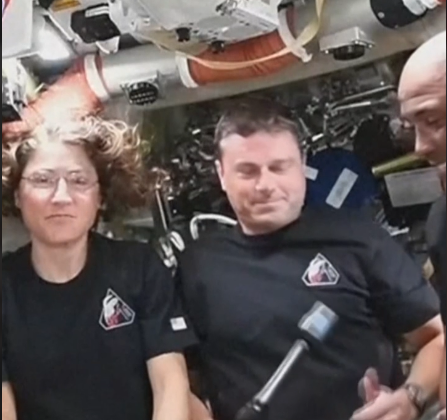
The Artemis II astronauts are bound for Earth after conducting a historic lunar fly-by and witnessing a total solar eclipse from their spacecraft.
Commander Reid Wiseman says the Orion spacecraft crew “saw sights that no human has ever seen”, while pilot Victor Glover says there are “no adjectives” to describe what they observed.
The spacecraft reached its maximum distance from Earth – 252,756 miles (406,771km) – during the lunar fly-by. The crew had already broken the previous record for the furthest distance humans have travelled into space.
The astronauts lost connection with Nasa while behind the Moon – the outage was expected and lasted around 40 minutes.
“It is so great to hear from Earth again,” said mission specialist Christina Koch as she broke the silence from the spacecraft.
US President Donald Trump tells the astronauts that they have “made history and made all America really proud” – and invites them to the White House.
The astronauts are due to splashdown in the Pacific Ocean off the west coast of the US at 20:07 eastern US time on Friday (01:07 BST Saturday).
Moon crater to be named after astronaut’s late wife
There was a poignant moment onboard the capsule yesterday when conversation turned to proposing names for craters on the Moon to memorialise this record-breaking voyage.
One of the craters should be named Integrity after their Orion spacecraft, the crew agreed – while another should be named after astronaut Reid Wiseman’s late wife Carroll who died in 2020.
The name proposals will need to be formally submitted to the International Astronomical Union,which governs the naming of features in space – but we suspect they’ll be open to the suggestion.
Artemis II is ‘kick-off for the next generation of space exploration’
Nasa’s head of science Dr Nicola Fox says the Artemis II Moon mission is all about “doing the work to set up that sustained presence on the Moon”.
Artemis IV, which is expected to launch in early 2028, will land humans on the Moon for the first time since 1972, Fox tells BBC Breakfast.
She says Nasa’s ultimate goal is to have astronauts living and working there continuously, which will pave the way for the “next giant leap in exploration, to send crews to Mars”.
Gravity in control and instant death awaits outside spacecraft, says ex-astronaut
Retired Nasa astronaut Terry Virts, who was formerly commander of the International Space Station, says the crew of the shuttle had to allow gravity to take over in order to slingshot the moon.
He says: “They are in deep space with no way to be rescued, getting the harshest radiation that doesn’t even exist on Earth, surrounded by instant death just a few millimetres outside of that thin aluminium shell.
“The entire 10-day mission is not exactly super safe but basically nothing happened today. The only thing that happened today was the moon flew by the capsule.
“They didn’t do a manoeuvre – they allowed the moon’s gravity to kind of bend the shape of their trajectory 180 degrees and bring them back to Earth.
“So it wasn’t like they had to do a big complicated manoeuvre or docking or landing or anything like that.
“Sir Isaac Newton is in charge – gravity is what’s manoeuvring the capsule now.”