


Poor performance of ordinary revenue tax bands and external shocks has forced the National Treasury to revise downwards some of its revenue projections.
The exchequer’s latest data shows that in the first two months of the 2026-27 financial year, Kenya Revenue Authority collected Sh488.9 billion in total revenue in the two months to August 2026.
This was against a target of Sh516.9 billion, leaving a shortfall of Sh28.1 billion, according to the Draft 2027 Budget Policy Statement.
The shortfall is a continuation of sustained misses targets that saw the government collect Sh3.2 trillion in the financial year ended June 2026, falling short of its initial target of Sh3.32 trillion by Sh122.9 billion.
Treasury attributed the shortfall largely to lower collections from ordinary revenue, with income tax and Value Added Tax (VAT) accounting for much of the weakness in ordinary revenue collections.
Data shows income tax receipts fell Sh14.4 billion below target, while VAT collections missed its target by Sh12.6 billion.
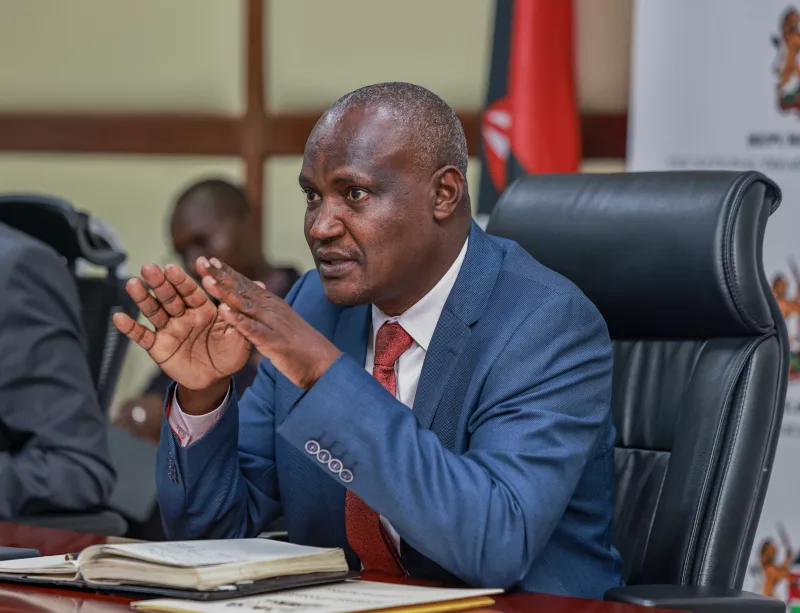
“The underperformance was recorded across most of the major revenue categories, particularly income tax and value added tax (VAT), which were below target by Sh14.4 billion and Sh12.6 billion, respectively,” said treasury CS John Mbadi in the BPS.
Income tax is paid by individuals and businesses on their earnings, while VAT is charged on the sale of goods and services, meaning there were a reduction in jobs or Kenyans capacity to purchase dropped.
The Treasury had initially projected total revenue of Sh3.32 trillion for the 2025/26 financial year in its Draft 2026 Budget Policy Statement. The latest estimates show that actual collections fell to Sh3.20 trillion.
The government has also revised its revenue expectations for the current financial year, which runs from July 2026 to June 2027, as early figures point to continued difficulties in meeting tax targets.
The current financial year, 2026-27, has a total revenue target of Sh3.631 trillion, ordinary revenue is expected to reach Sh3.25 trillion, compared with the previous projection of Sh3.39 trillion.
Treasury has also revised its total revenue projection for the 2027-28 financial year to Sh4.004 trillion, down from Sh4.044 trillion in the earlier estimates.
“By the end of August 2026, the government had collected Sh488.9 billion against a target of Sh516.9 billion, leaving a shortfall of Sh28.1 billion. Tax collections performed even worse, with ordinary revenue falling Sh37.8 billion below the target,” reads the draft budget statement.
Higher collections by ministries and government agencies helped cushion the gap by Sh9.7 billion.
By the end of September, the shortfall in ordinary revenue had widened to Sh58.2 billion, signalling mounting pressure on the government to improve collections during the remaining months of the financial year.
Import duty was among the few revenue streams that performed better than expected, collecting Sh31.7 billion against a target of Sh30.2 billion.
The figures suggest that the government could face difficulties financing its spending plans if tax collections fail to improve, potentially increasing pressure to borrow or review expenditure.
The Treasury has also lowered its medium-term revenue expectations for the 2027/28 financial year, indicating a more cautious outlook on how much money the government can raise.
The revised figures point to a growing reliance on collections outside ordinary taxes, including money raised directly by government ministries and agencies.
The Treasury estimates that total revenue will rise to 18 per cent of the country’s economic output by the 2029-30 financial year. However, achieving this target will depend on stronger tax collections and sustained economic growth.
The Treasury is also seeking to improve revenue collection by reviewing tax exemptions and reliefs that reduce the amount of money collected by the government.
The latest estimates show that tax expenditure, which measures revenue the government forgoes through exemptions, deductions and other tax benefits, declined to Sh262.6 billion in 2025 from Sh284.4 billion in 2024.
This represents a reduction of Sh21.8 billion in revenue forgone.
VAT exemptions and reliefs accounted for the largest share of the cost, at Sh175.8 billion, equivalent to 66.9 per cent of total tax expenditure in 2025.
The reduction followed changes to reliefs on certain goods and services that are either exempt from VAT or taxed at zero per cent.