


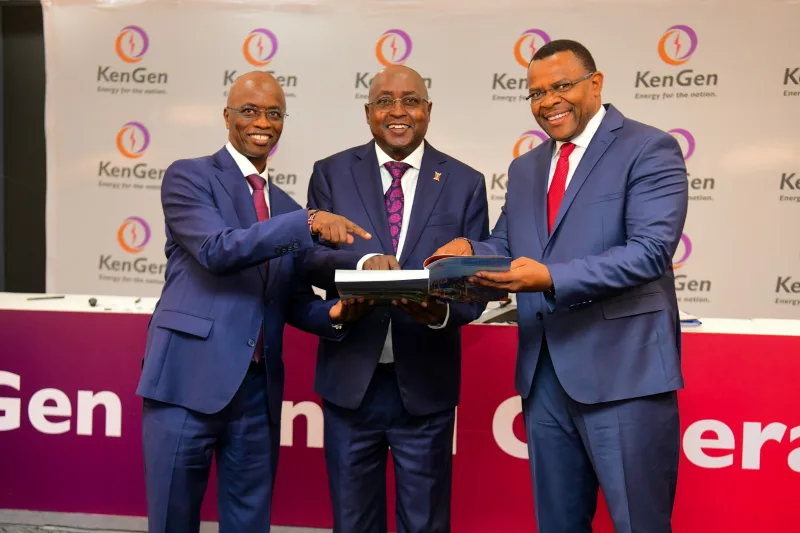
KenGen shareholders have agreed to a 16.7 per cent cut in dividend payout to Sh4.95 billion to channel more cash into infrastructure to boost electricity generation and meet rising demand.
At the company’s annual general meeting on Thursday, investors approved a first and final dividend of Sh0.75 per share for the financial year ended June 30, 2026.
This is down from Sh0.90 per share, or Sh5.94 billion, paid for the previous financial year.
The dividend is expected to be paid on or about January 21, 2027, to shareholders on the register at the close of business on October 29, 2026.
The lower payout comes as the Nairobi Securities Exchange-listed firm (Kenya Electricity Generating Company PLC) increases capital investment, while reducing its reliance on borrowing to finance future growth.
“We recognise the importance of dividends to our shareholders,” board chairman Frank Konuche said, “We also have to invest in the assets that will generate future earnings. Balancing shareholder returns, investment and debt reduction is essential to the long-term strength of the business.”
KenGen invested Sh15.5 billion in power infrastructure during the financial year, a 14.3 per cent increase, as it prioritised plant reliability, new generation capacity and the commercial exploitation of geothermal resources.
The investment came as the company recorded mixed financial performance, with revenue rising 6.4 per cent to Sh59.7 billion while operating profit increasing 4.1 per cent to Sh14.2 billion.
However, profit after tax declined 1.2 per cent to Sh10.35 billion, primarily reflecting lower finance income as cash was deployed into capital investments.
The company’s borrowings fell by Sh12.2 billion to Sh97.1 billion, strengthening its balance sheet as it pursues additional generation projects.
During the year, it supplied 8,975 gigawatt hours of electricity to the national grid, accounting for 57.2 per cent of national demand. More than 90 per cent of the electricity it dispatched came from renewable sources.
Managing director and chief executive Peter Njenga yesterday said investment in generation infrastructure was necessary to support economic expansion and rising electricity consumption.
“Kenya’s growing economy needs dependable electricity. Our investment is focused on keeping existing plants reliable while developing the generation capacity needed to support businesses, households and future growth,” he said, noting that peak electricity demand had reached 2,549 megawatts.
KenGen’s project portfolio combines rehabilitation of existing facilities with proposed new generation and energy storage developments.
These include the completed rehabilitation of Olkaria I geothermal power station, a proposed 42.5 megawatt Seven Forks solar plant and the redevelopment of Gogo hydropower station.
The company is also pursuing battery storage and the proposed raising of Masinga Dam to strengthen electricity system reliability and improve water management for hydropower generation.
Beyond electricity sales, KenGen is seeking to diversify revenue through industrial development and technical services.
Its Green Energy Park at Olkaria, Naivasha, is designed to attract manufacturing, food processing and data centre investments by bringing businesses closer to geothermal electricity, steam and industrial land.
The park has secured special economic zone status and designation as a customs-controlled area, providing a framework for attracting investors and developing industrial projects.
“Geothermal energy can do more than supply electricity to the grid,” Njenga said. “At Olkaria, we are bringing together energy, steam and industrial land to attract businesses that can create jobs and strengthen Kenya’s manufacturing base.”
Under its G2G 2034 Strategy, KenGen is also expanding consultancy services covering geothermal drilling, resource assessment, engineering and power plant operation and maintenance.
The Good to Great 2024–2034 is a 10-year corporate blueprint unveiled by the company in October 2024 to accelerate Kenya’s transition to 100 per cent renewable energy.
The services offer an opportunity to generate additional income from the company’s technical expertise and experience in developing and operating power infrastructure.
The investment programme comes ahead of a leadership transition at the power producer. Ronoh Kibet, currently general manager for commercial services, will succeed Njenga as managing director and chief executive on February 1, 2027.
KenGen said the transition would allow for an orderly handover as it advances generation projects, industrial development and technical services.
The dividend reduction signals a shift towards retaining more financial resources to support long-term growth, even as shareholders receive a return.