



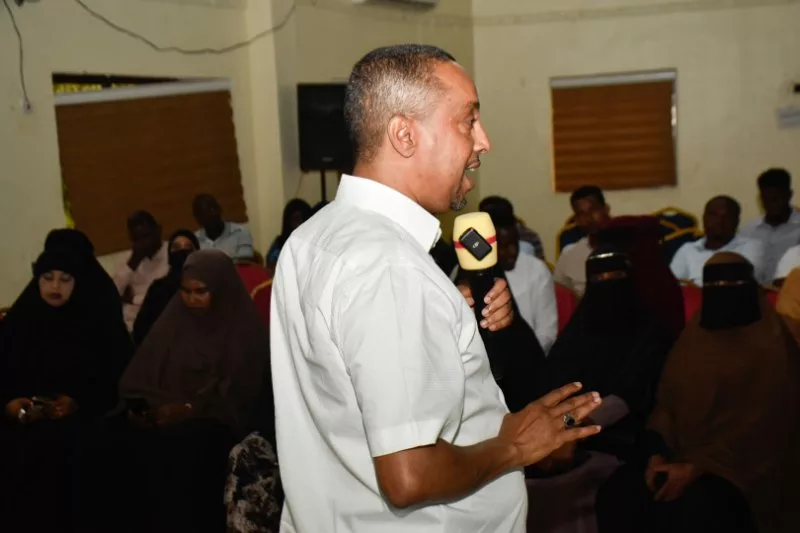
Garissa governor aspirant Abdiqani Dubat has pledged to end nepotism, political patronage and favouritism in county appointments.
Dubat said his administration would prioritise professionalism, integrity and accountability if elected in the 2027 General Election.
An auditor by profession and a former Principal Secretary in President William Ruto’s administration, Dubat made the commitment during a meeting with professionals from various sectors and young people in Garissa.
He outlined his governance agenda and responded to questions on challenges facing the county.
He said public appointments must be guided by qualifications, competence, experience and the ability to deliver, rather than family connections, friendships or political affiliations.
“There will be no employment based on family connections, friendship or political patronage. Public appointments must be based on qualifications, competence, experience and the ability to deliver,” Dubat said.
He added that his proposed administration would rely on professionals with relevant expertise to formulate policies and address challenges in critical sectors, including healthcare, education, agriculture and water.
The aspirant said Garissa needed a fundamental shift in its approach to leadership and public service. He argued that residents could not expect different results if the county continued operating under the same systems and practices.
“We cannot transform our society by continuing to do things the same way and expecting different results,” he said, urging residents to participate actively in discussions on governance and the county’s future.
During the meeting, several speakers raised concerns about corruption, nepotism, favouritism, unprofessionalism, disregard for the law and a culture of stereotyping.
They said these challenges continued to undermine effective leadership and service delivery in county governments.
Dubat said addressing these challenges would require leaders to uphold constitutional values, strengthen accountability mechanisms and ensure public resources were used for their intended purposes.
He argued that Garissa’s challenge was not merely the availability of funds but also how they were managed, prioritised and translated into tangible benefits for residents.
“There are many issues that we need to discuss as a community. We cannot continue pretending that everything is fine when we are not where we want to be. We cannot overcome our challenges without having serious conversations about our problems and the solutions available to us,” he said.
On water provision, Dubat questioned why residents continued to experience shortages despite resources being allocated to the sector.
He said the problem also required better planning, management and accountability.
“If you examine county expenditure, you will realise that the amount allocated to a sector does not necessarily translate into the services people receive. We must therefore look beyond budget figures and ask what the money is actually achieving,” he said.
“The water challenge is not simply a question of money. It is also a question of leadership, planning, management and accountability. We must establish why residents continue to experience water shortages despite the resources available to the county,” he added.
He maintained that public investment and private sector participation could coexist, provided commercial interests did not compromise residents’ access to affordable and reliable water.
In healthcare, Dubat said his administration would prioritise adequately equipped facilities, the availability of medicines, support for medical personnel and improved access to essential services, particularly in remote areas.
He also pledged regular performance reviews involving county executive committee members, departmental heads and other public officials to assess whether programmes were meeting their targets and development projects were delivering value for money.
Dubat said county employees should receive their salaries on time and be supported to perform their duties. He added that promotions, staffing decisions and other employment matters should be handled fairly and professionally.
He challenged residents, particularly professionals and young people, to take a more active role in shaping county leadership rather than remaining silent when governance challenges persisted.
“I am asking you to join me in this effort. I have offered myself for leadership because I believe change is necessary, but change cannot be achieved by one individual alone,” he said.
“If we do not take the initiative to bring about change, we cannot expect our circumstances to improve on their own. Change has to start somewhere, and I believe this is where we should begin,” he added.
Garissa, he noted, had significant economic potential in resources such as solar energy, gypsum, sand, gemstones and wildlife. He said these could be harnessed to attract investment, create employment and expand economic opportunities.
He said the county needed innovative approaches to turn these resources into sustainable economic benefits rather than relying on conventional development strategies.
Dubat’s bid adds another contender to the race for the Garissa governorship, which is expected to be shaped by political alliances, community dynamics and competing development agendas ahead of the 2027 polls.
He hails from the Abduwak clan, the same community as former governor Ali Korane, who is seeking to reclaim the seat he lost to incumbent Nathif Jama in the 2022 General Election.
The emergence of the two aspirants from the same clan adds another dimension to the contest, as political negotiations and community endorsements continue to influence the county’s evolving succession politics.