
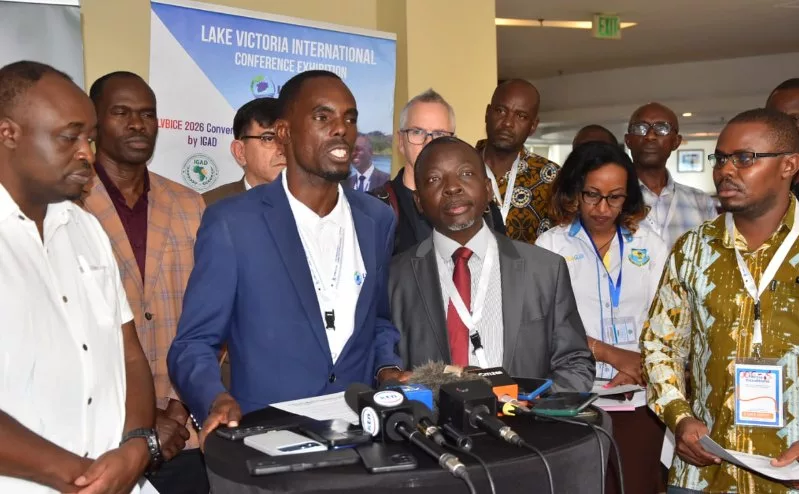
Delegates at the Lake Victoria Basin International Conference and Exhibition have called for a coordinated regional plan to strengthen climate resilience and attract investment to address environmental and development challenges facing communities around the lake.
Reading the resolutions adopted at the conference, Lake Victoria Basin International Conference and Exhibition national coordinator Clifford Omondi said the delegates had prioritised joint action on climate change, regional cooperation and financing for sustainable development.
The delegates resolved to develop a regional climate-resilient plan covering climate adaptation and mitigation, ecosystem restoration, water security, public health, education, sustainable livelihoods and resilient infrastructure.
The resolutions were adopted during the conference held in Kisumu from October 5 to 9, under the theme of “Harnessing technology and innovation for sustainable development in the Lake Victoria Basin”.
Omondi read seven resolutions, including a proposal to establish a regional mechanism for preparing bankable climate-resilient projects that can attract financing from climate funds, development finance institutions, bilateral and multilateral partners, and private investors.
The delegates also called for stronger links between research, policymaking and investment, proposing that scientific research, indigenous knowledge and technologies such as artificial intelligence and robotics be translated into evidence-based policies and programmes.
They further resolved to strengthen collaboration among regional institutions, national and county governments, research organisations and development partners to align priorities, coordinate interventions and avoid duplication of efforts.
On community participation, the conference called for greater local leadership, accountability and equitable access to climate finance, with particular attention to women, young people and vulnerable communities.
The resolutions also propose a common pipeline of priority regional projects to help partners coordinate financing, mobilise resources and implement shared development priorities.
A key proposal is the identification of a flagship regional climate investment that can demonstrate cooperation across the basin, attract public and private financing and deliver measurable environmental, social and economic benefits.
Omondi read the resolution requiring partners to identify a suitable flagship project within three months for implementation within the Lake Victoria Basin.
The delegates said the resolutions would provide a framework for coordinated regional action on climate resilience and sustainable development.