

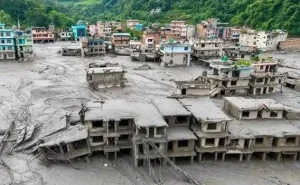

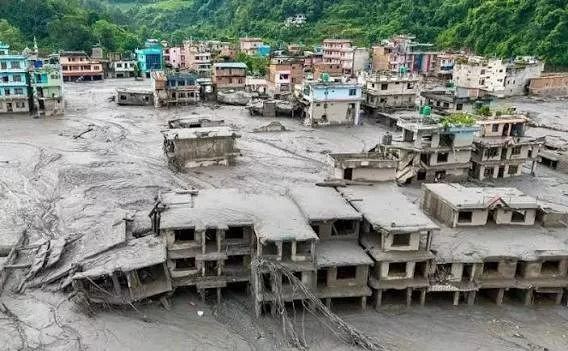
A study has found that climate change likely contributed to the glacier collapse that unleashed devastating floods on the Nepal-Tibet border.
There was “absolutely no doubt that human-induced climate change played a role here in the preconditioning of the disaster”, said Dr Friederike Otto, a climatologist at Imperial College London who co-authored the study.
The World Weather Attribution study said the disaster was the result of a “compound event” caused by rising temperatures, thinning glaciers, thawing permafrost and pre-existing geological weaknesses.
The findings came as Nepali authorities significantly revised the number of people missing in the disaster from 5,179 to 6,150.
The death toll still remains at around 1,400, according to figures released on Wednesday.
Massive floods and landslides swept through border towns and villages in Nepal and Tibet, wiping out thousands of houses, destroying energy infrastructure and leaving thousands dead or missing.
Scientists had previously said that the floods were caused by the collapse of a glacier slope near the peak of Langtang Lirung, a mountain on Nepal’s side of the Himalayas.
The large chunk of glacier hit the bottom of a valley with such force that it registered as a magnitude 5.2 earthquake, according to United States Geological Survey (USGS) data.
The World Weather Attribution study published on Thursday said climate change was a “destabilising factor acting on a pre-existing geological predisposition”, but it was not the only cause of the disaster.
According to the study, July and August temperatures in the area were around 1.5C (34.7F) warmer “due to human influence on the climate”.
Meanwhile, glaciers in the region had also been thinning by about half a metre (1.6ft) a year, which could weaken existing fractures and increase instability.
Heavy snowfall last October and November also added to a large amount of meltwater early this year.
This combination of activities “may have interacted to amplify the compound event,” the study said.
A magnitude 7.8 earthquake that struck the area in 2015 and triggered a rock-ice avalanche, could have also weakened the underlying rock mass, according to the study.
However, authorities said they could not confirm that earthquake’s exact impact on the glacier collapse last month.
Another co-author of the report, Utrecht University mountain hydrologist Dr Walter Immerzeel, told reporters that the area was a “geologically vulnerable slope”.
Immerzeel said it was “potentially weakened by the 2015 earthquake” and “destabilised further” by glacier and permafrost retreat.
The study confirms what other experts had suggested in the immediate aftermath of the disaster.
Some had previously told the BBC that the glacier collapse was likely caused by a combination of climate change and long-term tectonic movement.
The Langtang Lirung, like the rest of the Himalayas, has been slowly rising, which makes the glacier “steeper and steeper” and “it’s inevitable that parts of it fall off”, Dr Mike Searle, a professor of earth sciences at Oxford University, told the BBC last month.
However, he said that the collapse of such a big chunk of glacier “in one go” was “very unusual”.
Dr Simon Cook, a glacier expert with the University of Dundee said that while it was hard to attribute any single event to climate change, “climate warming ultimately destabilises these high mountain environments”.
In the wake of the disaster, Nepali authorities have called for global efforts to tackle climate change, saying the country is one of the lowest contributors to greenhouse emissions yet one of the most vulnerable places to the effects of global warming.
In his first foreign trip as Nepali Prime Minister, Balendra Shah is set to appear at United Nations General Assembly in New York next week to talk about the recent disaster and climate justice.