



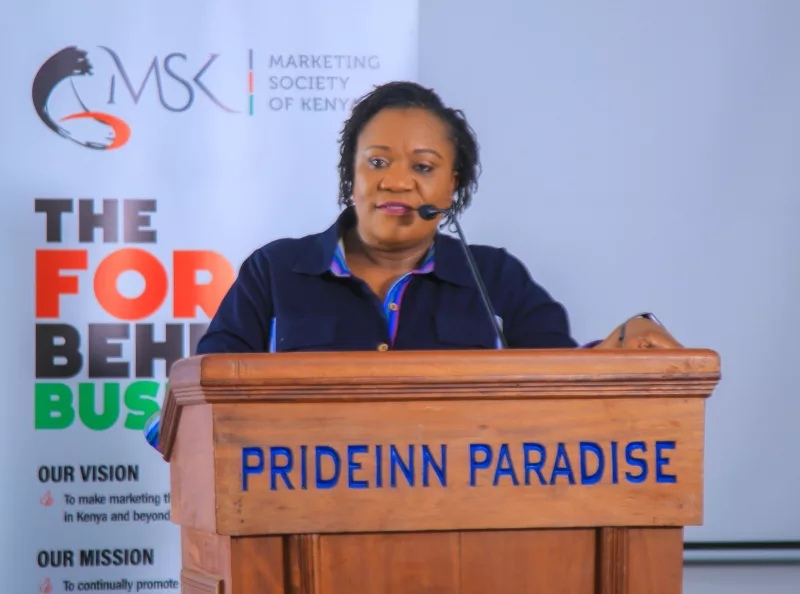
The Marketing Society of Kenya has urged marketers to take a bigger role in shaping Kenya’s economic growth as organisations navigate changing consumer expectations, rapid technological disruption and increasing pressure to demonstrate business value.
The call was made during the two-day MSK Marketers Conference 2026 held at PrideInn Paradise Beach Resort in Mombasa on September 10 and 11 under the theme “Growth by Design: Marketing for a Changing Economy.”
MSK chairperson Zuhura Odhiambo said the conference was deliberately structured to move the conversation beyond marketing communications and explore the wider role marketers must play in shaping customer experience, innovation, trust, business strategy and sustainable value creation.
According to Odhiambo, marketing has always been about growth, but changing economic conditions require organisations to approach growth differently.
“But in the environment, we are operating in today, growth cannot be assumed. It has to be designed -around a deeper understanding of the customer, a clear value proposition and the ability to connect creativity, technology and commercial outcomes,” she said.
Technopolis Development Authority CEO John Paul Okwiri said today’s economy was characterised by greater competition, with consumers becoming better informed through rapidly evolving technology while trust was increasingly difficult to earn.
According to him, these changes require organisations to think about how they can deliberately design growth using data and focus resources on what genuinely serves their strategy.
Kenya Tourism Board CEO June Chepkemei said growth could not be designed around campaigns alone, but must consider the entire customer system, from discovery and consideration through to the actual experience and ultimately advocacy.
She called on marketers to see themselves not simply as communicators, but also as designers of demand, conveners of stakeholders and stewards of long-term value.
“Growth by design is the opposite of growth by luck. The society needs marketers who think like designers of growth, not just communicators of products.”
The conference also focused on the changing relationship between brands and increasingly informed and discerning consumers, with trust identified as a key consideration.
During a session on Consumer Confidence in Uncertain Times, Beatrice Njiraini, Regional Director East Africa at Eskimi, explored how economic pressure, information overload and a changing media environment are making consumers more deliberate about the brands they choose.
She highlighted that 80 per cent of people trust the brands they use, with trust increasingly considered in decision-making and quality.
Chepkemei said a promise made in advertising must ultimately be delivered through the customer experience.
“Trust is no longer simply a brand metric; it is increasingly a growth asset. And if an advertisement promises ease and the customer encounters friction, the brand loses trust.”
The conference further highlighted the role of artificial intelligence in shaping the future of marketing and its impact on human judgement.
Mark Kaigwa, founder of Nendo, called on marketers to move beyond treating AI simply as a “chatbox” and begin experimenting with its ability to support research, writing, visual exploration, analysis, video and the creation of practical internal tools.
He said AI had significantly lowered the cost and time required to move an idea from concept to an initial prototype, changing the economics of experimentation.
Kaigwa cautioned that greater access to technology did not remove the need for human judgement, cultural understanding and local relevance. He urged marketers to use AI deliberately while retaining the human judgement and local intelligence required to create work that connects with consumers.
The conference also examined how technology can be used to move from mass marketing towards more personalised ways of reaching consumers.
Joe Kanyua, founder and principal adviser at JaaSify Technology PLC, challenged marketers to rethink traditional segmentation.
His presentation explored the journey from broad audience targeting towards a “segment of one”, supported by better customer identity, value exchange, continuous learning and technology capable of enabling more individualised customer experiences.
Speakers also challenged marketing professionals to move beyond reporting activities and demonstrate outcomes that contribute to growth.
The Micro and Small Enterprises Authority highlighted the importance of measuring marketing through tangible outcomes by creating applications that address enquiries, orders, customer retention and repeat purchases, rather than relying solely on followers or visibility.
Okwiri reminded delegates of the need to take greater ownership of the growth agenda.
“Don’t just design campaigns. Design growth. Design with evidence but leaves room for imagination. Design for attention but build for trust. Design for today’s results but never lose sight of tomorrow’s value.”
The MSK Marketers Conference 2026 brought together marketing professionals, business leaders, entrepreneurs, technology leaders and industry experts under the theme “Growth by Design: Marketing for a Changing Economy.”