

Faith-based institutions and indigenous communities have committed to use their networks to promote the ongoing conservation efforts.
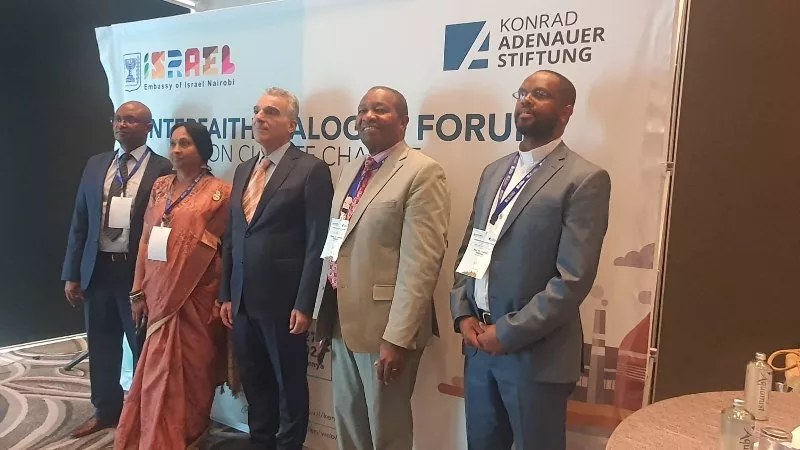
Speaking in Nairobi during an interfaith dialogue organised by the Embassy of Israel in Kenya and the Konrad-Adenauer-Stiftung (KAS), the leaders said they will use their masses to grow trees, conserve water, practice climate smart farming and restore heavily degraded ecosystems.
Inter-Religious Council of Kenya board member representing Deliverance Church-Lang’ata Geoffrey Njuguna said the religious leaders will hold the government accountable on how resources are utilised.
“Faith leaders must hold every level of government and every partner to account so that climate finance reaches the communities who need it,” he said.
The interfaith dialogue forum on climate change was held under the theme ‘Faith, stewardship and hope: The role of faith and indigenous leaders in building climate resilience communities.
Njuguna said the church will use its power to ensure Kenyans are taking active role in mitigating and adapting to the impacts of climate change adding that they have advantage as the church is everywhere.
“We get the masses coming to us without placing advertisements,” Njuguna said.
Njuguna said the church will speak to powers to ensure there is accountability when it comes to the use of resources meant to address the impacts of climate change.
“As religious leaders, you will hear us more and more addressing the politicians and telling them to understand that there is a country to safeguard even as we go to this election time. That they don’t just think about assuming power but we think about the welfare of Kenyans everywhere.”
Israeli Ambassador to Kenya Gideon Behar said the church has the responsibility in protecting the environment.
“Religious leaders and faith leaders have a very important role to play in protecting the environment and preventing the climate crisis. They have a moral leadership and a moral responsibility, and we need their voices heard locally, nationally, and internationally, because we are now at a crossroad for humanity when climate change is really deteriorating, the environment is being destroyed, and we need every possible power here, every possible partner, to stop this deterioration and to rebuild our world,” Behar said.
Behar said indigenous knowledge is also very crucial in addressing the impact of climate change.
“The people who have been living with nature for generations know the best how to steward the environment, how to protect animals, how to protect the trees,” he said.
The Ambassador said the Israeli Embassy is ready to support initiatives by sharing expertise in water management, agriculture, science, technology, sustainability and renewable energy.
Deputy Director of the Climate Change Directorate at the Ministry of Environment Thomas Lerenten said Kenya has robust legal framework for climate action, including the Climate Change Act of 2016 and the National Climate Change Action Plan.
Lerenten however said policies alone will not help deal with the challenges associated with the impacts of climate change.
He said partnerships among government, faith-based institutions, indigenous communities and civil society remains crucial as government could not address the crisis alone.
Catholic priest Rev. Fr Patrick Ndungu of the Archdiocese of Nairobi urged the church to step up environmental protection adding that the move is a moral responsibility.
Ndungu said there is a need for Kenyans to conserve water, adopt sustainable transport, reduce waste and invest in activities that restore degraded environments.