


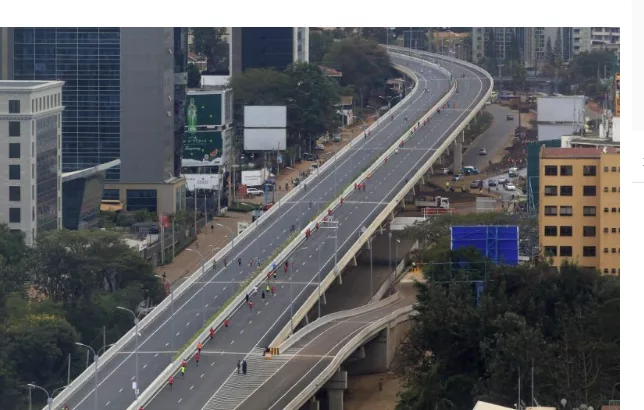
China Communications Construction Company (CCCC), the parent group of China Road and Bridge Corporation (CRBC), reported operating revenue of RMB204 million (Sh3.9 billion) from its Nairobi Expressway concession in the six months to June 30, 2026.
This was up from RMB190 million (Sh3.6 billion) in the corresponding period of 2025, representing growth of about 7.4 percent.
The Sh3.9 billion revenue in six months translates to Sh21.5 million daily.
The group’s interim report separately shows that all its concession projects generated RMB3.936 billion (Sh74.6 billion) during the period, meaning Nairobi accounted for about 5.2 per cent of concession revenue.
Even so, the Nairobi asset remains small compared with the scale of the Chinese infrastructure giant.
CCCC reported group revenue of RMB333.16 billion (Sh6.4 trillion) in the first half of 2026, down 1.16 per cent from the previous year.
Nairobi’s RMB204 million (Sh3.9 billion) therefore represented only about 0.061 per cent of total group revenue.
The company nevertheless operates in 139 countries and regions, making the Nairobi road a relatively small but strategically important overseas concession asset.
The Chinese firm recorded RMB200 million from the Nairobi concession in 2023, RMB323 million (Sh6.1 billion) in 2024 and RMB406 million (Sh7.7 billion) in 2025.
The road’s accumulated investment stood at RMB4.7 billion (Sh89.3 billion) by June 2026, while its toll-collection rights run for 27 years.
That growth has been closely linked to rising traffic.
Official Public-Private Partnership (PPP) data shows the road averaged 67,298 vehicles a day in FY2024/25, compared with about 59,000 two years earlier and only 11,000 when operations began.
During the first half of FY2024/25, 12.5 million vehicles used the road. Yet higher traffic has not automatically translated into profits.
Treasury data showed the operator recorded a Sh1.84 billion loss in the six months to December 2024, after collecting Sh7.16 billion in tolls against about Sh9 billion in expenses, including debt servicing, operations and maintenance.
Investment analysts have argued that although the expressway is commercially successful in attracting motorists, its financial model carries substantial long-term financing costs and foreign-exchange exposure.
The road was developed under a 30-year build-operate-transfer arrangement, with 27 years of toll collection after construction.
Kenya’s PPP Directorate puts the project value at Sh86.8 billion, with Moja Expressway responsible for financing, operating and maintaining the road before transferring it back to the State.
Original projections envisaged toll revenues of about Sh302.5 billion over the concession, while earlier government estimates placed annual revenue at roughly Sh11.2 billion.
“The model places traffic and revenue risk largely on the private operator rather than the taxpayer. This insulates taxpayers from unnecessary liabilities,’’ Mathew Mugambi, an investment banker, told the Star.