



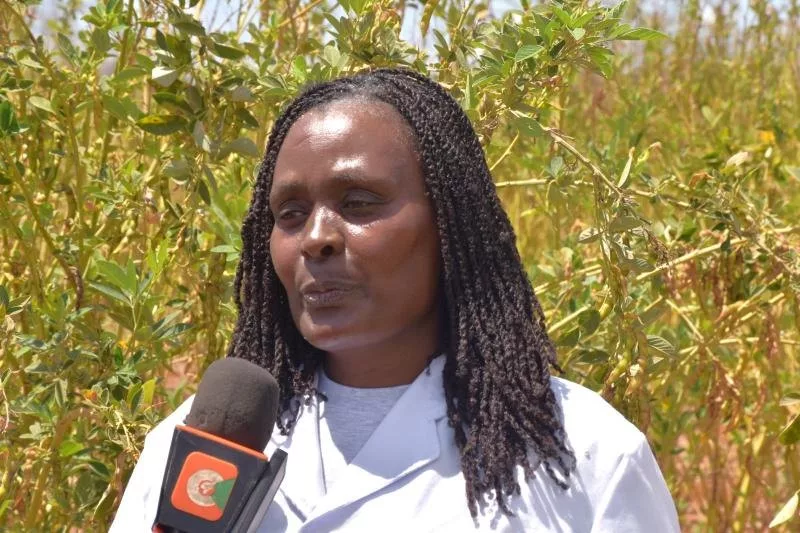
Benson Kyalo Mwengi, a farmer from Kasopi sublocation in Makindu subcounty, has grown pigeon peas for many years.
He has been growing the Kionza pigeon peas variety that takes up to eight or nine months to mature.
“If the rains failed, I could wait for even longer just to get anything to harvest. Sometimes I could go without a harvest for an entire year,” he says.
However, Mwengi is today harvesting pigeon peas almost throughout the year, thanks to a new variety developed by researchers at the Kenya Agricultural and Livestock Research Organisation (KALRO).
Known as Mituki in Kikamba, the variety has transformed Mwengi’s farm by shortening the period to harvest and allowing him to earn income even during dry periods.
“In my farming journey, we have gone through many things until we got to where we are,” Mwengi says.
He began testing Mituki about five years ago, planting it alongside the traditional variety so he could compare their performance. And there was a big difference.
“When you plant Mituki, it only takes three months before you start harvesting for the first time. In comparison, our old Kionza takes eight to 10 months to harvest,” he says.
While waiting for Kionza to mature, Mwengi can harvest Mituki two or three times.
The variety also produces larger and heavier seeds, cooks faster and has a sweeter taste.
But its biggest attraction is its ability to continue producing. Unlike Kionza, which bears once and stops, Mituki can continue flowering and producing pods throughout the year when moisture is available. Mwengi says even limited watering can keep the crop productive.
“I harvest from January to December, and I am able to sell all year round. My income as a farmer has improved a lot,” he says.
The variety is particularly suited to the hot, dry conditions of eastern Kenya, where temperatures can rise above 32 degrees Celsius.
Mwengi says Mituki continues growing under such conditions and can provide food and income when other crops struggle.
The farmer is also benefiting from the demand for pigeon peas in the market. He says prices can rise from about Sh40 per kg during the rainy season to around Sh100 during dry periods when supplies are lower.
“Mituki is number one in terms of income and yield compared to other crops I have,” he says.
Rael Karimi, a breeder from KALRO, says the success of Mituki is linked to the crop’s natural ability to survive in dry conditions.
“Pigeon pea has a deep rooting system that enables it to access moisture from deeper layers of soil, allowing it to produce during dry spells when other crops may fail. It can also be grown as a monocrop or intercropped with crops such as maize,” Karimi says.
She adds that when intercropped, Mituki can fix about 40kg of nitrogen in a season, benefiting subsequent crops and potentially reducing fertiliser requirements.
The variety was developed in response to farmers’ demand for a pigeon pea that could retain the desirable characteristics of traditional varieties while maturing earlier.
Released in 2018, it takes about 125 to 135 days to mature. It also has larger pods and grains, making it attractive to traders selling green pigeon peas.
“The variety has since been disseminated to farmers in Machakos, Makueni, Kitui and parts of Embu. Through small seed packets and on-farm demonstrations, about 9,000 farmers were reached in one year,” Karimi adds.
Dr Lillian Gichuru, a seed systems specialist at the International Maize and Wheat Improvement Centre, says developing a variety is only the beginning; getting enough quality seed to farmers is equally important.
Researchers have also screened Mituki for Fusarium wilt, a major pigeon pea disease that can cause losses of up to 70 per cent in susceptible varieties.
Gichuru says Mituki is tolerant to the disease and can produce about 1.7 to two tonnes even under high disease pressure.
The variety is now being commercialised, with several seed companies licensed to produce it.
For Mwengi, however, the value of the research is measured not only in tonnes harvested, but in the opportunities it creates.
His farm employs between four and 15 workers, depending on the season, providing jobs to local people.
“Mituki has helped me a lot. It has raised my cultivation level. I am grateful for the KALRO research that has brought us this seed,” he says.