


On Tuesday, Athletics Kenya made an historic announcement that could potentially change the landscape of global athletics forever, confirming that it has officially submitted the nation’s bid to stage the 2029 World Athletics Championships in Nairobi.
Should the bid prove successful and Kenya be selected, it would be a landmark moment not only for the East African powerhouse but for the entire continent, as an African nation would, for the first time in the history of the competition, welcome the world’s finest track and field athletes to its soil for the sport’s flagship championships.
“Nairobi has officially submitted its formal application to host the 2029 World Athletics Championships, presenting a compelling case to bring the global flagship event to African soil. The submission places the Kenyan capital firmly in the running for the global selection process.”
“Kenya has put forward a robust, government-backed bid that is expected to serve as a strong, historic push for the African continent. If successful, the selection of Nairobi would mark the first time the senior World Athletics Championships are held in Africa,” read the statement from the national athletics governing body.
The bid, therefore, carries significance far beyond the confines of a sporting stadium, because it represents Kenya’s bold attempt to take the world’s biggest athletics spectacle to the very heartland of a sport that has been woven into Africa’s sporting identity for generations.
The World Athletics Championships are a major global outdoor track and field competition organised by World Athletics, ranking alongside the Olympic Games as the highest-level international event for running, jumping, throwing and walking.
It is widely considered the third-largest sporting event in the world, bringing together roughly 2,000 athletes from over 200 nations.
The World Championships are held every two years, bringing together the globe’s elite track and field stars to battle for medals, national pride and the coveted distinction of being crowned world champion.
The championship itself was created to give track and field its own independent global stage separate from the Olympic Games, after athletics had for decades relied on the Olympics as its de facto world championships.
Following the 1980 Olympics, the IAAF officially approved the move and launched the first full-scale, multi-event World Championships in Helsinki in 1983, laying the foundation for what has now become one of the most prestigious spectacles on the international sporting calendar.
The championship has since grown into a premier global sporting event, eagerly anticipated for the adrenaline it generates, the rivalries it intensifies and, perhaps most importantly, the stars it creates and immortalises in the history books.
Kenya’s ambitious push is therefore not simply an attempt to bring the global showpiece to Kenyan soil for the very first time, but a historic charge to finally take the championships to a continent that has supplied some of athletics’ greatest champions, fiercest rivalries and most unforgettable performances.
And just like at the Olympic Games, Kenya has been a shining light at the World Championships from the very first edition, building an athletics legacy that makes Nairobi’s current bid more than a geographical proposition; it is a case built on decades of excellence, dominance and an unrivalled connection with the sport.
On the all-time medal standings, Kenya ranks second with a cumulative 182 medals, comprising 72 gold, 60 silver and 50 bronze, making it by far the highest-ranked African nation, with close regional rivals, Ethiopia, following in sixth place with 108 medals while South Africa sit further back in 22nd place with 28 medals.
The United States leads the World Athletics Championships all-time medal standings with a staggering 469 medals, but it’s the Kenyan stars who have repeatedly stamped their authority on some of the most demanding events on the championship programme.
In the men’s 3,000m steeplechase, for instance, Kenya boasts the most medals with 33 in total, comprising 13 gold, 12 silver and eight bronze, while the closest rival, Morocco, sits way behind with just seven medals.
Ezekiel Kemboi, affectionately dubbed ‘Baba Yao’, remains the ultimate symbol of Kenya’s steeplechase supremacy, having won four consecutive world titles in Berlin in 2009, Daegu 2011, Moscow 2013 and Beijing 2015, a remarkable sequence that cemented his status as one of the greatest water-and-barrier specialists the world has ever seen.
The same dominance is evident in the men’s and women’s 1,500m, where Kenya leads the all-time charts in the men’s event with 13 medals, comprising five gold, six silver and two bronze, followed by Morocco with eight, while in the women’s event Kenya tops the standings with eight medals, including four gold, three silver and one bronze, with Russia following with five cumulative medals.
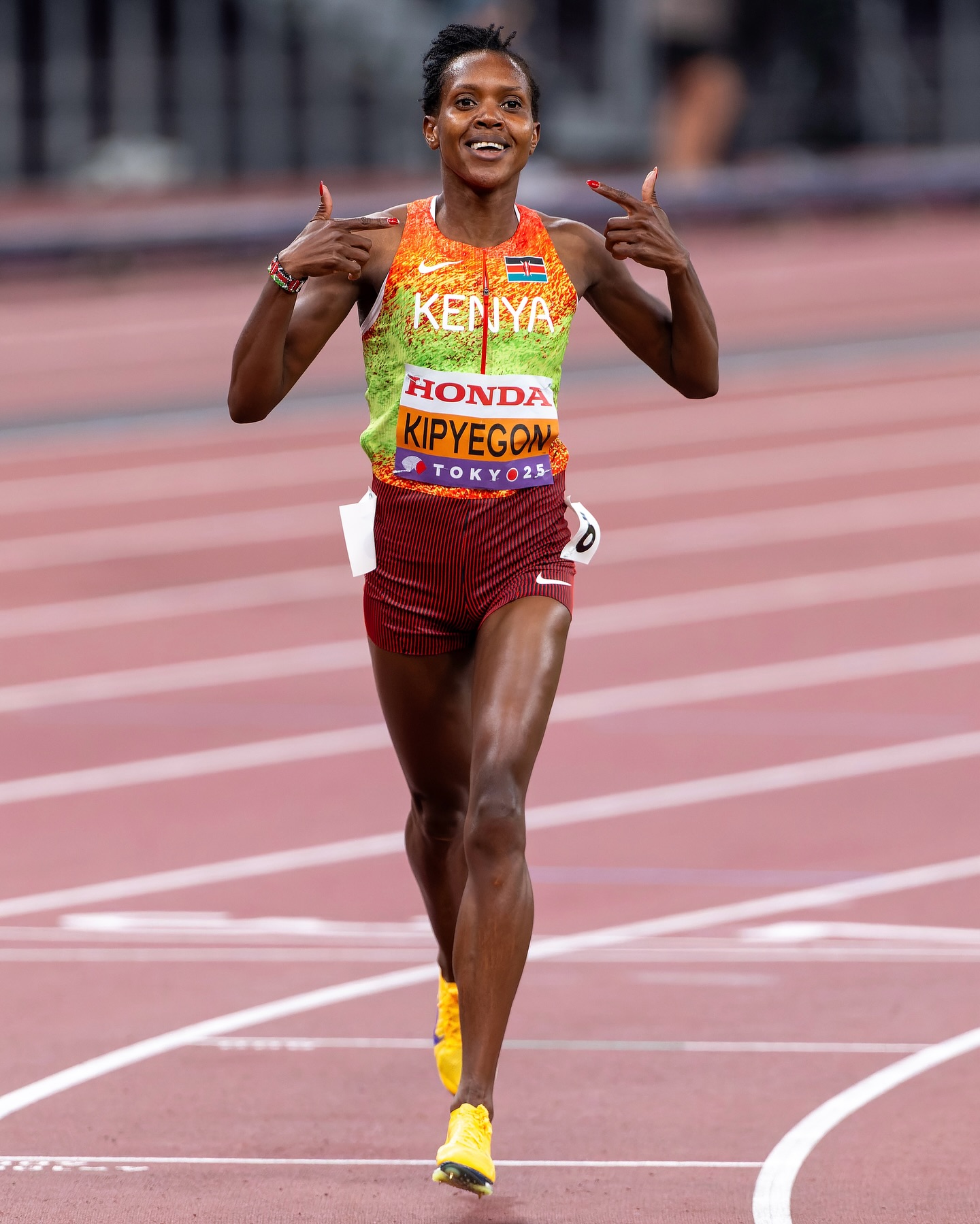
Interestingly, all four of Kenya’s women’s 1,500m gold medals have been won by one extraordinary athlete, Faith Kipyegon, who has established herself as the undisputed queen of the middle distance and one of the most decorated runners in modern athletics.
Further evidence of Kenya’s global footprint can be found in the marathon, where the nation has remained a force to reckon with, leading the men’s all-time medal standings with nine medals, comprising five gold, three silver and one bronze, with Ethiopia second with 13 medals, including three gold, six silver and four bronze.
In the women’s marathon, however, no nation comes close to Kenya’s dominant haul of 22 medals, including 16 gold, five silver and one bronze, with Ethiopia a distant second with just four medals, a remarkable illustration of the country’s extraordinary depth and tradition over the classic distance.
Kenya’s influence has also extended beyond the running track and into the field, with javelin icon Julius Yego making history by becoming the first Kenyan to win gold in the javelin at the World Championships in Beijing in 2015, a title he famously honed by watching YouTube videos, earning him the unforgettable nickname ‘The YouTube Man’.
At the most recent edition in Tokyo, Japan, Kenya yet again made history, this time in the women’s events, becoming the first nation in history to secure all gold medals from the 800m through to the marathon.
Yet while Kenya has conquered the world’s greatest athletics stages in different cities and repeatedly returned home laden with medals, its passionate fans have been denied the opportunity to watch their track and field icons compete on home soil against the global elite, cheering them through the pressure of championship rounds and pushing them towards the kind of performances that have made Kenya synonymous with athletics.
Instead, Kenyan fans have often been forced to remain glued to their television screens at odd hours because of different time zones, sacrificing sleep and rearranging routines simply to offer support to their stars competing thousands of kilometres away.
Known around the world as the home of athletics champions because of its extraordinary collection of icons and vast pool of emerging talent, Kenya has therefore earned the right to ask for something more than another medal celebration from afar; it deserves the opportunity to open its doors, fill its stadiums and welcome the world to Africa.
However, standing between Kenya and a historic breakthrough are three formidable European contenders: Britain, Italy and Germany. “Nairobi faces competition from London, Rome, and Munich for the 2029 edition.”
“The winning host cities for both the 2029 and 2031 championships will be announced by World Athletics after the Ultimate Championships in Budapest, Hungary next month,” the statement added.
London is no stranger to staging global sporting spectacles, having hosted the 2017 World Championships as well as the 1908, 1948 and 2012 Olympic Games, giving the British capital an enormous advantage in experience, infrastructure and international event management.
Yet Kenya has also written some of its most memorable chapters in London, finishing second overall at the 2017 World Championships with 11 medals behind the United States’ 30, while David Rudisha produced one of the most iconic performances in Olympic history by setting a world record in the men’s 800m at the 2012 Games.
Rome, meanwhile, has hosted the 1960 Olympic Games as well as the 1987 World Championships, and just like London, the Italian capital has witnessed Kenyan athletes leave an indelible mark on its athletics history.
Billy Konchellah and Paul Kipkoech set championship records in the men’s 800m and 10,000m respectively on their way to winning gold medals at the 1987 World Championships.
Germany, too, has a formidable hosting pedigree, having welcomed the world through the Olympic Games in Berlin in 1916 and 1936 and Munich in 1972, as well as the World Championships in Stuttgart in 1993 and Berlin in 2009.
In Berlin 2009, Kemboi set a championship record in the men’s 3,000m steeplechase, while Abel Kirui produced a course-record performance in the marathon, with Moses Kiptanui having earlier set a course record in the steeplechase in Stuttgart 1993.
London boasts world-class, pre-existing infrastructure, a proven track record of commercial success and strong financial backing from the UK Government.
The championships, should London win, would be staged at the London Stadium, the centre stage of the 2012 Olympic Games, which features a world-renowned track and capacity designed for elite international events.
Rome, meanwhile, will bank on its fully approved financial guarantees, a massive wave of recent major-event hosting experience and its historic athletics heritage centred around the Stadio Olimpico.
The Italian capital has built further logistical experience through the staging of high-profile international events, including the European Athletics Championships in 1934, 1974 and 2024.
Munich, on the other hand, will lean on the historic Olympiapark infrastructure, a proven record of staging major multi-sport events and its dual-year strategy covering both 2029 and 2031 championships.
The iconic Olympiastadion in Berlin, originally built for the 1972 Summer Olympic Games and now slated for comprehensive modernisation, sits at the centre of Germany’s bid.
But while London, Rome and Munich bring impressive credentials to the table, Nairobi’s case is built on something that cannot simply be constructed, modernised or purchased: a deep-rooted athletics culture and an emotional connection between the sport, its champions and the people.
Kenya has already demonstrated that it can stage world-class athletics events, having hosted the World Cross Country Championships in Mombasa in 2007, the World Athletics Under-18 Championships in Nairobi in 2017 and the World Athletics Under-20 Championships, also in Nairobi, in 2021.
“Kenya has hosted major global athletics events in the past, namely the World Cross Country Championships in Mombasa in 2007, the World Athletics Under-18 Championships in Nairobi in 2017 and the World Athletics Under-20 Championships, also in Nairobi, in 2021.”
“Kenya also hosts annual World Athletics Gold Label events, namely the Kip Keino Classic track and field meeting in Nairobi and the Sirkwa Classic Cross Country Championships in Uasin Gishu County.”
“Nairobi also hosted the 2010 African Athletics Championships at the Nyayo National Stadium,” the statement from Athletics Kenya added.
The Moi International Sports Centre, Kasarani, has already demonstrated its ability to produce the atmosphere required for a global championship, having staged an electric World U20 Championships where the stadium was filled to the brim and the sheer energy from the stands became one of the defining memories of the event.
The 2021 World U20 Championships in Nairobi were also instrumental in unearthing global and local talents who have since gone on to establish themselves among the sport’s brightest stars.
Among them were Botswana’s Letsile Tebogo, who won gold in the 100m, Kenya’s Emmanuel Wanyonyi, who triumphed in the 800m, Nigeria’s Nnamdi Chinecherem, who claimed gold in the men’s javelin, and Jamaican sprinting sisters Tina and Tia Clayton.
For Tebogo, Nairobi holds a special place in his heart, offering perhaps the clearest illustration of what staging a World Championships on African soil could mean to the next generation of athletes.
“My most memorable moment was when I won the first gold medal for Botswana in Kenya because that’s when I knew this could be something great and beautiful for the country and me as well,” the 23-year-old Botswana sprinter told Mozzart Sport in an interview.
That emotional connection is precisely what Nairobi can offer the World Championships, an event that would not merely pass through Africa, but would become part of the continent’s sporting story, allowing athletes from across the globe to compete in a city where athletics is not simply a profession or spectacle, but a deeply cherished way of life.
When selecting host nations and cities for the World Athletics Championships, World Athletics evaluates bids through a dedicated evaluation panel using a transparent and objective framework, with the primary areas assessed including the quality, capacity and readiness of the main stadium, track standards, seating capacity and training facilities. Other key considerations include security, logistics, government support and financial guarantees, areas in which Kenya believes it has assembled a credible and comprehensive case.
There is little doubt that the Kenyan government has demonstrated strong support for athletics, with substantial backing for the Kip Keino Classic and a structured rewards programme for medallists at global championships, while the government has also
nations and cities for the World Athletics Championships, World Athletics evaluates bids through a dedicated evaluation panel using a transparent and objective framework, with the primary areas assessed including the quality, capacity and readiness of the main stadium, track standards, seating capacity and training facilities.
Other key considerations include security, logistics, government support and financial guarantees, areas in which Kenya believes it has assembled a credible and comprehensive case.
There is little doubt that the Kenyan government has demonstrated strong support for athletics, with substantial backing for the Kip Keino Classic and a structured rewards programme for medallists at global championships, while the government has also
committed its full support to the Nairobi bid.
“The government has committed its full support to the bid, ensuring the necessary organisational framework, security measures, and modern infrastructure required to host a world-class global showpiece,” Athletics Kenya said in its statement.
Nairobi’s bid has also received significant backing from across the continent, including the Confederation of African Athletics (CAA), which has embraced Kenya’s attempt to become the first African nation to stage the senior World Athletics Championships.
“The Confederation of African Athletics (CAA) welcomes the bid from Athletics Kenya to host the 2029/2031 World Athletics Championships,” the continental body’s statement read.
CAA also expressed its full support for Kenya’s historic target, stressing the significance of bringing the world’s premier athletics championship to Africa.
“In this regard, the CAA Council, fully appreciating this bid, expresses its full support for Athletics Kenya in this project, which Africa has decided to embrace.”
The continental federation highlighted that hosting the championship would open African doors to the world, allowing the continent to showcase not only its athletic prowess but also its culture, heritage and growing influence on the international sporting stage.
“Hosting this competition will offer Africa the opportunity to further open its doors to the world and showcase the continent’s strength, heritage, excellence, and growing global influence in the field of athletics,” the statement added.
It also pointed to Kenya’s successful record of hosting previous global events, particularly the World Cross Country Championships and the World U20 Championships in Nairobi.
“Athletics Kenya has already demonstrated its ability to host world-class events in recent years, notably with the World Cross Country Championships in Mombasa and, most recently, the 2021 U20 World Championships in Nairobi, both of which were a resounding organisational success.”
“Therefore, we are confident that Athletics Kenya will once again dedicate all its efforts to ensuring the success of these World Championships,” the statement concluded.
Kenyan marathon icon Eliud Kipchoge has also thrown his considerable weight behind Nairobi’s bid, believing that after decades of Kenya providing the world with champions, record-breakers and unforgettable performances, the country deserves an opportunity to host the very event in which it has repeatedly excelled.
“I’m telling the world to give us the chance. Giving Kenya the chance is giving back to the sport. Kenya has been winning all the medals and breaking all the world records, winning the Diamond Leagues… winning everything,” Kipchoge said.
“The only gift that the world can give Kenya is to accept and give us the chance to host the World Championships in 2029. It will be a huge moment for Kenya and for Africa.”
The former world marathon record holder, who became the first man to run a marathon in under two hours in 2019, although unofficially, insists that Kenya’s dominance over the past four decades deserves recognition that goes beyond the medals accumulated on foreign soil.
“Kenya has been in the limelight in track and field for the last 40 years. It’s time the world said, ‘Let’s allow this beautiful country and this young continent to host the World Championships.’ That is the greatest gift the world can give Africa, and above all Kenya,” he added.