



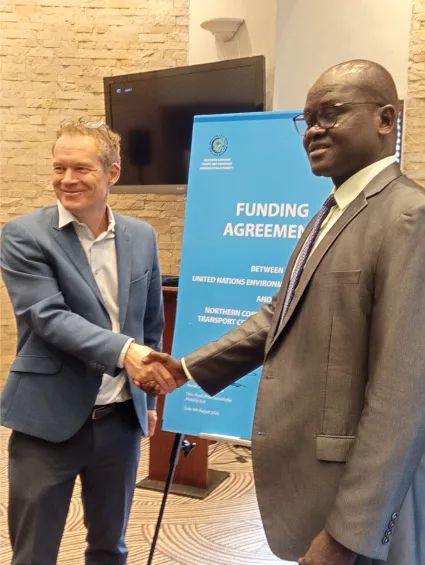
Kenya and five other Northern Corridor member states have launched a new programme aimed at making regional freight transport cleaner, more efficient and inclusive.
The move is expected to lower logistics costs, improve trade competitiveness and prepare the transport sector for the transition to low-carbon operations.
The initiative, unveiled through a funding agreement between the United Nations Environment Programme (UNEP) and the Northern Corridor Transit and Transport Coordination Authority (NCTTCA), will support implementation of the Northern Corridor Green Freight Strategy 2030, while promoting greater participation of women in the freight transport industry.
The Northern Corridor is East Africa’s busiest trade route, linking the Port of Mombasa with Uganda, Rwanda, Burundi, South Sudan and the Democratic Republic of Congo, and handles thousands of trucks transporting imports and exports every day.
NCTTCA executive secretary John Deng said the partnership will strengthen efforts to transform the corridor into a seamless, efficient and environmentally sustainable transport network while supporting economic growth across the region.
“Our goal is to transform the corridor into an economic development corridor through efficient and smart transport systems,” Deng said.
The latest funding will focus on three major areas including updating greenhouse gas emissions data across Kenya, Uganda and Rwanda, studying the feasibility of electric truck operations and port vehicle electrification at the Port of Mombasa, and developing a gender-inclusive green freight programme.
For Kenya’s logistics industry, the programme could provide a significant boost as transport operators grapple with rising fuel costs, increasing environmental regulations and pressure from global supply chains to reduce carbon emissions.
According to NCTTCA, about 2,000 to 3,000 trucks move approximately 75,000 tonnes of cargo daily from the Port of Mombasa to inland destinations across East and Central Africa, making the corridor one of Africa’s most critical trade arteries.
The planned study on electric truck drayage will assess whether trucks operating within the Port of Mombasa can gradually shift to electric mobility, potentially lowering fuel consumption and operating costs while reducing emissions.
UNEP and NCTTCA say ports offer one of the best starting points for electrification because trucks operate over short and predictable distances, making battery-powered vehicles commercially viable.
The agreement also aims to improve emissions accounting by collecting updated freight transport data and integrating the findings into the Northern Corridor Transport Observatory.
Reliable emissions data is increasingly becoming a requirement for accessing international climate finance and supporting investment in cleaner transport technologies.
The programme will also facilitate knowledge sharing with transport corridors in West Africa, Latin America and Southeast Asia to replicate successful green freight initiatives.
Another key pillar of the project is increasing women’s participation in the freight transport value chain.
A corridor-wide gender audit will identify barriers preventing women from participating in transport and logistics, while informing policy reforms and institutional changes to promote greater inclusion.
The programme will also convene governments, freight operators, civil society and women’s organisations to develop gender-responsive policies for the transport sector.
The initiative builds on the Northern Corridor Green Freight Strategy 2030, which seeks to improve freight fuel efficiency by 10 per cent, reduce carbon dioxide emissions intensity by 10 per cent, cut harmful pollutants including particulate matter, black carbon and nitrogen oxides by 12 per cent, and ultimately achieve net-zero freight transport by 2050.
Fuel accounts for nearly half of trucking operating costs, meaning improvements in fuel efficiency can significantly lower transport expenses while reducing greenhouse gas emissions.
The authority has already introduced eco-driving training programmes across member states, promoted harmonised vehicle standards and supported development of cleaner fuel policies to improve cross-border transport efficiency.
Recent emissions assessments show Kenya contributes the largest share of freight transport emissions along the corridor, underscoring the importance of accelerating the adoption of cleaner transport technologies.
As cargo volumes through the Port of Mombasa continue to grow, regional transport authorities believe investments in green freight infrastructure and smarter logistics systems will be essential in maintaining the Northern Corridor’s competitiveness, while helping member states meet their climate commitments.