


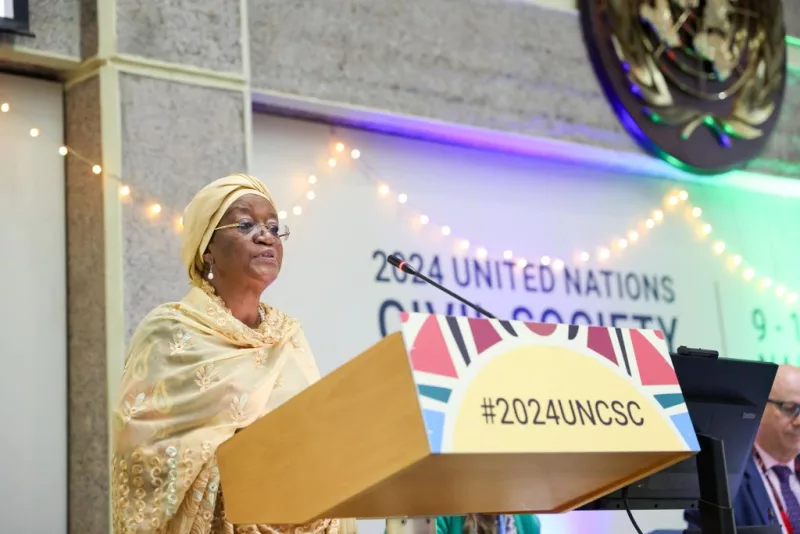
The United Nations Office at Nairobi (UNON) has evolved into one of the organisation’s most critical global operational hubs, thanks to Kenya’s strategic location, lower operating costs and world-class support services, Director-General Zainab Hawa Bangura has said.
Speaking during an interview with NTV on Wednesday, Bangura explained that the steady expansion of UN operations in Nairobi was driven by deliberate institutional decisions aimed at improving efficiency while reducing costs.
She said Kenya was always destined to play a significant role within the UN system because of its geographical position.
“Kenya was destined to play that role because of its geographical location. From here, you can reach everybody,” Bangura said.
The UN established its presence in Nairobi in 1972. Since then, the Gigiri complex has grown from hosting a handful of agencies to accommodating 88 UN offices, making it the only UN headquarters in the Global South.
“Today we have 88 UN offices in the Gigiri complex since 1972. We have grown over the period,” she said.
Bangura said the establishment and expansion of the United Nations Office at Nairobi was made possible through Kenya’s support over the years. She noted that Kenya’s founding President, Mzee Jomo Kenyatta, donated 100 acres of land in Gigiri, Nairobi, for the construction of the UN complex.
The late President Daniel Arap Moi later allocated an additional 40 acres, bringing the total size of the compound to 140 acres. Today, the sprawling Gigiri complex is home to the largest United Nations office outside New York.
Bangura revealed that the UN’s expansion in Nairobi accelerated after the organisation began reviewing its global operations during periods of financial liquidity challenges.
She said individual assessments were conducted to determine where operations could be delivered more efficiently.
“They looked at the fact that we have a compound in Kenya where agencies do not have to pay separately for security because everything is put together, and the costs go down,” she said.
She added that Nairobi also enjoys lower operational expenses because it does not require costly heating systems or extensive air conditioning needed in many other duty stations.
Beyond cost savings, Bangura said Nairobi’s time zone and connectivity make it uniquely positioned to support global operations.
“My staff at Gigiri can link up with anybody around the world within a 12-hour period. They did those assessments and realised it is better and easier for them to work from Nairobi. That is why they took the decision to come to Nairobi,” she said.
Today, Nairobi supports UN operations in 166 countries worldwide.
“Nairobi is the only duty station within a 12-hour period that can reach anywhere in the world. We provide services in 166 countries from here. It allows us to go as far as Fiji, Indonesia, the Pacific and Asia,” Bangura said.
She noted that the city has also become a critical emergency response centre for the UN.
According to Bangura, Nairobi hosts more UNICEF staff than any other location globally, although it is not the agency’s headquarters. The city accommodates headquarters personnel, regional staff and serves as an evacuation centre supporting operations in 14 countries.
“Every time we have crises and you look at where you can go, what comes in the middle is Kenya, the Nairobi office. That is how, over the period, Nairobi became a main centre for UN operations,” she said.
The Gigiri complex now employs nearly 6,000 people across its 88 UN offices.
Bangura described Nairobi as one of the UN’s most valued duty stations.
“When I got this job in Nairobi, I was told Nairobi is a golden gem within the UN. That is how they described it to me,” she said.
She also highlighted Kenya’s significant contribution to the UN workforce, noting that more than 60 per cent of staff based at the Nairobi duty station are Kenyans.
According to Bangura, Kenya has the highest number of UN staff globally, exceeding its geographical quota by nearly five times because many recruitment processes and operations are conducted through Nairobi.
However, she cautioned that securing employment with the UN is highly competitive and governed by a rigorous recruitment system.
“We are 193 member countries. If you apply for a job, you have to go through a system. People call me asking if they should send me their CV. We do not do CVs. We use the Personal History Profile (PHP),” she said.
She explained that applicants must first understand the UN’s online recruitment system before progressing through several stages, including written assessments and interviews.
“You go through three or four steps before you get to the interviews. The system is very transparent and very strict,” she said.
Bangura, however, disclosed that the UN has temporarily frozen recruitment due to ongoing financial liquidity challenges.