


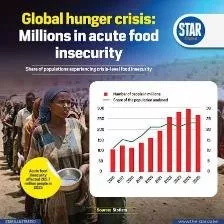
The State of Food Security and Nutrition in the World (Sofi) 2026 report says hunger worldwide fell to 645 million people in 2025, down from 659 million in 2024 and 688 million in 2022. However, Africa has overtaken Asia as the region with the largest number of hungry people.
The report, released by the Food and Agriculture Organization (FAO), the International Fund for Agricultural Development (IFAD), the United Nations Children’s Fund (UNICEF), the World Food Programme (WFP) and the World Health Organization (WHO), estimates that 309 million Africans experienced hunger in 2025.
The findings came as Kenya continues to battle worsening food insecurity driven by recurrent droughts, erratic rainfall, floods, conflict, disease outbreaks and displacement, particularly across the Arid and Semi-Arid Lands (Asals).
According to the United Nations Office for the Coordination of Humanitarian Affairs (OCHA), 3.3 million Kenyans were food insecure by March 2026, with the figure projected to increase to 4.1 million by June. Of these, about 700,000 people are expected to face emergency levels of hunger.
The humanitarian situation has also left children increasingly vulnerable.
More than 850,000 children under the age of five require treatment for wasting, including about 200,000 suffering from severe acute malnutrition.
Although the March-May long rains improved conditions in some parts of the country, severe drought persists in northern counties such as Mandera and Wajir.
Timothy Njagi, a development economist at the African Network of Agricultural Policy Research Institutes (Anapri), said prolonged dry conditions continue to deepen food insecurity across Kenya.
“Based on the data we have, many parts of the country are experiencing severe food shortages due to unfavourable weather conditions,” he said.
“Households in the Northeastern and lower Eastern regions are largely classified as being in the stressed or crisis phases of food insecurity, with many requiring emergency food assistance to cope with the prolonged dry conditions.”
Njagi warned that Kenya should prepare for a wider food deficit if the drought continues through the rest of the year.
“The country needs to start planning now by evaluating the food stocks we have, estimating the likely deficit and identifying coping strategies, including promoting alternative food crops that can thrive under the current conditions,” he said.
Globally, the Sofi report estimates that 7.8 per cent of the world’s population experienced hunger in 2025, down from 8.1 per cent in 2024 and 8.6 per cent in 2022.
This translates to nearly 14 million fewer hungry people than in 2024 and 43 million fewer than in 2022.
Despite this progress, Africa continues to carry the heaviest burden.
While the prevalence of hunger on the continent declined slightly from 20.3 per cent in 2024 to 20.0 per cent in 2025, rapid population growth pushed the total number of hungry people to 309 million, overtaking Asia’s 292 million.
The report warns that, unless current trends change, the number of undernourished people in Africa could continue to rise.
It also projects that about 520 million people worldwide could still be chronically hungry by 2030, putting the world off track to achieve the Sustainable Development Goal of ending hunger.
FAO director general Qu Dongyu said the latest figures show progress is possible but remains too slow.
“The report shows progress is possible, but we must move faster. Ending hunger and making healthy diets affordable requires political commitment, sustained investment and enabling policies,” he said.
He said recent shocks, including the Covid-19 pandemic, conflicts in Ukraine and Gaza, climate-related disasters and disruptions to global trade, have exposed weaknesses in global food systems and highlighted the need to make them more resilient.
IFAD president Alvaro Lario said nearly 2.7 billion people still cannot afford a healthy diet.
“Our task now is to turn the evidence Sofi provides into investment. Together, we can build the value chains, market systems and rural economies that make healthy food affordable for all,” he said.
The report further found that 56.6 per cent of Africa’s population experienced moderate or severe food insecurity in 2025, compared with 20.3 per cent in Asia, 22.9 per cent in Latin America and the Caribbean, and 8.7 per cent in Northern America and Europe.
The UN agencies warned that worsening conflicts, increasingly frequent climate extremes and shrinking humanitarian funding threaten to reverse recent gains. They called for greater investment in resilient food systems to ensure healthy and affordable diets for all.