



Conservationists have raised the alarm after several invasive Indian house crows were spotted in Nairobi.
This sparked fears that the destructive birds have expanded their range beyond the Coast.
Nature Kenya – the East Africa Natural History Society (EANHS) – confirmed on Thursday that about five Indian house crows had been sighted around the City Stadium area.
Speaking to the Star by phone, Nature Kenya species expert Paul Gacheru said the organisation received reports of the birds on Wednesday.
“Yes, there was a record yesterday (Wednesday). We got a few photographs of someone chasing them away,” Gacheru said.
The sighting confirms that the invasive birds have reached Nairobi, prompting conservationists to intensify surveillance to establish how many are already in the city.
“We are also trying to see how best we can start controlling them,” he said.
Gacheru described the arrival of the birds in Nairobi as a major concern.
He said the crows are capable of travelling long distances and may have followed the Mombasa Road corridor to the capital.
He added that limited resources and capacity have remained major obstacles to efforts to control the invasive species.
The Star sought comment from the Kenya Wildlife Service (KWS), but efforts to obtain a response were unsuccessful.
KWS and other stakeholders are currently implementing control measures against the birds along the Coast.
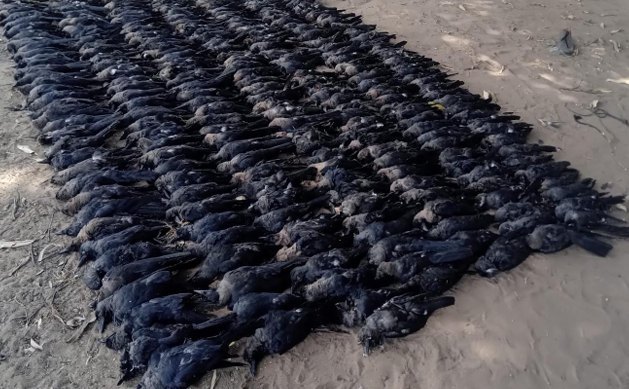
A recent report covering the period between January and April showed that 140,322 Indian house crows had been poisoned in an operation coordinated by KWS.
Originally native to the Indian subcontinent, the Indian house crow (Corvus splendens) has spread to several parts of the world, including Kenya and Dodoma in Tanzania.
The highly adaptable scavenger thrives in urban environments, particularly around food sources and waste disposal sites.
Studies have shown that the invasive bird threatens local ecosystems by preying on native wildlife, including lizards, which play an important role in pest control and maintaining food webs.
The birds also compete with native and introduced bird species for food and habitat. They prey on a wide range of animals, including small mammals, birds and reptiles, disrupting ecological balance and biodiversity.
Conservationists are using Starlicide to control the invasive species, whose population has grown significantly along the Kenyan coast.
Without natural predators, the birds continue to spread and disrupt local ecosystems, prompting authorities to intensify control efforts.
According to conservationists, Starlicide breaks down within 10 to 12 hours. If a poisoned crow dies and is later eaten by a scavenger such as a dog or vulture, it is considered safe because the poison is rapidly metabolised.
The poison remains the most effective method of reducing Indian house crow populations.
Over the past two decades, control measures combining trapping and the carefully supervised use of Starlicide have reduced the house crow population in Zanzibar Town by 95 per cent and by between 75 and 80 per cent across the island.