


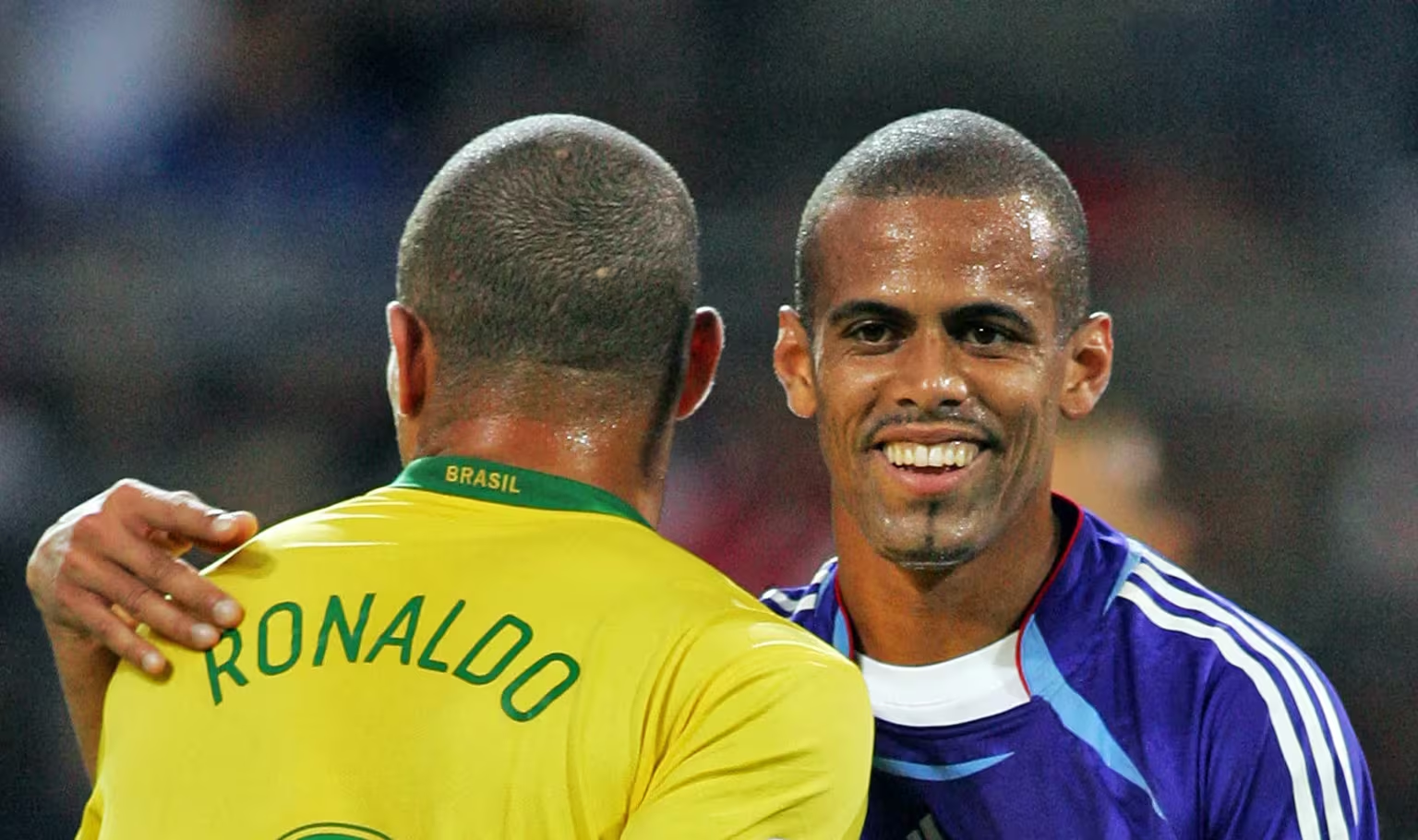
Hearing the anthem of the country of your birth at the FIFA World Cup™ is a special feeling. But what if that happens when you’re playing for the other team? That was the situation Alex Santos found himself in at the tournament in 2006 when representing Japan against Brazil in the group stage.
The Maringa-born Parana native was the Samurai Blue’s starting left-back in that meeting with Brazil in Dortmund on 22 June 2006. “It felt very strange but, at the same time, I enjoyed it,” he reflects, looking back 20 years.
His story, and the building of ties with his adopted country, go back much further than that. As a teenager, Santos moved to Japan for the chance to study and play football at a local school. He stayed on in the country, joining Shimizu S-Pulse and becoming a naturalised Japanese citizen. He would go on to represent the Asian nation at the 2002 World Cup, which Japan co-hosted with Korea Republic.
“I came over at 16 to study, so my route was very different from other players. By the time I finished school, I could speak the language and understood Japanese culture, so I decided to apply for citizenship,” Santos tells FIFA. “It was a long process and took a year and a half, but it came through in December 2001. It was similar to what’s been happening with Brazil, where some players have been brought in late for this tournament.”
Four years later, in Germany, the World Cup draw placed Brazil and Japan together in Group F. Japan lost 3-1 to Australia in their opener and then played out a goalless draw with Croatia, leaving them needing a win in their third match to advance to the knockout stage. Standing in their way were the reigning world champions, who had arrived in Europe with one of the most star-studded squads in their history, led in attack by Ronaldo, Ronaldinho, Adriano and Kaka.
“Players like Ronaldinho and Ronaldo were people I used to watch on television,” he says. “It was a chance to find out whether our team was really good enough because we were up against the best. We knew if we were to have any chance of neutralising them, we’d need to work incredibly hard. We used zonal marking rather than going man to man because we knew any one of them could change the game with a single move. Neither side was weaker – we couldn’t leave anywhere unmarked.”
One trump card for Japan was the presence of Zico. The Flamengo legend, often credited for his role in popularising football in Japan, was their coach at that World Cup. Santos remembers: “Zico brought a creative side to us, rather than just playing defensively. We tried to win the game, to go at them. We wanted to be aggressive and get the victory any way we could. Today, you see Japan playing attacking football and defending hard when they need to. They pose a real threat in attack with the pace and movement to wear opponents down. They defend and they attack – it’s the style of football Japan have played since Zico’s era.”
As the teams stood on the pitch in Dortmund, two anthems rang out around the stadium which resonated greatly with the man wearing the blue shirt with No14 on the back. “I learned to sing the Japanese national anthem at school and to respect what it meant. I’d chosen citizenship to represent Japan and I was ready to fight with everything I had for them. But then, when I heard the Brazilian anthem, it was such a strange feeling. It is like having your parents standing in front of you and having to choose which one you love more. You just can’t.”
As for the match itself, Brazil came from behind to win 4-1, a result that confirmed Japan’s elimination. The Seleção would go on to fall to France in the quarter-finals. Since then, Japan have appeared at every World Cup but have never gone beyond the last 16. Against Carlo Ancelotti’s side in Houston on Monday, they will try to get through the Round of 32 and reach the last 16 again – and keep their hopes of going further alive. What does Santos expect? “Knowing both teams, I think Japan will want to impose a very high tempo, with a lot of transitions, and Brazil will try to steer clear of that. I don’t think they’ll press Japan high up the pitch. Japan won’t throw everything at Brazil either. They know what Vinicius Junior, Rayan and the others are capable of on a very fast counter-attack.”
Today, he is CEO of Brazilian club Galo Maringa and president of the Instituto Alex Santos, which helps children and teenagers get involved in football. Watching from afar, he makes no secret of where his support will lie. “I’ll definitely be supporting Japan but I won’t be sad if Brazil win,” he says. “It’s a real opportunity to move up a level. The World Cup comes down to results and Japan will only take that next step if they can overcome teams of that standard. Brazil, the Netherlands, Germany, Argentina … this is Japan’s chance.”